



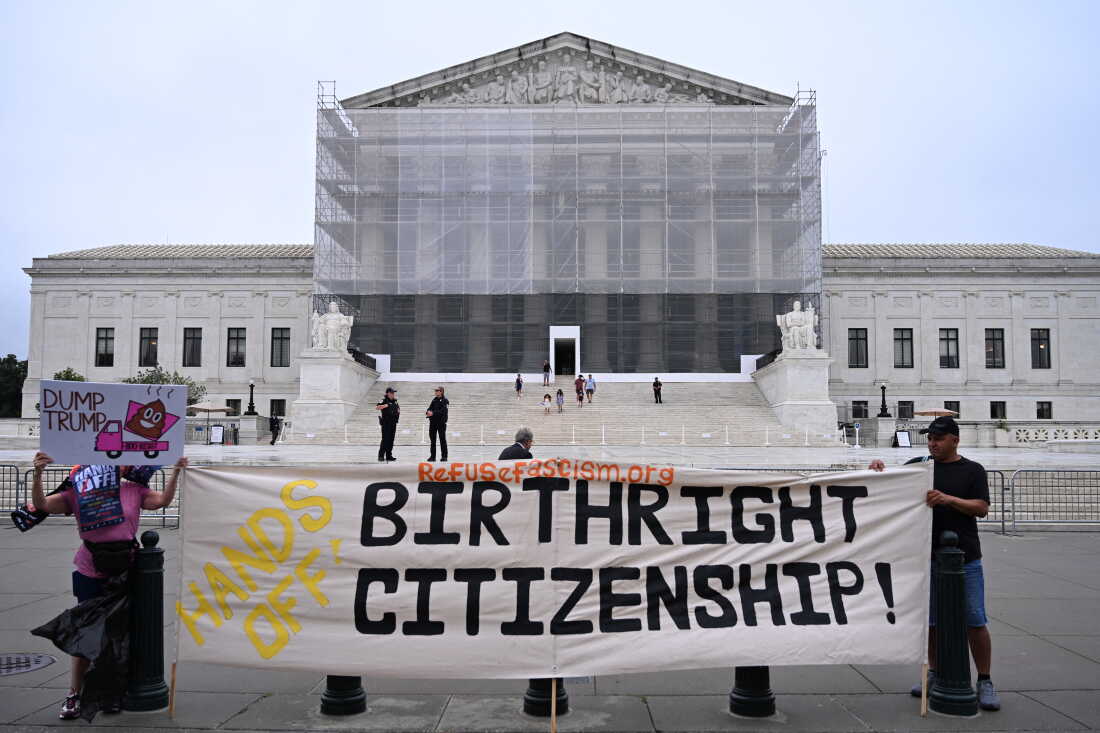
Demonstrators hold a sign reading “Hands Off Birthright Citizenship!” outside the Supreme Court on June 27, 2025. The Supreme Court did not rule on President Trump’s controversial executive order, but it did limit lower courts’ ability to block executive actions with universal injunctions.
Alex Wroblewski/AFP via Getty Images
hide caption
toggle caption
Alex Wroblewski/AFP via Getty Images
After the Supreme Court issued a ruling that limits the ability of federal judges to issue universal injunctions — but didn’t rule on the legality of President Trump’s executive order on birthright citizenship — immigrant rights groups are trying a new tactic by filing a national class action lawsuit.
The lawsuit was filed on behalf of two immigrant rights organizations whose members include people without legal status in the U.S. who “have had or will have children born in the United States after February 19, 2025,” according to court documents.
One of the lawyers representing the plaintiffs, William Powell, senior counsel at the Institute for Constitutional Advocacy and Protection at Georgetown Law, says his colleagues at CASA, Inc. and the Asylum Seeker Advocacy Project think that, with the class action approach “we will be able to get complete relief for everyone who would be covered by the executive order.”

The strategic shift required three court filings: one to add class allegations to the initial complaint; a second to move for class certification; and a third asking a district court in Maryland to issue “a temporary restraining order or preliminary injunction asking for relief for that putative class,” Powell said.
In the amended complaint, filed two hours after the Supreme Court’s ruling, the immigrant rights attorneys said that Trump’s effort to ban birthright citizenship, if allowed to stand, “would throw into doubt the citizenship status of thousands of children across the country.”
“The Executive Order threatens these newborns’ identity as United States citizens and interferes with their enjoyment of the full privileges, rights, and benefits that come with U.S. citizenship, including calling into question their ability to remain in their country of birth,” reads the complaint.
Rights groups and 22 states had asked federal judges to block President Trump’s executive order on birthright citizenship. Issued on his first day in office, the executive order states, “the Fourteenth Amendment has never been interpreted to extend citizenship universally to everyone born within the United States.”

But after three federal district court judges separately blocked Trump’s order, issuing universal injunctions preventing its enforcement nationwide, the Trump administration asked the Supreme Court to block universal injunctions altogether.
The Supreme Court did not rule on the birthright issue itself. But after the ruling, Trump called it a “monumental victory for the Constitution, the separation of powers and the rule of law,” in a briefing at the White House.
The president said the ruling means his administration can now move forward with his efforts to fundamentally reshape longstanding U.S. policy on immigration and citizenship.
Friday’s ruling quickly sparked questions about how the dispute over birthright citizenship will play out now — and how the ruling on universal injunctions might affect other efforts to push back on executive policies, under President Trump and future presidents.
“Nationwide injunctions have been an important tool to prevent blatantly illegal and unconstitutional conduct,” the National Immigrant Justice Center’s director of litigation, Keren Zwick, said in a statement sent to NPR. The decision to limit such injunctions, she said, “opens a pathway for the president to break the law at will.”

Both Zwick and Powell emphasized that the Supreme Court did not rule on a key question: whether Trump’s executive order is legal.
At the White House, Attorney General Pam Bondi would not answer questions about how the order might be implemented and enforced.
“This is all pending litigation,” she said, adding that she expects the Supreme Court to take up the issue this fall.
“We’re obviously disappointed with the result on nationwide injunctions,” Powell said. But, he added, he believes the Supreme Court will ultimately quash Trump’s attack on birthright citizenship.
“The executive order flagrantly violates the 14th Amendment citizenship clause and Section 1401a of the Immigration and Nationality Act,” Powell said, “both of which guarantee birthright citizenship to nearly all children born in the United States, with only narrow exceptions for ambassadors [and] invading armies.”
The court’s ruling set a 30-day timeframe for the policy laid out in Trump’s executive order to take effect.
“The Government here is likely to suffer irreparable harm from the District Courts’ entry of injunctions that likely exceed the authority conferred by the Judiciary Act,” a syllabus, or headnote, of the Supreme Court’s ruling states.
The majority opinion, written by Justice Amy Coney Barrett, also discusses the differences between “complete relief ” and “universal relief.”
“Here, prohibiting enforcement of the Executive Order against the child of an individual pregnant plaintiff will give that plaintiff complete relief: Her child will not be denied citizenship,” Barrett wrote. “Extending the injunction to cover all other similarly situated individuals would not render her relief any more complete.”

In her dissenting opinion, Justice Sonia Sotomayor said the ruling suggests that constitutional guarantees might not apply to anyone who isn’t a party to a lawsuit.
The concept of birthright citizenship has deep roots, dating to the English common law notion of jus soli (“right of the soil”). The doctrine was upended for a time in the U.S. by the Supreme Court’s notorious Dred Scott ruling.
Current legal standing for birthright citizenship in the U.S. extends back to the 1860s, when the 14th Amendment of the Constitution was ratified, stating, “All persons born or naturalized in the United States, and subject to the jurisdiction thereof, are citizens of the United States.”
“Any executive order purporting to limit birthright citizenship is just as unconstitutional today as it was yesterday,” Wendy Weiser, vice president for democracy at the Brennan Center for Justice at NYU Law School, told NPR.
“There is nothing substantively in the decision that undercuts those lower court opinions. The opinion just undercuts the tools available to the courts to enforce that constitutional mandate.”
