


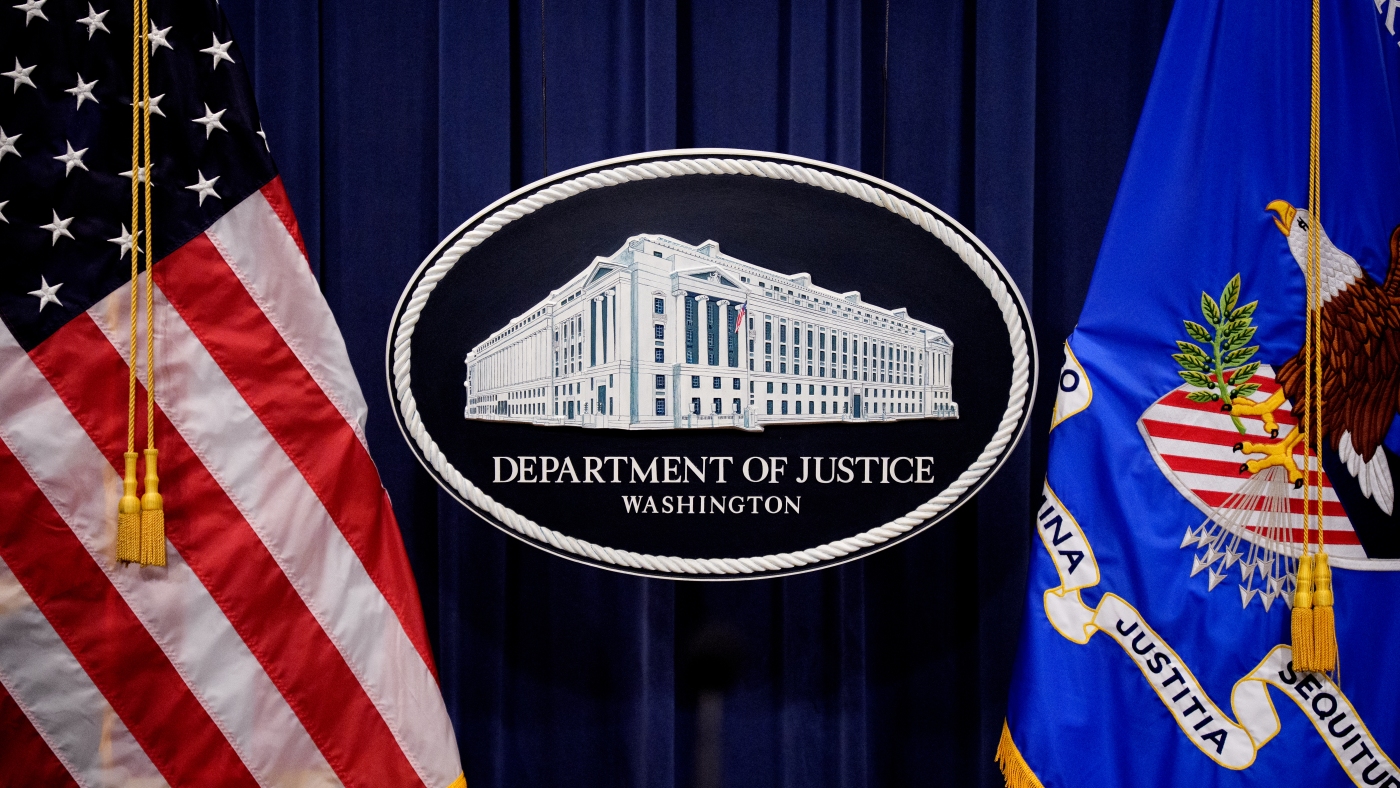

The Department of Justice logo is displayed before U.S. Attorney General Pam Bondi arrives for a news conference at the agency on May 6, 2025 in Washington, DC. The DOJ announced in a June memo that it is aggressively prioritizing efforts to strip some Americans of their U.S. citizenship.
Andrew Harnik/Getty Images/Getty Images North America
hide caption
toggle caption
Andrew Harnik/Getty Images/Getty Images North America
The Justice Department is aggressively prioritizing efforts to strip some Americans of their U.S. citizenship.
Department leadership is directing its attorneys to prioritize denaturalization in cases involving naturalized citizens who commit certain crimes — and giving district attorneys wider discretion on when to pursue this tactic, according to a June 11 memo published online. The move is aimed at U.S. citizens who were not born in the country; according to data from 2023, close to 25 million immigrants were naturalized citizens.
At least one person has already been denaturalized in recent weeks. On June 13, a judge ordered the revocation of the citizenship of Elliott Duke, who uses they/them pronouns. Duke is an American military veteran originally from the U.K. who was convicted for distributing child sexual abuse material — something they later admitted they were doing prior to becoming a U.S. citizen.
Denaturalization is a tactic that was heavily used during the McCarthy era of the late 1940’s and the early 1950’s and one that was expanded during the Obama administration and grew further during President Trump’s first term. It’s meant to strip citizenship from those who may have lied about their criminal convictions or membership in illegal groups like the Nazi party, or communists during McCarthyism, on their citizenship applications.
Assistant Attorney General Brett A. Shumate wrote in the memo that pursuing denaturalization will be among the agency’s top five enforcement priorities for the civil rights division.

“The Civil Division shall prioritize and maximally pursue denaturalization proceedings in all cases permitted by law and supported by the evidence,” he said.
The focus on denaturalization is just the latest step by the Trump administration to reshape the nation’s immigration system across all levels of government, turning it into a major focus across multiple federal agencies. That has come with redefining who is let into the United States or has the right to be an American. Since his return to office, the president has sought to end birthright citizenship and scale back refugee programs.
But immigration law experts expressed serious concerns about the effort’s constitutionality, and how this could impact families of naturalized citizens.
The DOJ memo says that the federal government will pursue denaturalization cases via civil litigation — an especially concerning move, said Cassandra Robertson, a law professor at Case Western Reserve University.
In civil proceedings, any individual subject to denaturalization is not entitled to an attorney, Robertson said; there is also a lower burden of proof for the government to reach, and it is far easier and faster to reach a conclusion in these cases.

Robertson says that stripping Americans of citizenship through civil litigation violates due process and infringes on the rights guaranteed by the 14th Amendment.
Hans von Spakovsky, with the conservative Heritage Foundation, supports the DOJ’s denaturalization efforts. “I do not understand how anyone could possibly be opposed to the Justice Department taking such action to protect the nation from obvious predators, criminals, and terrorists.”
As for the due process concerns, von Spakovsky said, “Nothing prevents that alien from hiring their own lawyer to represent them. They are not entitled to have the government — and thus the American taxpayer — pay for their lawyer.”
“That is not a ‘due process’ violation since all immigration proceedings are civil matters and no individuals— including American citizens — are entitled to government-furnished lawyers in any type of civil matter,” he said.
The DOJ and Trump White House declined to comment for this story.
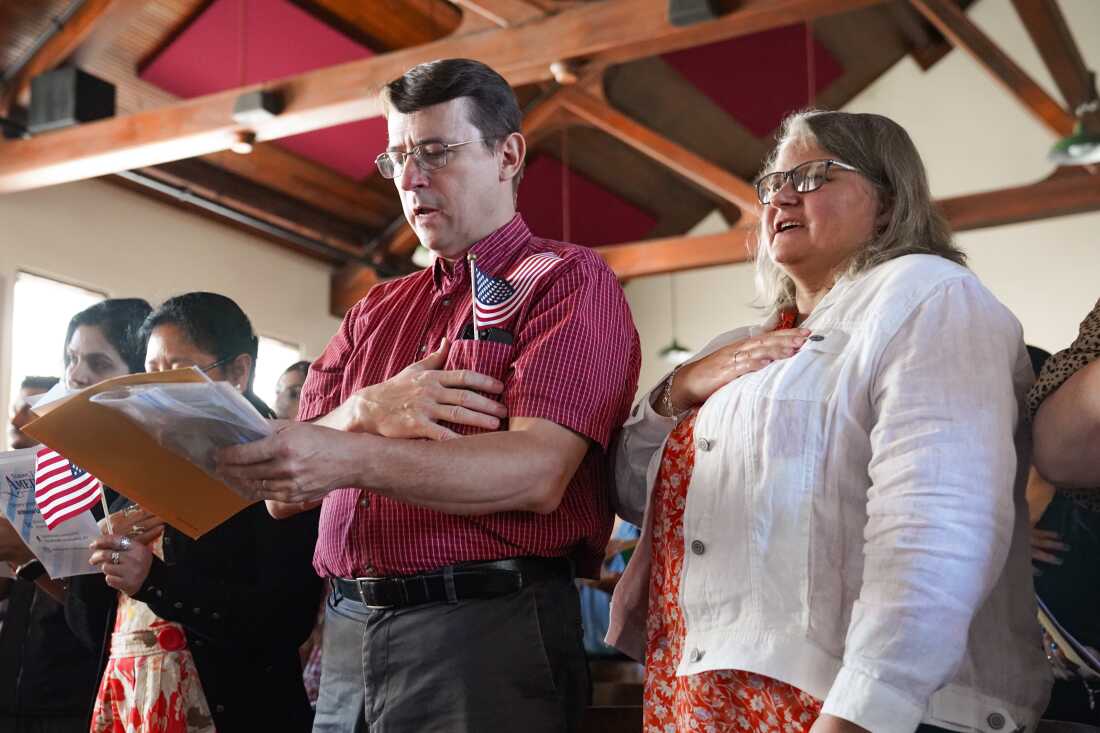
People say the Pledge of Allegiance as part of receiving their citizenship at a Nationalization Ceremony hosted by the Jimmy Carter National Historical Park on Oct. 1, 2024 in Plains, Georgia. The Justice Department is directing its attorneys to prioritize denaturalization in cases involving naturalized citizens who commit certain crimes, according to a June memo.
Megan Varner/Getty Images/Getty Images North America
hide caption
toggle caption
Megan Varner/Getty Images/Getty Images North America
A broad criteria
According to this new memo, the DOJ is expanding its criteria of which crimes put individuals at risk of losing their citizenship. That includes national security violations and committing acts of fraud against individuals or against the government, like Paycheck Protection Program loan fraud or Medicaid or Medicare fraud.
“To see that this administration is plotting out how they’re going to expand its use in ways that we have not seen before is very shocking and very concerning,” said Sameera Hafiz, policy director of the Immigration Legal Resource Center, a national advocacy organization providing legal training in immigration law.
“It is kind of, in a way, trying to create a second class of U.S. citizens:” where one set of Americans is safe and those not born in the country are still at risk of losing their hard-fought citizenship, she said.
Other immigration experts point to another part of the guidance, which gives U.S. attorneys broader discretion to determine other eligible denaturalization cases. “These categories do not limit the Civil Division from pursuing any particular case,” the memo states, and priorities for denaturalization can include “any other cases referred to the Civil Division that the Division determines to be sufficiently important to pursue.”
Steve Lubet, professor emeritus at the Northwestern University Pritzker School of Law, said that language appears to grant the federal government “wide discretion” on deciding whom to target.
“Many of the categories are so vague as to be meaningless. It isn’t even clear that they relate to fraudulent procurement, as opposed to post-naturalization conduct,” he said.
Von Spakovsky argues, “When we extend the opportunity for naturalization to aliens, we are granting them a great privilege — the privilege of becoming a U.S. citizen. Quite frankly, I don’t think it matters whether someone was a human trafficker or a drug smuggler before they entered the country, while they were applying for citizenship, or after their naturalization.”

He continued, “Anyone who has abused the privilege of the opportunity of becoming a U.S. citizen should have that citizenship revoked when they engage in such reprehensible behavior.”
Lubet, who has written extensively about denaturalization, also raised concerns about the potential impact on families — particularly children whose citizenship was derived through a parent whose naturalization was later revoked.
“What struck me is the ripple effect that this would have on children who were naturalized through their parents,” he said. “ People who thought they were safely American and had done nothing wrong can suddenly be at risk of losing citizenship.”
The DOJ didn’t respond to questions about how this could impact children of naturalized parents or what happens in cases where an individual would be left stateless by being denaturalized.

A woman from Peru and her children are detained and escorted to a bus by federal agents following an appearance at immigration court on June 23, 2025, in San Antonio.
Eric Gay/AP/AP
hide caption
toggle caption
Eric Gay/AP/AP
A slippery slope
The order to revoke the citizenship of Elliott Duke, the Army vet originally from the U.K., may be one of the first examples of the Trump administration’s aggressive denaturalization efforts in Trump’s second term.
In 2012, while serving in Germany, Duke began receiving and distributing child sexual abuse material via email and the internet, according to the DOJ.
In January the following year, Duke became a naturalized American citizen, but revoked their U.K. citizenship to do so.
The DOJ filed a legal case against Duke back in February of this year in Louisiana seeking Duke’s denaturalization based both on the conviction for child sexual abuse material and the failure to disclose their crimes during the naturalization process.
In the months it took to get a decision on their case, Duke tried to get a defense attorney to help fight the case — to no avail, they told NPR. Duke was also unable to travel to Louisiana for the court proceedings.
“If you commit serious crimes before you become a U.S. citizen and then lie about them during your naturalization process, the Justice Department will discover the truth and come after you,” Shumate, the assistant attorney general, said in a statement.
Duke is still trying to determine what options exist for an appeal and how this impacts their current prison term. But for now, Duke is effectively stateless.
“My heart shattered when I read the lines [of the order]. My world broke apart,” Duke said.
Regardless of the crimes Duke committed, the situation sets a dangerous precedent, said Laura Bingham, executive director of the Temple University Institute for Law Innovation and Technology. If the government continues to open the question of citizenship up for people who have already received it, this creates a slippery slope for everyone, she said.
Citizenship “is not supposed to be something that you can continuously open up for some people, and you can’t for others,” Bingham said.

A woman from Peru signals through the barred and tinted windows of a bus after she was detained following an appearance at immigration court on June 23, 2025, in San Antonio.
Eric Gay/AP/AP
hide caption
toggle caption
Eric Gay/AP/AP
Denaturalization goes back to McCarthy era
In a 2019 report co-authored by Robertson, Un(Civil) Denaturalization, she writes that denaturalization was wielded frequently as a political tool in the McCarthy era.
“At the height of denaturalization, there were about 22,000 cases a year of denaturalization filed, and this was on a smaller population. It was huge,” she told NPR.
The Supreme Court stepped in and issued a ruling in 1967 that said that denaturalization is “inconsistent with the American form of democracy, because it creates two levels of citizenship,” Robertson explained.
“So the United States went from having 20,000 some cases of denaturalization a year to having just a handful, like 1,2,5,6, very small numbers for years after 1967,” Robertson said.
That is, until the Obama administration, which used new digital tools to find potential cases of naturalization fraud going back decades. Under Operation Janus, an initiative launched by immigration and justice officials in the Obama era, they claimed a national security interest in examining potential cases of immigration fraud that could be tied to terrorism.
Then Trump’s first administration sought to significantly expand the government’s use of denaturalization and chose to file denaturalization cases against individuals via civil courts rather than criminal.
Despite her concerns about the new criteria, Robertson is skeptical how many cases they would apply to.
“The thing is there just aren’t very many cases that fit within [the Trump administration’s] framework of priorities [for denaturalization],” Robertson said.
“So if they’re really intending maximal enforcement, I think what they’re going to end up doing is focusing on people who have not committed any serious infraction, or maybe any infraction at all, but people for whom there is a possibility” that there are grounds to revoke citizenship, Robertson said. “It fits in with the other ways that we’ve seen immigration enforcement happening” under this administration.
Do you have information about the Trump administration’s denaturalization effort? Have you been served in a case trying to revoke your naturalized citizenship? Reach out to the authors through encrypted communications on Signal. Jaclyn Diaz is available on Signal at jaclynmdiaz.54 and Juliana Kim is available at julianahkim.82.
