



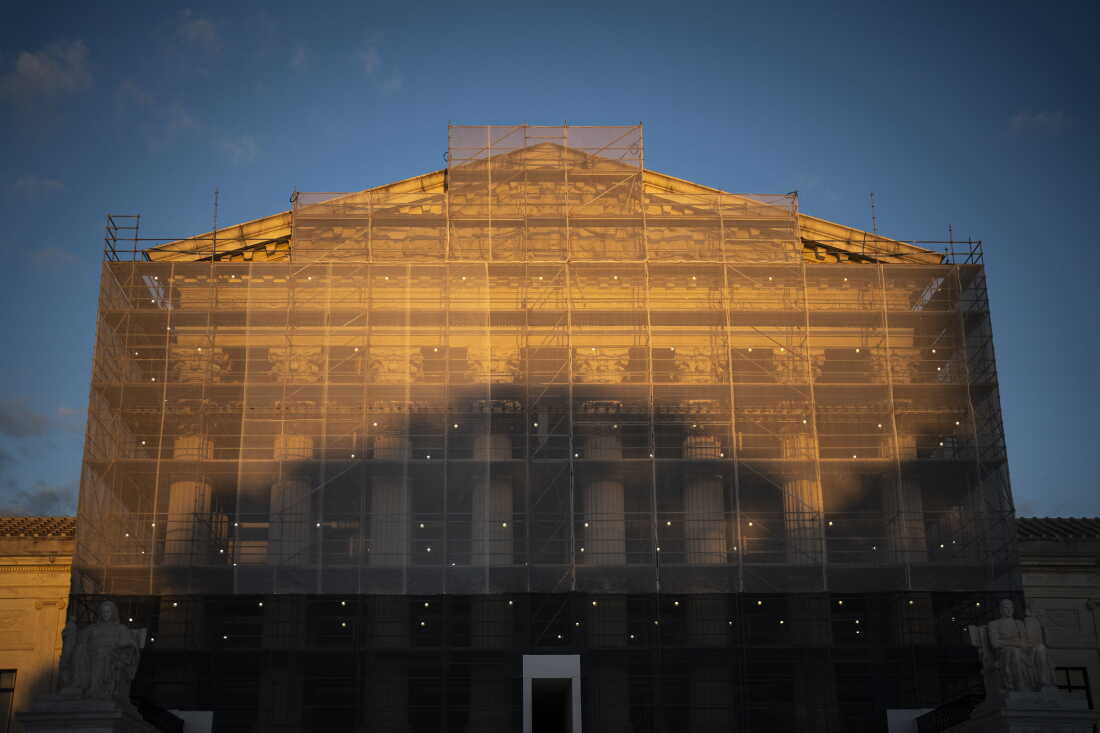
The sun sets the day before the Supreme Court on Oct 6 in Washington, D.C.
Jabin Botsford/The Washington Post via Getty Images
hide caption
toggle caption
Jabin Botsford/The Washington Post via Getty Images
The Supreme Court hears arguments Wednesday in a consequential case with potentially profound economic consequences for the country and the presidency: The issue is tariffs.
Standing in the Rose Garden last April, President Trump proclaimed what he called “liberation day,” a day that “will be remembered as the day American industry was reborn.”
Oral arguments in the case are set for 10 a.m. ET. Listen here:
Carrying out his campaign pledge to impose massive tariffs on foreign imports, Trump issued an executive order that initially imposed a tariff of at least 10% on goods from most countries doing business with the United States. Goods from countries like China have been hit with much higher tariffs — up to 145%, though they have since come down. Imports from allies like Canada and Mexico have been taxed at 25%; Canada’s rate was later increased to 35%. In an interview with CBS’ 60 Minutes this week, Trump credited the tariffs with the deal he just negotiated with China, boasting that without tariffs, China would not have “come to the table.”
The case before the court
But the up and down, fluctuating tariffs around the world spooked American businesses, prompting a court challenge, contending that the president had exceeded his authority in imposing the tariffs.
In some two dozen previous cases, the Supreme Court has been largely receptive to Trump’s claims of presidential authority, but those victories came on the Supreme Court’s emergency docket, allowing Trump policies to take effect on a temporary basis while the litigation played out in the lower courts.
In contrast, the tariff cases are the real deal, with the court having ordered full briefing and expedited arguments in the case, and offering the justices the first real opportunity to say “no” to the president.
One of the lead challengers to the tariffs is Victor Owen Schwartz, a wine and spirits importer from upstate New York who has been in business for 40 years.
“The thing is there’s such a misconception out there that foreign entities are paying the tariffs,” he says, adding: “I can’t say this enough times: Americans are paying the taxes. American business is paying the taxes and it will be passed on to consumers.”
According to Schwartz, small businesses not only have to worry about fluctuating tariff rates, but the tariffs have also plunged the value of the dollar compared to the euro. When you add up all of these costs, he says, they amount to about 35% more he has to pay for his wines. So, he charges more, eats part of the tariff, and is down to a barebones profit that in the long run, he says, is “unsustainable.”
Or as Schwartz wryly puts it: “Do you think I can increase the price of Sancerre by 35%?”
Trump’s view
Countering that argument is Trump who sees tariffs as potentially bringing in trillions of dollars to the federal government. They’ve brought in $195 billion this fiscal year, according to the Committee for a Responsible Federal Budget, a fiscal watchdog group.
“I always say ‘tariffs’ is the most beautiful word to me in the dictionary,” Trump has said, “because tariffs are going to make us rich as hell. It’s going to bring our country’s businesses back that left us.”
Indeed, the tariffs are so important to the president that he flirted with the idea of attending Wednesday’s argument. In the end, he decided against being the first president to do that, instead sending his treasury secretary.
Regardless of who is in the court chamber on Wednesday though, the justices certainly know that a ruling against Trump would be a dramatic, even embarrassing, setback for the president, and none of the six conservatives, including three Trump appointees, is likely looking for a confrontation with the nation’s chief executive.
The issue the justices must resolve is whether Trump has the power to unilaterally set tariff rates under the International Emergency Economic Powers Act, known as IEEPA. Lower courts have ruled that Trump exceeded his authority under both the statute and the Constitution.
But the president argues that both allow him to impose tariffs in order to deal with persistent trade imbalances and to stem the flood of fentanyl coming into the United States. Both, he asserts, present national emergencies and pose a threat to national security.
As Solicitor General D. John Sauer put it in the administration’s briefs, were the Supreme Court to invalidate the tariffs, it “would have catastrophic consequences for our national security, foreign policy, and economy.” And he said, that were the court to rule against the president, it would “lead to dangerous diplomatic embarrassment.”
While the administration conceded in the lower courts that this is the first time in the 50-year history of IEEPA that any president has tried to use the statute to impose tariffs on his own, it continues to maintain that the Trump tariffs are beyond the jurisdiction of the courts altogether, and that the only check on presidentially imposed tariffs would be if Congress were to specifically reject them.
Arguments against tariffs
Countering that argument at the Supreme Court on Wednesday, lawyer Neal Katyal will tell the justices that the word “tariff” isn’t even in the IEEPA statute and that there is “zero” authority under the statute to justify such sweeping presidential authority when the constitution itself gives the legislature, not the president, the power to tax.
“The idea that every president had this power all along—Presidents Reagan to Obama— and none of them knew it and all of them have been spending all this time negotiating with Congress to try and get tariff authority when they had it from the start, is just too fanciful to believe,” Katyal asserts.
He notes that Congress has created “an extensive trade architecture” governing everything from how a president may deal with trade deficits to national security questions. For instance, a different statute does allow the president to increase tariffs by 15% when there is a serious trade deficit, but only for 150 days.
“The president has said, ‘I can blow past all of those things and do whatever I want,'” says Katyal. And that, he maintains, is contrary to the nation’s history dating from its founding.
“That is why we had the Boston Tea Party. It is why our Revolutionary War was fought. The idea that you can tax Americans through the monarch’s decision alone is as foreign to our Constitution and our traditions as anything I have ever seen.”
IEEPA wasn’t aimed at tariffs or taxes at at all, says Katyal’s co-counsel Michael McConnell, a conservative former federal judge appointed by George W. Bush, who now is director of the Stanford Constitutional Law Center. “It’s a statute about imposing various forms of sanctions, economic sanctions on countries with whom we are in conflict,” he says, adding, “It has nothing to do with imposing taxes on Americans for engaging in perfectly lawful trade with friendly nations.”
One of the issues raised by the challengers is that the administration’s argument also fails under the so-called “major questions doctrine,” first enunciated by the court’s conservatives in 2022. It says that for Congress to delegate a major policy decision to another branch of government, it must be explicit in its text about doing so. But at least one member of the court, Justice Brett Kavanaugh has indicated that in his view at least the major questions doctrine does not apply to foreign affairs and national security.
The briefs filed by interested groups in Wednesday’s case are remarkably lopsided, with 38 briefs supporting the challengers, representing over a thousand organizations and individuals on the right, left, and center of the political spectrum. Also among those supporting the challengers are a large group of national security experts from previous Republican and Democratic administrations and a similarly diverse set of 44 economists on both the left and right, including four Nobel prize winners.
On the other side are six briefs, mainly representing individuals, who did not want to be interviewed for this story.
That said, the case is not a slam dunk at all, says conservative scholar Jonathan Adler, of William and Mary Law School.
“In general, the court is very reluctant to second guess presidential determinations that something implicates national security or that there is an exigency,” he says.
Of course, just what are exigent circumstances is often in the eye of the beholder, and the current court often rejected the Biden administration’s assertion of exigent circumstances.
