



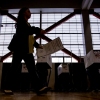
Police officers stand outside a polling station in Las Vegas on Election Day, Nov. 5, 2024. In recent years, election administrators have formed closer working relationships with local law enforcement.
Ronda Churchill/AFP via Getty Images
hide caption
toggle caption
Ronda Churchill/AFP via Getty Images
When Chris Davis first started working in law enforcement over 30 years ago, elections would come and go relatively unnoticed.
“Election Day was something, as a police officer, you may not even realize was happening,” he said. “It wouldn’t even come up on roll calls.”
Davis is now chief of police in Green Bay, Wis. And elections have rapidly become a big part of his job, something he plans for year-round.
“I think a lot of that is just because we’re right in the middle of the Wisconsin battleground,” Davis said. “I remember really being struck when I came here at just how, almost, nervous a lot of city staff were about elections.”
Davis’ experience reflects a trend experts have noticed across the country: Since the 2020 election, local law enforcement has increasingly been playing a bigger role in helping local officials secure elections.
“The number of threats that election officials face, that jurisdictions face, that election workers face all mean that law enforcement does have a heightened role to play and a longer-term role to play,” said Katie Reisner with the nonpartisan States United Democracy Center. “It’s not a matter of just tapping in for Election Day and tapping back out.”
According to a survey of local election officials conducted earlier this year by the Brennan Center for Justice, 32% of local election officials reported experiencing “threats, harassment, or abuse because of their job.”

Threats and harassment increased notably for election officials after President Trump’s unfounded claims that the 2020 election was rife with fraud. The last few years have also seen historic rates of turnover among voting officials.
In Green Bay, Davis said it became clear to him after talking to city officials that the police department needed to take “a more proactive role” during elections.
But collaboration between local agencies is not just happening in battleground states. According to the Brennan Center survey, a whopping 89% of election administrators said prior to the 2026 midterms they plan to “coordinate with at least one other agency or department to ensure safe and secure elections.”
“A never-ending conversation”
To ensure coordination, Reisner said local election officials and local enforcement need to start talking to each other — and often. And to start making plans well before elections take place.
“What we encourage folks to avoid is trying to find the name of their election official, you know, on Election Day. No one wants that,” she said. “But what is really productive is to have really intergovernmental, cross-functional collaboration well in advance of Election Day.”
Tina Barton, co-chair of the Committee for Safe and Secure Elections, worked as an election administrator for two decades — almost half the time in Michigan, another battleground state.
She also said communication between election officials and law enforcement should be “a never-ending conversation.”
“There are elections that are taking place all year long all across the country,” Barton said. “So, this is something that we are always in planning mode for the next election cycle. It’s important to start those conversations at the minute that you even think you should start doing it.”

In Green Bay, Davis says such conversations led him to realize that he and his department didn’t really know much about election laws.
They weren’t sure about laws around electioneering, for example. Wisconsin also has a law that allows voters to challenge the eligibility of another voter at a polling site.
“I could see if that actually happened, that could turn into a disturbance where the police get called pretty quickly,” Davis said. “We’re already in a really tense environment around elections, and it’s not going to take much for one of these situations to turn into something that a police officer is going to show up at.”
Local police are proving to be particularly helpful with a rise in bomb threats.
During the 2024 election, officials received a record number of bomb threats, though Barton said elections went very smoothly, mostly because officials were prepared.
“For the average American, they probably think ’24 was a pretty quiet election cycle,” she said, “but that was because of all of these tabletops, and all of the training, and all the hard work that election officials and law enforcement and other stakeholders put in doing this training and planning and practicing over the last few years.”
Police urged to “keep a light touch” at polling sites
Police involvement in elections, though, does raise some concerns among voting rights advocates.
These concerns are particularly heightened this year, due to some mixed messages from Trump officials and allies about federal law enforcement, particularly immigration officials, being near polling locations.

Acting U.S. Attorney General Todd Blanche has asked why there’s an objection to sending immigration agents to polling locations. Federal law prohibits federal troops or law enforcement from interfering with voting.
Andrew Harnik/Getty Images
hide caption
toggle caption
Andrew Harnik/Getty Images
There are also worries that some local law enforcement could overstep. In Riverside County in California, the local sheriff — and a Republican gubernatorial candidate — seized hundreds of thousands of ballots, sounding alarm bells throughout the election administration community.
California lawmakers have since expressly banned such interference, but there are worries that even a visible police presence around elections could be a problem.
Reisner of States United said police could “inadvertently contribute to voter suppression,” by intimidating some voters, and that anywhere voters are casting ballots is where law enforcement “is going to want to keep a light touch” and mostly stay behind the scenes.
“That’s what we don’t want,” she said. “We don’t want anyone to feel that by coming in and exercising their civic right and responsibility to cast their ballot that they are in any way, you know, putting themselves at risk or entering a highly securitized space.”
In Green Bay, Davis said he and his officers have figured out the “right balance” for how present they should be while people are voting.
“We have to realize that we can have an impact on somebody’s voting experience, and we certainly don’t want to do that,” he said. “I think we’ve been able to find the right balance for our community. … Police professionals who are planning for elections [need] to figure out what that looks like and get it right for your individual community, because that varies a lot.”
Col. James Grady II, director of the Michigan State Police, said his organization doesn’t man election sites. Troopers would have to be called to a location in order to have a presence there.
“Of course, if there is a complaint where someone has some inappropriate behavior or someone is being attacked, anything like that, the state police will respond,” he said. “But … we don’t want someone to feel uncomfortable because law enforcement is there in a uniform.”
Police presence around elections can depend on state law. Barton said some states require law enforcement at the polls, while others prohibit it.
Reisner said there are election-related sites — where voters are not casting ballots — that could be aided by a police presence, like tabulation centers where ballots are counted.
“Ballots often will come in from outlying precincts and come into the vote count facility,” she said. “[I]n recent election cycles, we’ve seen these vote count centers become the targets of heightened protest activity, heightened threats, and so heightened disruptions, all of which could pose, you know, distractions or other kinds of impediments to folks getting their work done.”
Evolving threats
Green Bay Chief Davis said he expects the needs of election officials to evolve from one cycle to the next. He said this is something he’s gotten used to.
“One of the things a career in police work teaches you is: This isn’t going to be the same job in five years [as] it is now,” he said. “And it teaches you to just adapt and meet the challenge, the next challenge as it gets here. And there’s a little bit of forward thinking that we have to do.”
In Michigan, Colonel Grady said even though a lot of these kinds of threats are somewhat new, tension around elections isn’t a new thing for many Americans.
“Sometimes I do think that people forget that this country does have a past where there was a history when there were certain people that weren’t allowed to vote,” he said. “And now those things have changed. You know, there’s a different threat out there now.”
