



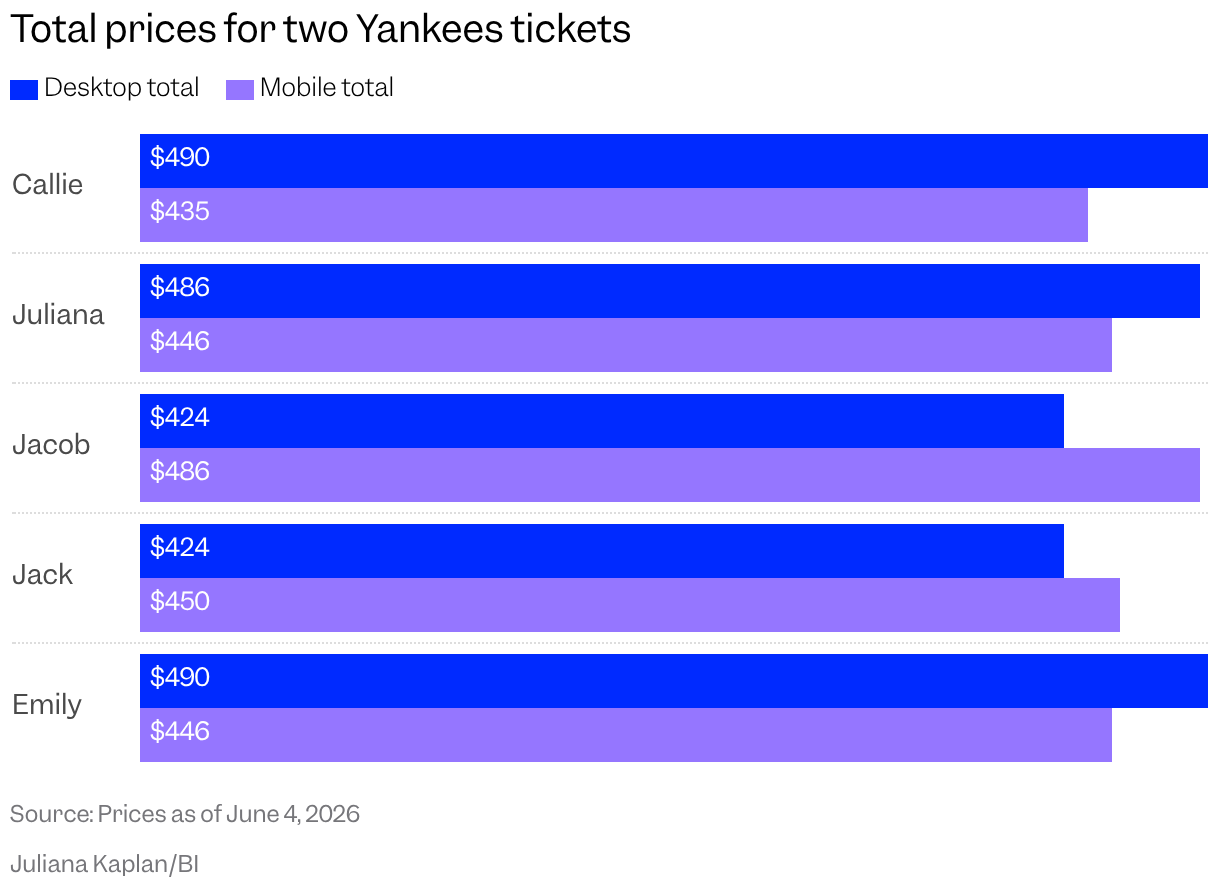
A pair of tickets to see the Yankees play the Red Sox on Saturday, June 6 — Section 217, Row 13, Seats 1-2 — would have cost you $424 on StubHub if you tried buying at 10 in the morning a couple of days before the game.
Or $435.
Or $446.
Or $450.
Or $486.
Or $490.
Those prices weren’t for different seats or different listings. They didn’t come from different ticket platforms or resale apps. They were the exact same tickets, viewed at the same time on the same site by different people. If no one was comparing notes, it would have gone unnoticed.
Most consumers are accustomed to doing some level of comparison shopping. We see if Aldi or Walmart has better deals on steak, or check if a clothing brand is offering lower prices in-store or on its website. Dynamic pricing is annoyingly pervasive across the economy.
But even in an era of constantly shifting prices, event tickets are a particularly confounding black box. Prices are sky high, funny business abounds, and it can feel as though nothing would surprise anyone at this point. Despite the general expectations for chaos, our endeavor was still eyebrow-raising — and should tell consumers the answer to how much something costs is increasingly, “It depends, and maybe by a lot.”
I recently fell down the rabbit hole trying to understand the modern ticket-pricing model, so the other day I decided to bring four of my colleagues with me for a little experiment. The five of us got onto a video call, fired up StubHub on our phones and computers, and were able to put the exact same tickets for the aforementioned Yankees-Red Sox game into our carts at the same time. During our trial, we were quoted six different prices, and no individual was offered the same price on their phone as on their laptop.
The difference wasn’t in the ticket price itself, which was $183 apiece across the board — it was in the fees. My colleague, Juliana, had a $60 fee tacked onto each of her tickets when she shopped from her desktop in the Business Insider office. Our other coworker, Jacob, beaming in from his computer in Chicago, was charged only $28. His fees went up when he used the mobile browser on his phone. Juliana’s fees went down when she looked from the app.
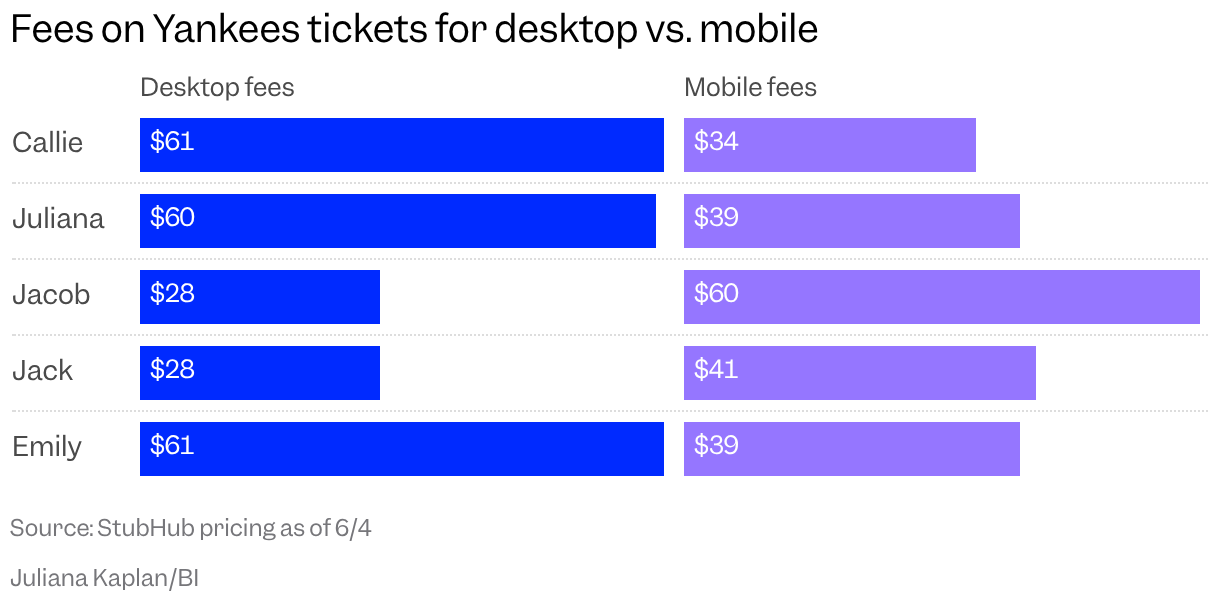
This resulted in some pretty significant variation in total costs. From her laptop, my colleague Callie would have paid $490 total, 14% more than our coworker Jack, who was also cruising the web via big(ger) screen. I was signed into my StubHub account on both my laptop and the mobile app. The former quoted me $490, the latter $446 — $44 is a lot of hot dogs and beer. (OK, at current stadium prices, some hot dogs and beers.) In many instances, StubHub’s design suggested we were getting discounts, with the quoted price next to a crossed-out higher “original” price.
When I reached out to StubHub to ask what gives, I was met with a shrug. “In this economy, we regularly test deals to balance fan access and a competitive price,” a spokesperson said in an email, adding it’s been “standard practice” across e-commerce for years across retail, travel, and ticketing. They said our little experiment showed “randomized, anonymous testing, which helps us explore pricing options to get the most fans to events.”
Sure, dynamic and variable pricing have been around for a long time — we’ve all gotten cheaper drinks at happy hour or paid through the nose for last-minute plane tickets. But technology has unleashed a new beast: Companies have the ability to set special, just-for-you prices, and it’s often not clear to consumers when it’s happening, how, or why.
Much of the concern around algorithmic pricing is that instead of a fixed model, companies may use our personal characteristics to target each individual with a precise number, leveraging our data to determine exactly what we’re each willing to pay. A 2025 Federal Trade Commission report found that retailers increasingly have the capacity to engage in surveillance pricing, though it didn’t nail down how widespread the practice is.
I tried to find a rhyme or reason for the variation in StubHub. Did it know some of us were more inclined to make big purchases on the big screen? Was there something about gender or location? Or was it a case of good or bad luck? When it comes to these types of price swings, specific explanations may not matter — and may not even exist, says Katie Wells, the author of a 2025 report from progressive think tank the Groundwork Collaborative and publication Consumer Reports that found Instacart was charging different customers significantly different prices for the same food from the same stores. It might not be the case that characteristic A leads to the company charging price B, especially in the age of AI.
“It could be true that it’s random on one day, and it could be A/B testing the next day, and it could be a combination of a third of using personal data,” Wells says. “We don’t know.”
Lindsay Owens, the executive director of the Groundwork Collaborative, tells me the widespread acceptance of dynamic pricing lets platforms get away with this. We’ve grown accustomed to prices for concerts and sporting events rising and falling based on supply and demand, so it’s easier to add in and tinker with surcharges that will go unnoticed. Everyone just assumes the prices platforms offer will be all over the place, so they don’t look under the hood to see why.
“They have more room to run, and they clearly have chosen to tuck their head, grab the football, run down the field,” says Owens, the author of the coming book “Gouged: The End of a Fair Price—and What That Means for Your Wallet.”
Ticket platforms have to use “all-in pricing” nowadays, meaning fees are included in the cost from the get-go when fans start searching. That only solves part of the fee problem, though — it’s often not clear what this money is going toward, and platforms can move surcharges around however they feel.
StubHub isn’t the only platform where prices for the same tickets bounce around at the same time. As I journeyed further down the rabbit hole, I found that Ticketmaster quoted me different fees on the same resale tickets for a Bruno Mars show in August — a $390 base ticket had a $74.10 fee added on my phone and $66.30 on my computer. On Vivid Seats, another popular resale platform, the base ticket prices varied on top of the fees.
A Ticketmaster spokesperson told me that fee fluctuations occur only on their secondary-market tickets, never on primary-market tickets, and that they’re not personalized or tied to specific behavior. They said service fees can generally be “discounted” by 2-3% to help listings be more competitive, and they’re working on ways to make it clear at checkout. A Vivid Seats spokesperson told me that its app prices are intentionally lower.
Alexander Mackay, an associate economics professor at the University of Virginia, tells me that some experimentation by these companies should be expected, because correctly determining price sensitivity can be tricky. All events are unique, and they’re competing against a multitude of other things people could do with their time —hence why some acts overshoot how much they can try to charge.
I feel like it just gives a bad name to the entire industry.
I reached out to a New York-area ticket broker to see what he makes of all this. It’s hard to feel too bad for scalpers, but he tells me this isn’t a good deal for them either — sellers don’t see any money from the extra fees consumers are forking over, they just get the proportion they’re entitled to from the base ticket price.
“I know, like everyone wants to say, ‘Oh, brokers, we’re the bad guys,'” he says. “No, I actually agree, I don’t care if we make less money. I want all-in pricing. I want transparency. I don’t want this bullshit either. I feel like it just gives a bad name to the entire industry.”
When it comes to prices, it’s easy to feel like we’re all trapped in an endless game of Whack-a-Mole. After Instacart got heat for charging different prices to the same people for different items, it said it was simply running tests and then eventually promised to stop. Uber Eats basically brushed off our reporting this year that it was charging disparate fees for the same McDonald’s orders. Delta and Wendy’s have faced consumer backlash over toying with algorithmic pricing.
Regulators and legislators are trying to do something about it, but personalized pricing is often hard to detect: there aren’t a lot of laws around it, and even where there is proposed legislation, businesses may be able to find loopholes.
Mark Tremblay, an assistant economics professor at the University of Las Vegas, Nevada’s Lee Business School, has spent the past six months studying ride-share data from Uber to try to figure out how its booking fees are calculated. Like StubHub, most of the variation in total prices isn’t in the actual ride itself — which is often a pretty simple time-and-distance formula — but in the fees, which Uber made variable in August 2021. “Distance appears to matter, time appears to matter, but there’s a lot of other things we don’t observe that seem to matter,” he says. “We can’t explain how.”
Tremblay’s concern is that much of this legislation on personalized pricing will focus only on the base price for the ticket, ride, etc., leaving companies free to turn the fee dial as they wish. “If all those regulations are specific to the price and not the fee, then the laws won’t actually do anything,” he says.
For consumers, the modern American shopping experience is a constant battle that no one signed up for and no one can win. The answer to this tickets conundrum is to open up a bunch of browsers and devices to compare fees and prices to try to get the best offer. Nobody wants to do that — they just want to go heckle a Red Sox player at Yankee Stadium on a warm June afternoon.
Emily Stewart is a senior correspondent at Business Insider, writing about business and the economy.
Business Insider’s Discourse stories provide perspectives on the day’s most pressing issues, informed by analysis, reporting, and expertise.
