



A Fulton County, Ga. staff member works as people vote in a runoff election in Atlanta on June 16, 2026.
Mike Stewart/AP
hide caption
toggle caption
Mike Stewart/AP
With just under four months before the midterm elections, a wave of court rulings, lawsuits and new laws is reshaping how elections are run in the U.S. In its spring session, the Supreme Court significantly narrowed the Voting Rights Act.
“The Voting Rights Act of 1965, the most important civil rights law of the 1960s, has no teeth left. And that’s just the beginning of what they’ve done in terms of weakening democracy,” journalist Ari Berman says.
Berman is a voting-rights expert for the progressive publication Mother Jones. He notes that more recently, the court preserved mail-in voting by a single vote, then struck down decades-old limits on how much political parties can spend on candidates. Meanwhile, President Trump is pushing Congress to pass the SAVE America Act, which would require showing a passport or birth certificate to register to vote, and create strict ID requirements to cast a ballot.
“Half of all Americans don’t have passports. So already there, you’re talking about half the country can’t comply,” Berman says. “Ask the average person, ‘Do you know where your birth certificate is?’ And a lot of people are gonna struggle to find it.”

Berman describes the president as “obsessed with the mechanics of voting” — “Every time he feels like his party is losing, he tries to mess with the mechanics of the voting in one way or another, either trying to overturn the election or getting his party to gerrymander ahead of time to protect their vulnerable majority or whatever it might be,” he says.
Berman sees President Trump’s promotion of the SAVE America Act as part of a larger plan to sow distrust in the system and possibly challenge the results of the midterms: “If Republicans lose, he’s going to say, ‘Well, we didn’t have the SAVE Act, therefore the election was rigged.’ … He is creating the predicate for some kind of dramatic intervention to either challenge how people vote, how their votes are counted, or how the elections are ultimately certified,” Berman says. “That’s probably the thing that’s keeping me and other experts on voting up at night is, what steps could this administration take to try to interfere in the voting process that we’ve never seen another administration or history take before?”
Berman is the author of several books, including Minority Rule: The Right-Wing Attack on the Will of the People — and the Fight to Resist It and Give Us the Ballot: The Modern Struggle for Voting Rights in America.
Interview highlights
On the historical bipartisan support of the Voting Rights Act

The Voting Rights Act was passed by overwhelming support by the Congress in 1965. It was a white southerner, LBJ, who made the case for the Voting Rights Act, said in very powerful terms that we could not have an America in which people were disenfranchised based on the color of their skin. The Voting Rights Act was reauthorized four times by the Congress, each time with overwhelming bipartisan support. Each reauthorization of the law was signed by a Republican president — and what changed was the Supreme Court. You had a Supreme Court, first with the appointments of Justices Roberts and Alito, and then with the three judges appointed by Trump, that turned its back on that bipartisan consensus and made it their mission to overturn the Voting Rights Act, and to really overturn the second reconstruction of the 1960s, and to roll back the most important accomplishments of the civil rights movement. …
My fear is that we are returning to a politics of Jim Crow in the South. We are returning a politics white supremacy in the South. And the decision destroying the Voting Rights Act doesn’t just weaken the country’s most important civil rights law, it really weakens the entire project of multiracial democracy.
The Louisiana v. Calais decision in late April was a death blow to the Voting Rights Act because … they’ve basically struck down the creation of majority-minority districts in which Black voters or other voters of color can elect their candidates of choice. And we’ve already seen in the wake of that decision a mad scramble by Southern states, places like Tennessee, Louisiana, Alabama, to redraw their maps to reduce Black representation before the midterms. … My fear is that we are returning to a politics of Jim Crow in the South. We are returning to a politics of white supremacy in the South. And the decision destroying the Voting Rights Act doesn’t just weaken the country’s most important civil rights law; it really weakens the entire project of multiracial democracy.
On the SCOTUS campaign finance decision, which struck down limits on political party spending
Before there were limits on these types of expenditures; now there isn’t. Meaning that an individual can give a lot more money to a party than they can give to a candidate. Now the party can spend an unlimited amount on behalf of those candidates, and it’s just another way in which wealthy individuals will have more influence in the political process. …

This wasn’t the first decision by the Supreme Court, by the Roberts Court, that deregulated the campaign finance system in such a way that gives wealthy individuals far more power. … This is now a decades-long project by the Roberts Court to give wealthy individuals more power in the political process.
On the ongoing action against mail voting
The evidence shows that mail voting is safe and secure, and lots of states use it. There are states that have all-mail elections for a long time, places like Oregon and Washington, and even Republican-controlled states like Utah. Alaska is another one that votes largely by mail, and there’s no evidence that those states have higher rates of fraud than states that vote a different kind of way.


And so the disturbing part of the dissent in the mail ballot case was that this was about a very narrow issue, whether ballots that are postmarked by Election Day can be counted if they’re received in some period after. The conservative justices who dissented made a much bigger argument against mail voting, basically calling into question mail voting writ large. And that’s going to embolden Trump. It’s going to embolden Republican states to try to take more drastic action to end mail voting, even as lots of Republicans continue to vote by mail. President Trump himself has voted by mail on numerous occasions, most recently in a special election for the Florida legislature. And so my fear is that often what we see is that even when the GOP-appointed justices lose, their dissent often becomes the basis to be in the majority the next time this kind of case comes around.
On both red and blue states redrawing maps
Once we get out of the midterms, a lot of state legislators are going to come back and they’re going to redraw new maps in ’27, in ’28, both red and blue states. And my fear is that this is going to be a race to the bottom — that Republican-controlled states are going to try to maximize their representation, Democratic-controlled states are gonna try to maximize their representation. What it’s gonna lead to is more polarization, less competition, more partisanship, all the things that voters say they hate about the system the most is going to become magnified. And that’s ultimately why I think we need a solution on a national level here to get rid of this kind of partisan gerrymandering once and for all.
On growing support for Supreme Court reform
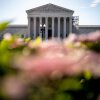
I’ve been talking to a lot of voting rights experts in the past months and asking them, could Congress pass a new Voting Rights Act? Could Congress pass on a ban on partisan gerrymandering? Could they make racial gerrymandering illegal, for example? And basically, everyone tells me they could do it, but the Supreme Court is just going to strike it down, which is why the issue of Supreme Court reform is gaining momentum in Democratic circles, whether it’s term limits, whether it is expanding the Court, whether it’s doing something to rein in a Court that feels unchecked by democracy, by the normal democratic norms.
Monique Nazareth and Thea Chaloner produced and edited this interview for broadcast. Bridget Bentz and Molly Seavy-Nesper adapted it for the web.
