



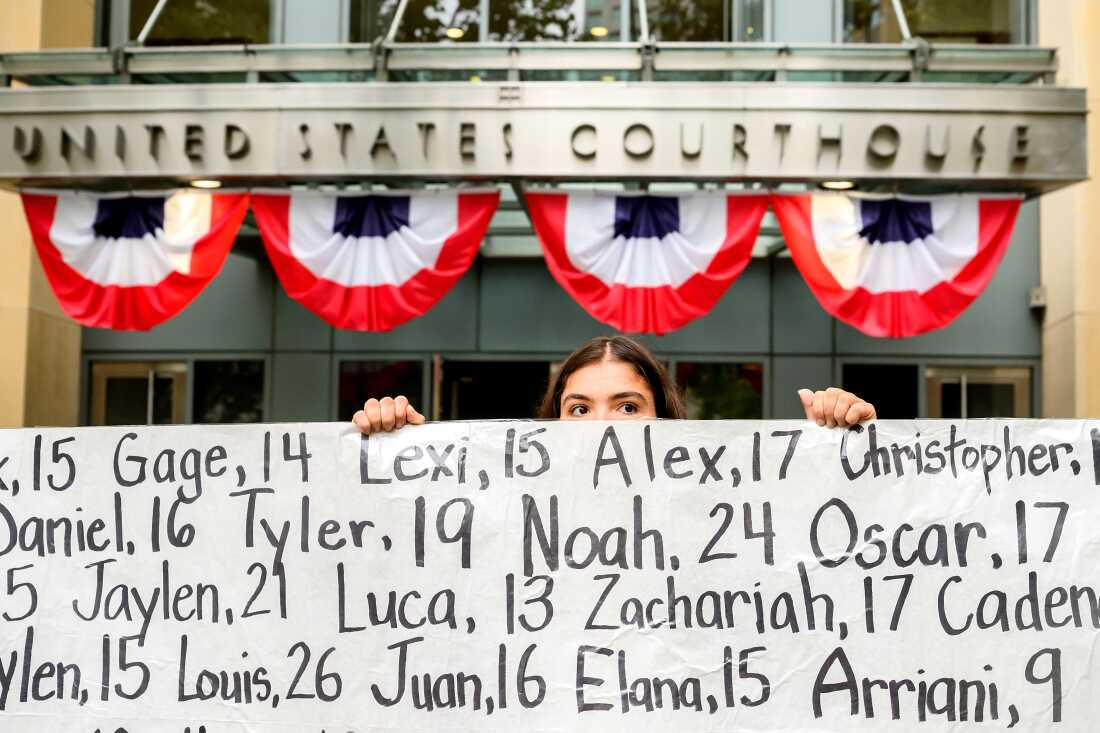
Olivia Konar holds a banner with names of young people who advocates say died as a result of social media outside the Ronald V. Dellums Federal Building and U.S. Courthouse on Tuesday, Aug. 18, 2026, in Oakland, Calif. Her sister Coco Konar died in 2022 when she was 17. Social media company Meta agreed to a nearly $17 billion settlement with a group of states over its child safety practices.
Noah Berger/Associated Press
hide caption
toggle caption
Noah Berger/Associated Press
Sign up for NPR’s Up First morning newsletter for the stories you need to start your day.
Meta has agreed to change the ways teens use its platforms and pay states up to $17.1 billion to settle claims its products are addictive and harmful to kids. It’s the latest sign that long-running public frustration with tech companies is turning into concrete changes for the industry.

2026 has already seen a wave of setbacks for social media giants. In the spring, Meta lost two high-profile court cases over claims its products, including Instagram, harmed young users. The company and rival platforms including Google’s YouTube, TikTok and Snapchat all settled similar lawsuits, though thousands more are pending. This week, TikTok reached a separate $400 million settlement with the Justice Department over claims it illegally collected kids’ data.

Pressure is also growing from regulators and lawmakers around the world. A slew of U.S. states have enacted restrictions on kids’ social media use, while Australia last year became the first country to ban children under 16 from social media entirely, leading countries including Britain, Canada, Denmark, Indonesia and New Zealand to say they will follow suit. (In France, a law banning children under 15 from social media was blocked this month on constitutional grounds.)
“There’s clearly an enormous momentum shift here in the United States and globally in the public’s assessment of social media platforms and the broader tech industry,” said Jim Steyer, CEO of Common Sense Media, a nonprofit research and advocacy organization.
Among the largest corporate settlements ever
Meta’s settlement is among the largest ever struck by a U.S. company. Critics are calling the recent run of legal defeats the tech industry’s “Big Tobacco moment” — referring to the litigation campaign of the 1990s that forced tobacco companies to strike big settlements and changed how they marketed their products.
The settlement announced this week with 47 states, the District of Columbia, and three U.S. territories aims to be about more than just Meta. It’s structured as an attempt to set industry standards for how platforms treat young users. Meta agreed to pay out an initial $12 billion over 10 years. It will pay another $5 billion if YouTube, TikTok and Snap also reach settlements with the states, pay similar financial penalties and implement similar changes to their platforms, including stricter time limits, age checks, and blocks on nighttime use.
“This is an industry-wide problem. Meta is part of the industry, a major player in the industry, but there’s a bigger ecosystem,” California attorney general Rob Bonta said at a press conference on Wednesday. “We will not be satisfied until we address all of the problems in the entire industry.”
Meta used its public statement about the settlement on Wednesday to call out its rivals.
“The framework we’ve negotiated will empower parents to easily manage how their children access our platforms,” Meta chief legal officer C.J. Mahoney said in a statement. “Our new Time Limit commitments, Night Mode features and usage limits during school hours set the right path forward for our whole industry, but this framework will only work if all our peers join us. Because teens move fluidly across dozens of apps, we need an industry-wide solution. We therefore call on our industry peers, TikTok and YouTube, to implement this new framework, right away.”
YouTube, TikTok and Snapchat owner Snap didn’t respond to requests for comment.
The settlement is an unusual approach to developing regulation, said Samir Jain, vice president of policy at the Center for Democracy and Technology, a nonprofit that advocates for digital rights.
“Usually when we want an industry to obey a certain set of regulations, we have processes in place, whether that’s passing laws in Congress or an agency exercising its regulatory power,” he said. That involves safeguards including making sure laws or rules don’t violate constitutional rights, he said.
Jain said that while “ensuring children are protected and have safe and private online experiences is important,” he’s concerned that the government not infringe on users’ — including children’s — rights to speech and access information online. He’s also among privacy advocates who are skeptical about age verification requirements that could lead to tech companies collecting more data from their users.
A “ripple effect” for lawsuits, laws and regulation
Beyond the financial penalties and platform changes, Meta’s settlement could have a “ripple effect” on other lawsuits, legislation and regulation, said Isabel Sunderland, policy lead for technology reform at Issue One, a bipartisan nonprofit that advocates for political reform.
She pointed to internal documents and communications among Meta employees and executives that have been made public during the federal trial in Oakland that ended in this week’s settlement and in previous trials in California and New Mexico state courts this year.
“They’re also opening up huge troves, thousands of documents of discovery that is hugely important for researchers, for lawmakers to be able to write better policy, for the public to understand what their relationship to technology looks like, and how technology companies are designing their products.”

In the federal trial, former Meta engineer and whistleblower Arturo Béjar testified that he was involved in internal studies that surveyed how often users experienced harmful content, such as bullying, self-harm and violence. He said that instead of publicizing these results, Meta put out different metrics estimating violations of content policies that did not equate to “harm” — which Béjar described as creating “a false impression of safety.”

Meta headquarters is pictured on Thursday, March 26, 2026, in Menlo Park, Calif.
Noah Berger/Associated Press
hide caption
toggle caption
Noah Berger/Associated Press
“The decision-making process of the companies has been a huge piece of evidence that we’ve pulled out from these trials,” Sunderland said. That information could help lawmakers draft new laws and respond to tech companies’ challenges to legislation once it’s passed, she argued.
The larger backlash against Big Tech
New laws aiming to mitigate the potential harms of social media on kids are already being proposed and enacted across the country.
States including New York, New Jersey, Idaho, South Carolina, Utah and Virginia have passed laws aimed at restricting kids’ social media use, including by requiring platforms to verify users’ ages and prohibiting design features considered addictive. (Some of these laws have been blocked from taking effect amid legal challenges on First Amendment grounds.)
In California, lawmakers are considering a package of bills restricting addictive features for kids and allowing families to sue tech companies if kids are harmed.
At the federal level, online child safety legislation has repeatedly failed to pass, despite bipartisan support. On Wednesday, Sens. Richard Blumenthal (D-Conn.) and Marsha Blackburn (R-Tenn.), the lead sponsors of the Kids Online Safety Act, put out a statement calling the Meta settlement “a first step toward giving kids and parents the tools they need to take back control of their online lives” and urging Congress to pass their bill this year.
Jain, of the Center for Democracy and Technology, says the backlash against tech is also showing up in growing resistance to artificial intelligence, which has emerged as a potent issue in the 2026 midterms and as the focus of lawmakers in many states.
“Whether it’s what’s going on with data centers or some of the recent reports around hacking and things like that … the polling data around AI is quite bad, and I think indicates a lack of trust in the tech companies and in the AI companies that, to my mind, is at least somewhat of a carryover from what people have seen with social media companies,” he said.
Adding up the disparate strands of tech backlash, “I think we have all the ingredients that we need to make this an inflection point,” said Sunderland of Issue One.
“We have people who are passionate about these issues, everyone from young people to parents to grandparents, who all agree fundamentally on these issues. We have the evidence backing this up. We have the knowledge of what these companies knew and the design decisions that they made,” she said. “What we need at this moment is for that to translate into action, and we need that to translate into action at the federal and state level as well.”
