


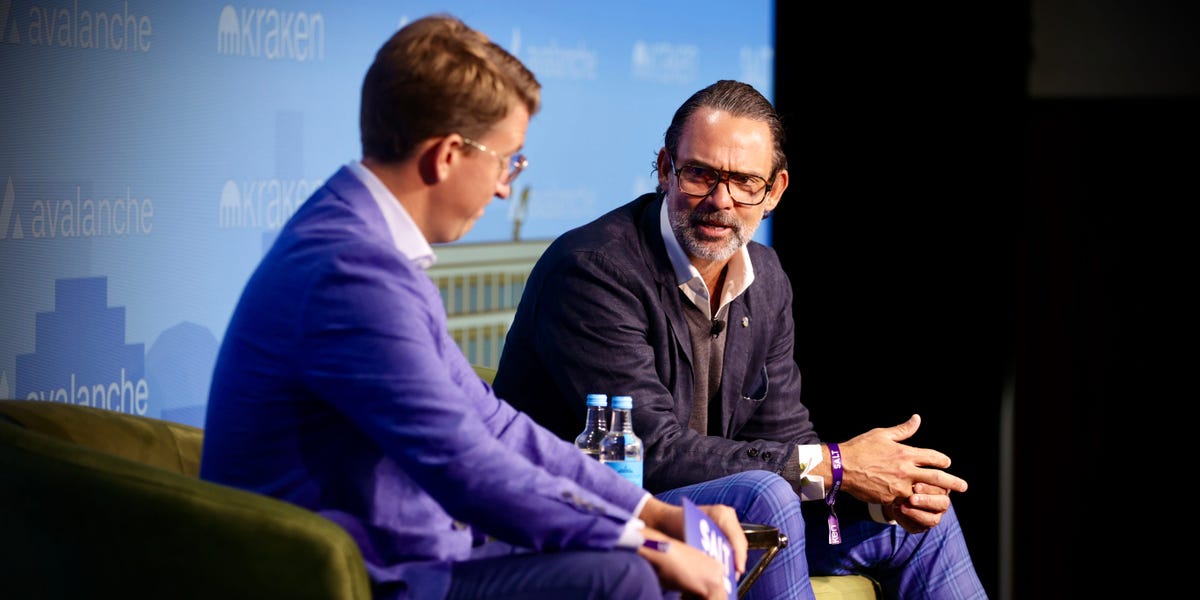
At an elite gathering of investors on Wednesday, some of the juiciest conversations were about the outlook for AI, job creation and destruction, and Elon Musk’s vision of the future.
I attended the second day of SALT London, the alternative investments conference hosted by Anthony Scaramucci’s SkyBridge Capital at The Chancery Rosewood hotel in Mayfair, where rooms can cost $3,000 a night.
The speakers onstage — a who’s who of finance folk — tackled topics ranging from crypto regulation and AI safety to investing in sports and building a resilient portfolio.
Across the day, however, three topics dominated: the ongoing AI bubble debate, how the job market will develop as AI grows, and the world’s richest man, Elon Musk.
Keep reading to see what some of the biggest names on the SALT stage talked about:
One of Peter Thiel’s core lieutenants said the AI bubble is close to bursting
SALT
The AI boom is a bubble that could pop before the new year, according to one of tech billionaire Peter Thiel’s top lieutenants.
“At some point the music will stop,” Jack Selby, a managing director at Thiel Capital and the managing partner of VC firm Copper Sky Capital, told the SALT audience.
Selby said the AI business is “outrageously” capital-intensive given the cost of the microchips, data centers, and other infrastructure needed to run models. AI executives have resorted to “outrageous, fanciful storytelling” to raise the money required, he added.
He said it’s “pretty astounding” that debt markets are continuing to fund the AI buildout. If he had to pick an over-under on when the “euphoric” AI “momentum market” would finish, he said he “would take the under before the end of this year.”
Selby questioned why Anthropic is hustling to raise money from public markets, when the maker of AI chatbot Claude is “basically a bank” given it makes more money from interest on its cash than from its business.
Anthropic’s amended S-1 filing this week showed it earned $2.4 billion of interest income in the first nine months of this year, while its operating loss was around $1.3 billion over the same period. It held around $96 billion of cash and cash equivalents at the end of September.
“They have more money than they know what to do with, so why in the world are they rushing to go public?” Selby asked.
The veteran tech investor also predicted that Democrats reclaiming control of the House and Senate in this week’s midterm elections would be a headwind for defense-technology companies like Anduril.
But he said that could be a “nice, cold glass of water to calm down” a “very hot sector,” which he earlier described as the second-largest bubble today after AI.
The ‘biggest job creation program in the history of the world’ is coming
Elon Musk has been loudly predicting that AI, robotics, and multiplanetary travel will usher in an age of abundance, where everyone can have “whatever stuff they want.”
While Musk has warned the road to that future will be “bumpy,” Nick Finegold, Curation Capital’s founder and executive chairman, said at SALT that it could also unlock all kinds of new jobs.
“I think when SpaceX and Tesla probably merge, you’re going to see Musk start to tell stories about what I believe will be the biggest job creation program in the history of the world,” Finegold said.
“I think the narrative has to change from taking your jobs to creating new jobs for people,” he added.
SALT
Finegold predicted some “commoditized jobs” will be lost to AI, but hundreds of thousands of jobs could be created in financial services for those willing to get creative with new tools.
He said the price of creating content is “collapsing,” and soon a $50,000 budget will be equivalent to a $10 million budget, democratizing the ability to tell visual stories at scale.
His firm has built a platform, Curation Connect, where investor relations teams can use AI video tools to turn regulatory disclosures into films and explainer videos at a fraction of the cost of hiring a media agency.
Cybersecurity will be ‘bigger than AI,’ argued Stephanie Link of Hightower Advisors
SALT
There’s plenty of room to run for AI hyperscalers and the “food chain” around them, Stephanie Link, the chief investment strategist at Hightower Advisors, said during a SALT panel.
Link said there’s a pressing need to build more data centers, upgrade the largely antiquated US electrical grid, and harness more power to meet the immense demand for AI over the next decade.
She also said that cybersecurity is “going to be bigger than AI” because of the security challenges raised by AI.
During the discussion, Link pointed to Amazon CEO Andy Jassy’s April letter to shareholders, in which he said the e-commerce giant has over 1 million robots working in its fulfillment centers and that it’s only in the “early stages” of leveraging the technology.
She estimated that the number of active robots will need to grow around 30-fold to over 150 million by 2035 to satisfy demand.
“If I think AI is in the third inning, and cyber’s in the second inning, I think we’re not even at the batter’s box on robotics,” she continued.
