


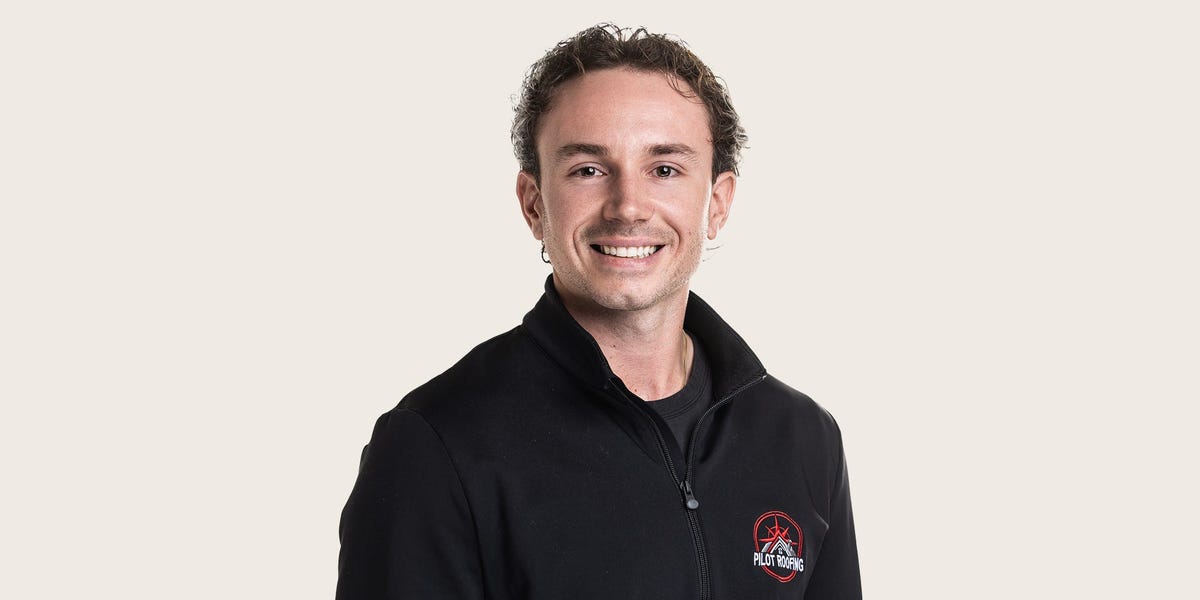
This as-told-to essay is based on a conversation with Andrew Ringler, 29, co-owner and director of finance at a Michigan-based roofing company. It’s been edited for length and clarity.
I’d always thought I’d pursue a career in finance.
I graduated from Michigan State University with a degree in finance, and during my time there, I had a handful of internships. My goal was to do equity research for a large investment fund.
Now, I own my own roofing company.
I took on a roofing sales job while waiting to start my corporate role
Once I graduated in 2019, I got a consulting role which, for a lot of people in finance, would be a dream come true. However, I wasn’t set to start the job until August, and I couldn’t go three or four months without a job.
My college roommate — who’s now one of my business partners — was working in the roofing industry doing sales, and was able to help me get a job with him for that summer. I was working hard; I don’t have a lot of other hobbies, so I just put my nose to the grindstone.
A lot of times in the roofing industry, you don’t get paid for a job you sold until it’s complete and the payment is collected, sometimes months later.
After I started my corporate job, I started having a lot of my roofing commission payments come in at the end of September. I realized I was making more in roofing sales than I would be in my consulting job.
The roofing industry was starting to become more attractive
I was always in a cubicle at my consulting job. And while my official hours were 9 a.m. to 5 p.m., I’d often work 10-hour days because I was willing to work more and enjoyed what I was doing.
Meanwhile, as a 1099 employee in roofing sales, I was able to structure my days how I wanted to; I could be outside on a beautiful sunny day in June as opposed to showing up at the office when it was dark out and leaving when it was dark out.
I got approval to keep selling roofs on the side, and because I like to work a lot, it worked out well.
I took the leap and left finance
During the summer of 2020, I made the tough decision to leave my finance role.
I’ve read a lot of books about risk, finance, and business, and if there’s a time to take a jump, it’s when you’re young. I didn’t have a family or any big responsibilities, so it made sense for me. It felt like I had an opportunity to bet on myself.
For a lot of people in my life, it was shocking. Many of my friends and mentors were in finance, and they were like, “What are you doing? You’re leaving a lot of people’s dream company for the roofing industry. That seems super odd.”
My dad is a CPA and a financial advisor, so I shared my goals and success in the roofing industry with him before I made the career change. Still, even he was a little hesitant at first. I was leaving a job that had security, benefits, and 401(k) matching — every parent’s dream for their kid.
Over time, the people in my life became more understanding, but there was definitely a period of six months to a year when people were a bit judgmental about the career switch.
At times, I’ve felt that people viewed me differently because of my career choice, but I like to prove people wrong, and it’s only fueled the fire to show everyone I made the right choice.
I thought I might go back to finance
During the first six months or so of working in roofing full-time, there was a thought in the back of my mind that I might just be in the industry for a year or two before pivoting back to the finance industry.
However, I continued to be successful at it year after year, so I continued.
I could work as much as I wanted to work — sometimes 80- to 90- hour weeks — and unlike with my finance job, my income reflected it. It also gave me an opportunity to learn leadership and mentoring at a young age.
I’m now the co-owner of a roofing company
Last year, I split off from the roofing company I was with for more than six years, and I now own Pilot Roofing with two other owners. We have three full-time employees and are recruiting more.
In finance, I did a lot of data analysis and looked at spreadsheets all day. I still do a lot of that as an owner, but a lot of my day-to-day work is now working with customers and having an impact on the community I grew up in. I get to treat everyone I interact with — customers, insurance adjusters, employees — as friends.
In the white-collar world, everything has to be so proper. It was hard, especially as I was starting my career, to build relationships; you don’t know what you can or can’t talk about or share.
In the blue-collar world, everything is much more casual. I get to talk to people about the Detroit Lions or their son’s baseball team, and have more real-life, real-world connections.
I also have a more flexible lifestyle. I get to travel and to see my friends and family whenever I want.
In addition to the flexibility, though, there can also be a lot of unpredictability. Finance was a very structured and controlled environment, but in roofing there are a lot of variables outside my control, like weather, material availability, and material prices. There are constant obstacles — but it’s what makes the work exciting.
I take pride in challenging the stigma around working in the trades
When I meet people and they ask what I do, there’s less interest than when I previously told people I was a financial consultant. There’s often an unfair stigma surrounding the roofing industry; people associate working in the trades with a lack of educational or professional success, but I take a lot of pride in challenging that stigma. Success isn’t defined by working behind a desk or having a certain job title.
There’s no doubt in my mind that I made the best decision for me. There’s nothing I miss about being in a corporate environment. There’s a certain level of prestige that comes with finance, but I’ve learned that prestige and personal fulfillment aren’t necessarily the same thing.
Whether it’s roofing, heating and cooling, or plumbing, these jobs will never go away. I think there’s a large opportunity for young people getting into the trades who want to work hard. There are incredibly talented, hardworking, and successful people in the industry and I’m proud to be a part of it.
It’s not for everybody, but for me, it’s been very rewarding.
Do you have a story to share about pivoting from a corporate job to the trades? Contact this editor, Jane Zhang, at [email protected].
