


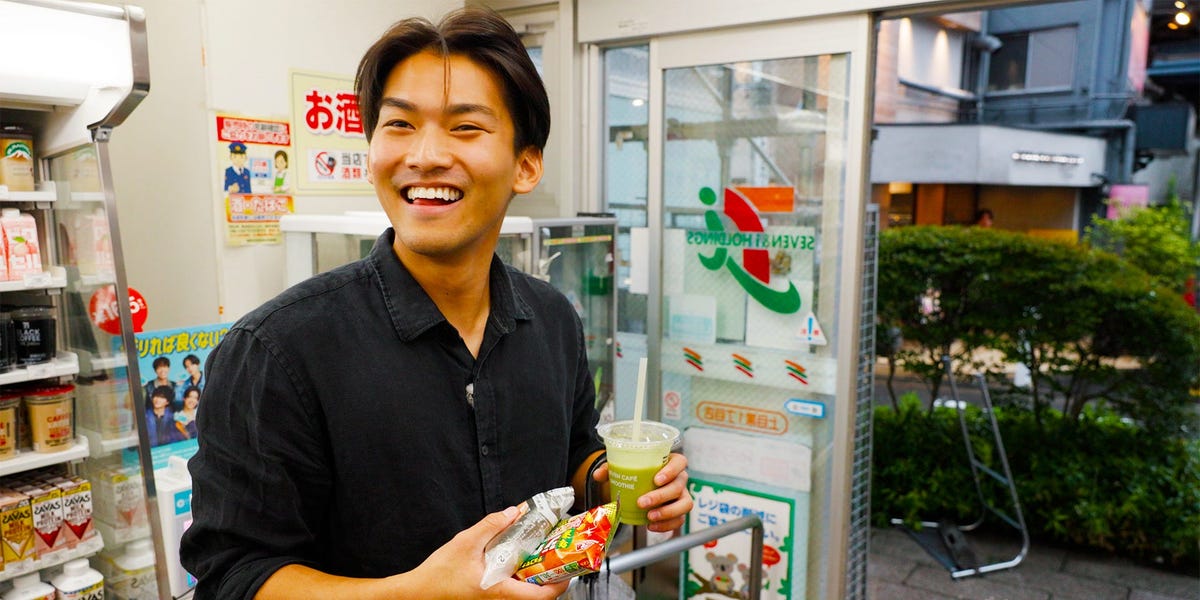
This is an as-told-to essay based on a conversation for Business Insider’s video series, The Pay Check, with Kaito Itokazu, 25, who lives in Tokyo. It has been edited for length and clarity.
I’m a software engineer living in Tokyo, earning around $60,000 a year as a salaryman, plus around $30,000 from side gigs. I’m originally from Los Angeles, and I moved to Japan three years ago.
Salaries in Japan are much lower than in the US. When I tell my friends in America and Japan my salary, I get the exact opposite responses. My friends in the US are shocked and worry about how I make it work. When I tell my friends in Japan, they’re like, “Oh wow, that’s really good for your age.”
This is because it’s much cheaper to live in Japan. Even with a lower salary, it’s possible to live comfortably.
Each year I tend to evaluate whether this coming year is worth the opportunities, experiences, and connections I can create — as opposed to when I was growing up in the US — and every year has been yes. In the past three years, I’ve switched jobs, moved apartments, and now I’m starting a side business.
Compared to the national average, my salary is on the higher end, which gives me more opportunities and experiences and allows me to live in Tokyo. I am extremely grateful and fortunate for that.
Side income and housing in Japan
For my side business, I create websites and web applications and help businesses integrate AI into their workflows. I also teach kids basic computer programming. With my side gigs, I’m projected to make an additional $30,000 a year. That’s around $90,000 a year in total. A lot of the money I get from my side business is expensed or reinvested into it.
My base rent is around $840 — that’s almost double my previous rent when I was living in Yokohama. The size is around the same, so what I’m really paying for is the prime location.
Business Insider
Moving into a new apartment is pretty expensive in Japan. You have to put down a deposit that you don’t get back — mine was $2,000. Because of the nature of my apartment, they wouldn’t let me move things on my own, so I had to hire a professional company to move the furniture, which cost around $500.
For utilities, I pay around $57 a month for gas, water, and electricity. I also spend around $250 on AI tools. In total, from housing to utilities to streaming, it comes to around $970 a month.
Day-to-day spending in Tokyo
Being in the city, I don’t really need a car. Most of my transportation is by subway and bus. When I go to work, I get my transportation fee reimbursed. So I usually spend $120 a month on public transportation for fun outings. If you’re not careful, the trains can add up.
I spend $130 on groceries, $250 on eating out, $70 on cafés and coffee shops, and $70 on convenience stores. Those numbers are pretty embarrassing to admit; I could definitely spend more on groceries and less on eating out.
Business Insider
Yet, one of the things I really like about being in Japan is the amazing food. To me, it’s worth a little extra money to try new places and eat out. The $70 for the convenience stores comes from items like snacks, rice balls, yogurt, and ice cream. I also tend to eat out with friends or coworkers most of the time. Compared to the average Japanese person, I spend a little more on food and groceries.
I like to play soccer or futsal — that adds up to around $38 a month. Recently, pickleball and paddle have been trending, so I spend around $26 on them and $51 on my gym membership. After that, around $65 goes toward nightlife and bars, and I spend about $32 on a haircut every month.
I also love to travel within Japan, Asia, and to America. If I happen to go home to the US, it can be around $1,000, but on average I spend around $470 a month. I recently went to Busan, South Korea, for a $200 round-trip flight; I visited my grandparents in Kagawa for a $120 round-trip flight; and I also went to Mount Fuji for around $31.
Managing finances in Japan
For health insurance, $212 is deducted from my paycheck each month for standard healthcare from my employer. I broke my wrist three years ago, and when I wanted to get it checked out in the US, it would take me around two weeks to get an appointment. While I was in Japan, my wrist started bothering me, and I was able to get it checked out immediately. I went in that same day for X-rays and scans. I initially paid for the surgery, but my insurance reimbursed 70% of the cost. The total came to around $300.
On average, I save around $1,500 to $3,500 a month. Of that, 30% goes to investments, 30% to an emergency fund, and the rest goes back into my side business. In Japan, we also have a residence tax that applies to you a year after you move. You get taxed on your previous year’s salary at around 10% of your salary, fixed.
I went to Chapman University in the US and recently paid off my student loan debt. I was fortunate to be in a position to receive a scholarship and use money from my internships to pay off my student loans.
Business Insider
Now, I’m trying to find a balance between being financially smart and being able to experience and spend money how I want to. I have a budget range, and I don’t want to go over it. I also have money saved up in case something goes wrong with a fund or if I want to invest it — but I also have some money I use to travel or experience new things. If I decide to settle down in Japan, I think I’m on track financially.
As I build a community and make more connections, Japan starts to feel less like a temporary place and more like a second home. That makes it much harder to leave.
