


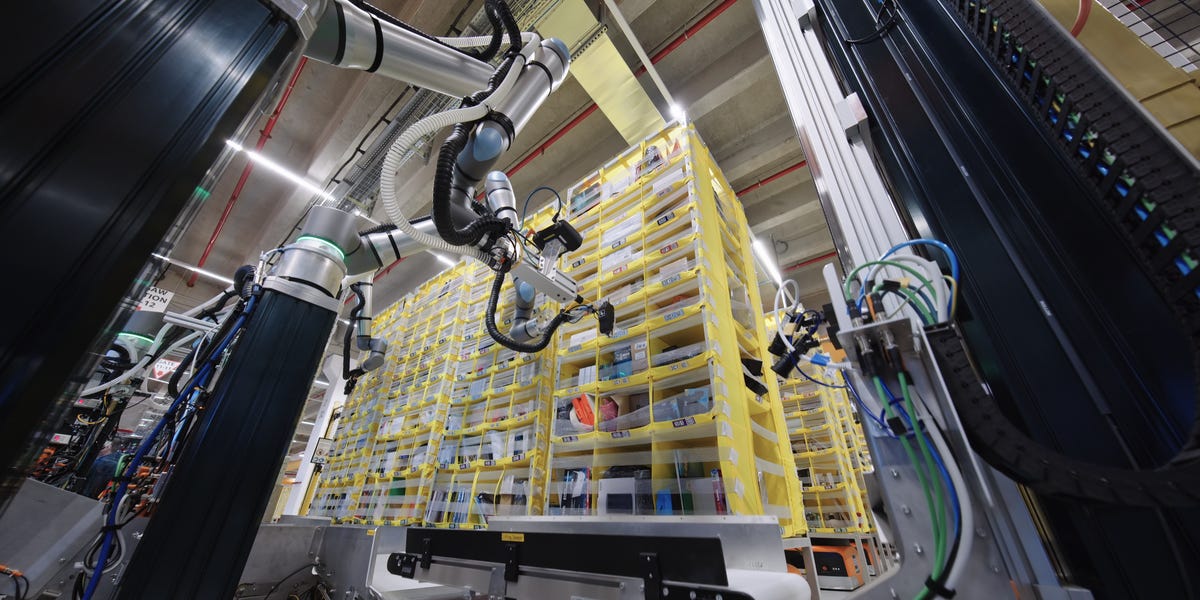
When Amazon unveiled its Vulcan touch-sensing warehouse robot last week, it framed the technology as a way to make frontline jobs safer and easier.
What the company didn’t mention is a broader ambition: using Vulcan and its expanding fleet of warehouse robots to reduce its need to hire a lot more humans.
An internal document obtained by Business Insider describes Amazon’s long-term vision of automating many warehouse tasks. The document, dated late last year, said Vulcan and similar robots are “critical to flattening Amazon’s hiring curve over the next ten years” as the company builds “the world’s most advanced Fulfillment Network.”
This suggests Amazon is trying to use automation to slow the rate of new hiring, rather than replace existing workers. People in senior positions at the company who are familiar with the matter say the automation push is also a response to growing costs and possible labor shortages in Amazon’s warehouses.
The document, marked “Amazon Confidential,” was produced by Amazon’s retail team to review various important projects. It also outlined several AI initiatives designed to further optimize warehouse efficiency and employee productivity.
‘Higher-value tasks’
Amazon/Cover Images via Reuters Connect
The company still plans to “have a lot of people for a long period of time,” an Amazon spokesperson told BI, adding that many future roles would involve “higher-value tasks.”
“Our robotics solutions are designed to automate tasks in an effort to continue improving safety, reducing repetition, and freeing our employees up to deliver for customers in more skilled ways,” the spokesperson said. “Since introducing robots within Amazon’s operations, we’ve continued to hire hundreds of thousands of employees to work in our facilities and created many new job categories worldwide, including positions like flow control specialists, floor monitors, and reliability maintenance engineers.”
The spokesperson also cautioned against drawing conclusions from a specific internal company document.
A leader in automation
Amazon has been a leader in warehouse automation for years, having acquired Kiva Systems in 2012 for roughly $775 million. The company has consistently streamlined its operations through technology, integrating more than 750,000 robots to work alongside over 1 million frontline employees in storing, picking, packing, and shipping goods.
For roughly a decade, Amazon’s head count grew massively, even though it was embracing automation. But this has gone into reverse in recent years.
After doubling its workforce to 1.6 million between 2019 and 2021, Amazon’s head count declined to 1.55 million last year.
Amazon public filings
Humans working alongside robots
Amazon introduced Vulcan last week as its first tactile robot. It’s capable of sensing and adjusting the force needed to pick products from crowded bins and tall baskets, improving safety and speed.
According to the internal document obtained by BI, Amazon’s robotics team is working on at least two AI models intended to be building blocks for new applications that “will significantly enhance the efficiency and responsiveness of our robotics systems.” The company is also working on a new AI model called “Tetris,” aimed at reducing variable labor and transportation costs, the document said.
In the document, Aaron Parness, the director of applied science at Amazon Robotics, emphasized robots’ role in enhancing efficiency and safety to ultimately enable the company to fulfill more orders and deliver more shipments.
“We’ve always envisioned a solution that’s robots and humans working side by side,” Parness wrote. “And we think the sum of the two together is better than the parts alone.”
He added that automation helps Amazon retain frontline employees in a competitive labor market by improving the work environment and offering new technical career paths in maintenance and operations.
“You have to be competitive for workers,” Parness said, “so that people will want to work and stay at Amazon.”
Related stories

Business Insider tells the innovative stories you want to know
Business Insider tells the innovative stories you want to know
A potential solution for labor shortages
Some Amazon employees told BI that machines such as Vulcan are designed not only to enhance productivity but also to help address a growing labor gap.
One employee said the company had set aggressive targets to automate much of the warehouse workload over the next decade to drive down costs. Amazon is also extensively researching how to upskill the current workforce to move them into more maintenance-related jobs, this person added.
With Amazon’s continued growth, finding enough workers has become increasingly difficult, another Amazon insider told BI. If the company doesn’t automate more, it will struggle to keep up with demand, this person added.
A $10 billion opportunity
Amazon
Vulcan is one of several systems Amazon has introduced in recent years, including robotic arms such as Robin and Sparrow that sort orders and mobile units like Proteus that transport packages across warehouses.
Amazon’s automation strategy could save as much as $10 billion annually if 30% to 40% of US orders are fulfilled through next-generation facilities by 2030, Morgan Stanley estimates.
“We expect Amazon to continue to expand its warehouse network (to support growth) while also upgrading the footprint toward next-gen robotics in new builds and retrofits,” Morgan Stanley analysts wrote in a research note earlier this year.
Amazon CEO Andy Jassy reaffirmed the company’s commitment to automation during a February earnings call, saying its robotics investments aim to boost safety, productivity, and cost efficiency.
“We’ve already seen substantial value from our robotics innovations,” Jassy said.
Have a tip? Contact this reporter via email at [email protected] or Signal, Telegram, or WhatsApp at 650-942-3061. Use a personal email address and a nonwork device; here’s our guide to sharing information securely.
