

Annelise Capossela for NPR
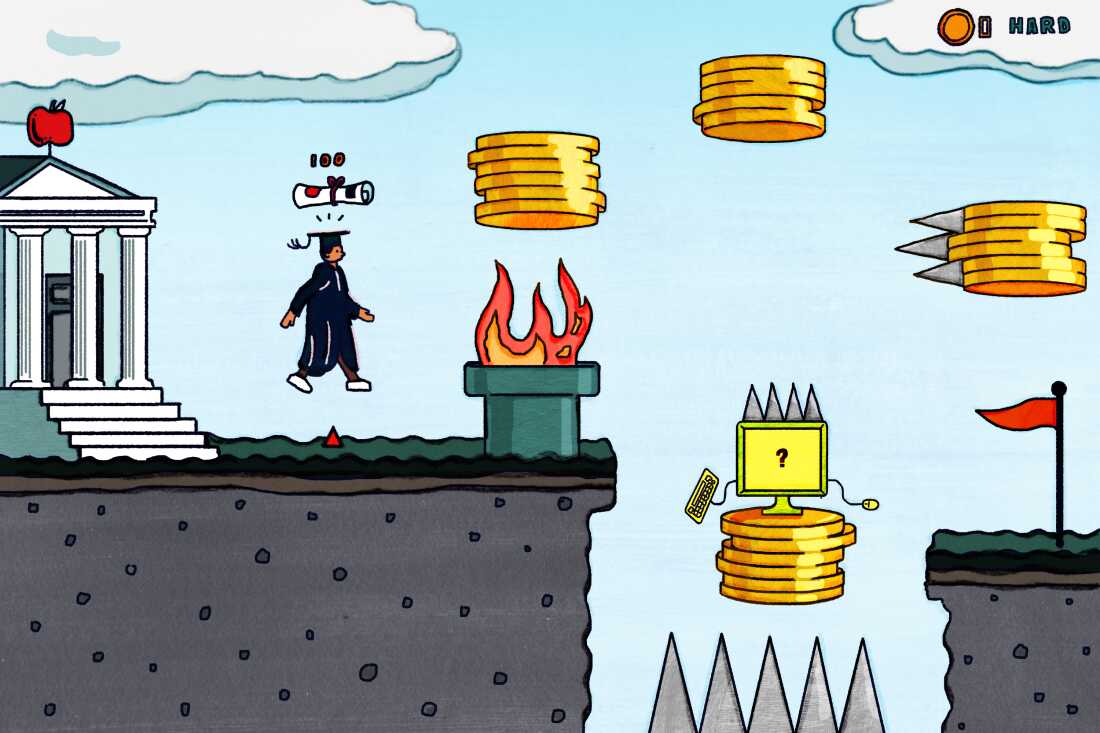
Borrowers have spent much of 2025 trying to keep up with dizzying changes to the federal student loan system.
The Trump administration and Congress are in the process of overhauling everything from how much Americans can borrow to how quickly they have to pay it back.
Here’s what to know as we head into a new year:
President Biden’s SAVE Plan is ending
The U.S. Department of Education announced in early December that it had reached a proposed settlement agreement to end the popular, yet controversial Biden-era student loan repayment plan known as SAVE.

The Saving on a Valuable Education Plan “was the most affordable, generous and flexible plan for millions of student loan borrowers,” says Persis Yu of the liberal advocacy group Protect Borrowers.
But it was so affordable, generous and flexible – with its fast-tracked loan forgiveness and monthly payments as low as $0 for low-income borrowers – that Republican state attorneys general sued the Biden administration for exceeding its authority.
Legal challenges put SAVE borrowers in limbo for months, during which they were not required to make payments on their loans. Interest began accruing in August.
This new agreement, pending court approval, would end the long legal battle by ending SAVE itself.
“The law is clear: if you take out a loan, you must pay it back,” Under Secretary of Education Nicholas Kent said in a statement announcing the proposed agreement. “American taxpayers can now rest assured they will no longer be forced to serve as collateral for illegal and irresponsible student loan policies.”
Under the agreement, the Education Department would commit to moving the roughly 7 million borrowers still enrolled in SAVE into other repayment plans – though some of those plans are also in flux.
Whether you blame Biden or Republicans for SAVE’s downfall, Betsy Mayotte, founder of the Institute of Student Loan Advisors (TISLA), says it puts borrowers in a real bind.
“People that made other financial decisions based on what they thought their payment was gonna be on the SAVE plan – they’re in trouble,” Mayotte says. “A payment plan has never been challenged in court and has never been pulled out from existing borrowers.”
Now, Mayotte says, those roughly 7 million SAVE borrowers will have to change plans and find a way to afford what will likely be higher monthly payments.
Complications for borrowers working toward Public Service Loan Forgiveness
Liz Kilty, an oncology nurse in Portland, Ore., has been on the SAVE plan from the start.
“As soon as SAVE was an option, I signed up for it,” says Kilty, who works in a public hospital and wanted to keep her monthly payments reasonably low on her way toward Public Service Loan Forgiveness (PSLF).
Since 2007, PSLF has offered a path for borrowers who work in public service – including teaching, nursing and policing – to have their loan balances erased after 10 years on the job.
Kilty has $36,000 in debt remaining, and 15 payments to go before she can qualify for loan forgiveness.
But SAVE’s legal troubles have slowed her down: Since her payments were frozen, so too was any progress she could make toward forgiveness. “I was like, ‘Are you kidding me?’ Like, ‘This is the year I’m going to be done, and this is the year that they’re going to screw things up?’ I’ve been waiting a decade [for forgiveness] and now things could go awry, and you’re just helpless.”
Earlier this month, Kilty applied for the PSLF Buyback, to make her remaining 15 payments in one lump sum and finally qualify to have the remainder forgiven.
One reason PSLF is still an option for Kilty and other borrowers is because it was created by Congress.
The Trump administration doesn’t have the authority to stop PSLF – but it has worked to change the rules. Effective July 1, 2026, the department says it will deny loan forgiveness to workers whose government or nonprofit employers engage in activities with a “substantial illegal purpose.” The job of defining “substantial illegal purpose” will fall not to the courts but to the education secretary.
In November, the cities of Boston, Chicago, San Francisco and Albuquerque, N.M., sued the Trump administration over those PSLF changes.
The complaint argued that a city or county government’s resistance to the administration’s immigration actions, for example, could lead the secretary to exclude that government’s public workers – including a local nurse, like Kilty – from loan forgiveness.
Repayment plans are changing
SAVE aside, trying to change repayment plans in 2026 is about to get weird.

That’s because, in the One Big Beautiful Bill Act (OBBBA), Republicans also decided to gradually shut down two other popular, more affordable plans: Income-Contingent Repayment (ICR) and Pay As You Earn (PAYE). Both base payments on a borrower’s income, and both will end in mid-2028.
Current borrowers can still, technically, enroll in these plans – for now. Another income-adjusted plan to consider – one that’s not going anywhere – is Income-Based Repayment (IBR).
You can find a handy list of all of these plans and compare your monthly payments on the Education Department’s Loan Simulator.
Congress also used the OBBBA to create two new repayment plans, beginning on July 1, 2026, that, for new borrowers, will replace all of the current options.
1. The standard plan
Under this new standard plan, new borrowers would agree to a repayment window between 10 and 25 years, depending on the size of their debt, with what they owe being divided up, along with interest, into equal monthly payments, like a home mortgage.
Under this plan, borrowers with larger debts would qualify for a longer repayment period.
2. The Repayment Assistance Plan (RAP)
For borrowers worried they don’t earn enough to cover the standard plan’s rigid monthly payments, Republicans created the RAP for future and current borrowers alike.
Payments would, for the most part, be based on borrowers’ total adjusted gross income (AGI), and the department will waive any interest that is left after a borrower makes their monthly payment. The result: Borrowers in good standing will no longer see their loans grow.
In fact, Republicans want to make sure borrowers see their balances go down every month. For those whose monthly payments are less than $50, the government would match whatever they do pay and apply it toward the principal.
While other plans offer forgiveness of remaining debts after 20 or 25 years, the RAP would delay that to 30 years. That’s a big difference, says Preston Cooper, who studies student loan policy at the conservative-leaning American Enterprise Institute (AEI).
Borrowers with typical levels of debt “and typical incomes for their degree level are almost always gonna pay off well before they hit that 30-year mark,” Cooper says. “So if you’re going into RAP, I wouldn’t be thinking about forgiveness because you’re probably gonna pay it off.”
Beginning July 1, 2026, new loans will be subject to new borrowing limits
We’ve covered big changes to repayment, but there are also big changes to how much graduate students can borrow in the first place. (Undergraduates won’t see any changes.)
New limits will make it harder for lower- and middle-income borrowers to attend pricier graduate schools. Republicans are shutting down the current grad PLUS program, which allows students to borrow up to the cost of their degree.
“Colleges could simply raise the price, pass the cost on to students, and the federal government would be required to write a check through the federal student loan program, ” Cooper says. “That system was completely untenable, and I very much understand why Congress elected to end it.”
After July 1, grad students’ borrowing will be capped at $20,500 a year. Ideally, Cooper says, this will push some schools to lower their prices.
Until they do, though, Persis Yu, with Protect Borrowers, says many students will face a serious funding gap between their federal loans and the actual cost of graduate school.
“Students are gonna have to make up that gap with some other type of funding,” Yu says, “and many students are gonna have to turn to the private student loan market.”
Mayotte, at TISLA, says she thinks some schools will abandon certain degree programs.
“I got a bad feeling in the pit of my stomach when this law went through because I don’t think it’s gonna lower the cost of education like members of Congress think that it might,” Mayotte says.
Borrowers working toward a professional graduate degree (think medicine or law) will have their borrowing capped at $50,000 a year.
Parents and caregivers who use parent PLUS loans to help students pay for college will also see new loan limits. They will be capped at $65,000 per child.
“The precipice of a default cliff”
Amidst all this change, data shows that millions of borrowers are struggling to keep up with their payments.
Preston Cooper at AEI recently published an analysis of the latest federal student loan data, and the results were sobering: 5.5 million borrowers in default, another 3.7 million more than 270 days late on their payments and 2.7 million in the early stages of delinquency.
“We’ve got about 12 million borrowers right now who are either delinquent on their loans or in default,” Cooper says.
That’s more than 1 in 4 federal student loan borrowers – a crisis raising bipartisan alarm.
Persis Yu, of Protect Borrowers, warns America is at “the precipice of a default cliff.”
Mayotte adds, “I really do think we’re headed for historic default rates, for a while.”
And so, heading into 2026, the big question hanging over the Trump administration and Congressional Republicans is: Can all the changes they’ve made help bring these borrowers back into good standing? Or will the default numbers snowball into an avalanche?
