

Close Menu
USTaxNews.live – Your Trusted Source for U.S. Tax & Finance Updates
  • Home
  • Audit
  • Finance
  • IRS
  • Legal
  • Tax News
  • Tax preparation
  • Tax Tips
  • USA Accounting
What's Hot

Read the Memo From Skydance’s CEOs After Beating Q3 Earnings Estimates

November 9, 2026

Skydance $6 billion cost savings breakdown

November 9, 2026

Lucid Group (LCID) earnings Q3 2026

November 9, 2026

Subscribe to Updates

Subscribe to our newsletter and never miss our latest news

Subscribe my Newsletter for New Posts & tips Let's stay updated

Subscribe to USTaxNews

* indicates required

Subscribe for Tax Updates

Get the latest IRS news, tax tips, and deadlines delivered to your inbox.

style="display:none">
Facebook X (Twitter) Instagram
USTaxNews.live – Your Trusted Source for U.S. Tax & Finance Updates
  • Home
  • About Us
  • Advertise With Us
  • Contact Us
  • DMCA
  • Privacy Policy
  • Terms & Conditions
  • Home
  • Audit
  • Finance
  • IRS
  • Legal
  • Tax News
  • Tax preparation
  • Tax Tips
  • USA Accounting
USTaxNews.live – Your Trusted Source for U.S. Tax & Finance Updates
Home » How a Month of War on Iran Has Remade the World Economy
Audit

How a Month of War on Iran Has Remade the World Economy

EditorBy EditorMarch 29, 2026No Comments8 Mins Read
Share Facebook Twitter Pinterest LinkedIn Tumblr Email
Share
Facebook Twitter LinkedIn Pinterest Email Copy Link


It’s not easy being the world economy right now.

One month into the US and Israeli war on Iran, the shock is upending everything from supply chains to air travel.

As the price of a barrel of oil settles in at north of $100, up from $70 before the war, gas prices in the US are flirting with $4 a gallon, the highest since Russia invaded Ukraine in 2022. And on the other side of the world, consumers in places like the Philippines and India are waiting hours in line for fuel as governments ration dwindling supplies.

“No country will be immune to the effects of this crisis if it continues to go in this direction,” Fatih Birol, the head of the International Energy Agency, told journalists in Australia earlier this week.

This energy supply shock threatens to drive up inflation, which could mean higher interest rates, which can lead to a recession. It’s a delicate balance that is difficult to calibrate in the uncertainty of war. Some economists are warning of a dreaded 1970s -style stagflation, a perfect storm of high prices, a stalled economy, and rising unemployment.

The war is also hammering supply chains for things like helium, a critical component in the semiconductor chips powering the AI revolution, and fertilizer, which could, in time, lead to higher grocery prices.

President Donald Trump says the war on Iran is intended to mitigate what he called the “imminent threat” of its ballistic missiles, alleged nuclear weapons program, and its proxies in the Middle East, like Hezbollah in Lebanon and the Houthis in Yemen.

Iran, however, has shown resilience. How long the war lasts will likely depend on how long the world can withstand its economic impact. Here are some of the major ways that impact is spreading.

The oil shock

Gasoline drips from the tip of a gas station nozzle.

Gasoline drips from a gas station nozzle. The US and Israeli war on Iran has disrupted oil supplies, sending the price of oil skyrocketing past $100 a barrel and forcing some countries to ration supplies. 

Alain JOCARD / AFP

Global oil prices have skyrocketed since the military conflict began in late February, mainly due to the near-closure of the Strait of Hormuz. About 20% of the world’s oil supply and liquefied natural gas pass through the waterway off Iran’s coast.

Other major oil hubs across the Middle East have also sustained damage, including the United Arab Emirates’ Port of Fujairah, further driving up oil prices to over $100 a barrel. When the markets closed on Friday, Brent oil sat at $112.57, while West Texas Intermediate landed at $99.64.

For the average person, the fallout means two things: spending more money at the pump and surging energy bills. In America, the national average gas price reached $3.98 on Sunday, up from $2.98 in February.

Some countries are trying to cushion the price shock through rationing. That includes the Philippines, where officials implemented a temporary four-day workweek for federal workers and urged businesses to conserve energy. Pakistan also implemented a shortened workweek, closed schools for two weeks, and had public-sector employees work from home to ration oil.

This month, the International Energy Agency released 400 million barrels of oil from reserves to ease global economic volatility. The agency said this war is creating “the largest supply disruption in the history of the global oil market.”

Financial markets begin to crack

A trader looks worried on the floor of the New York Stock Exchange.

A trader works on the floor of the New York Stock Exchange on March 9 in New York City. 

Spencer Platt/Getty Images

Trump has a way with words and has used them strategically to influence markets. Stock traders appeared to wise up this week, however, as multiple exchanges entered correction territory.

Two major indexes — the Dow and the Nasdaq 100 — are now halfway to a bear market. The latter, composed mostly of American tech companies and already reeling from uncertainty over the impact of AI on software companies, slid into the realm of a correction at the close of trading on Friday.

The broader S&P 500, meanwhile, notched its fifth week of losses by the end of the day on Friday, coming in just shy of a correction after a January peak of almost 6,980.

BCA Research, an independent provider of global investment data, said that if losses continue at this pace, it would be a strong “motivator” for Trump to rethink his war strategy.

While it’s been a dire few weeks for the markets, not everyone thinks the war, as it stands now, is enough to reverse optimism around the industrial renaissance driven by AI and the tax cuts from Trump’s “One Big Beautiful Bill.”

“The bottom line is that the Iran shock is not big enough to offset the strong tailwinds to the US economy,” Torsten Sløk, the chief economist at Apollo Global Management, said Friday.

The spectre of stagflation

A gas station sign in Los Angeles shows prices over $5 a gallon.

The war on Iran has sent the average national price of gas in the United States close to $4 a gallon. In California, gas prices are already well over $5 a gallon. 

Frederic J. BROWN / AFP

Inflation is bad. So is a recession. Stagflation is both at the same time.

Sløk spent much of 2025 warning about the possibility of stagflation — the dire confluence of rising inflation and sluggish economic growth — driven by Trump’s on-again-off-again tariff policies. In January, Sløk changed his tune, turning optimistic that the economy had improved.

A month later, Trump bombed Iran, surprising the world and putting stagflation back on the table, driven this time by the potential for the rising cost of oil to trigger inflation. The last time stagflation took hold, in the 1970s, it was also driven by the price of oil. It devastated the US economy, lowered living standards, and triggered intense financial pressure on consumers.

Stagflation is often considered the worst-case scenario for the economy since it’s difficult to resolve. The Federal Reserve would be restricted in its ability to cut rates to ease a recession, because it would risk stoking even more inflation.

Federal Reserve Chairman Jerome Powell waved off the threat of stagflation in a press conference earlier this month. Powell said the current economic climate was difficult, but didn’t think it was comparable to the 1970s.

Economist Paul Krugman, however, isn’t so sure.

Air travel chaos

A phone shows flights avoiding airspace over Iran on a flight-tracking app.

The Iran war has forced airlines to reroute or cancel flights all over the Middle East. 

Marcin Golba/NurPhoto

The airline industry felt the war’s reverberations immediately.

Airspace closures in the region forced airlines to reroute or cancel flights, leaving tourists marooned. Dubai International has gradually resumed operations for some flights, but many airports have either limited operations or suspended flights.

Many US embassies in the Middle East are also closed, leaving large swaths of travelers stranded without a clear way home. One American visiting Dubai when the war broke out told Business Insider he felt “betrayed and left out to dry” by the government’s lack of support.

Although the UAE said it would bear “all hosting and accommodation costs for affected and stranded passengers,” some tourists have racked up thousands of dollars in additional costs while waiting to book a ticket home.

And now jet fuel prices are skyrocketing, making plane tickets more expensive. Jet fuel reached an average of $197 a barrel on March 20, according to the International Air ​Transport Association. The price was $99 at the end of February. Some airlines — like Qantas and Air India — are raising ticket prices and passing the costs on to consumers.

Supply chain disruptions come for AI and the price of food
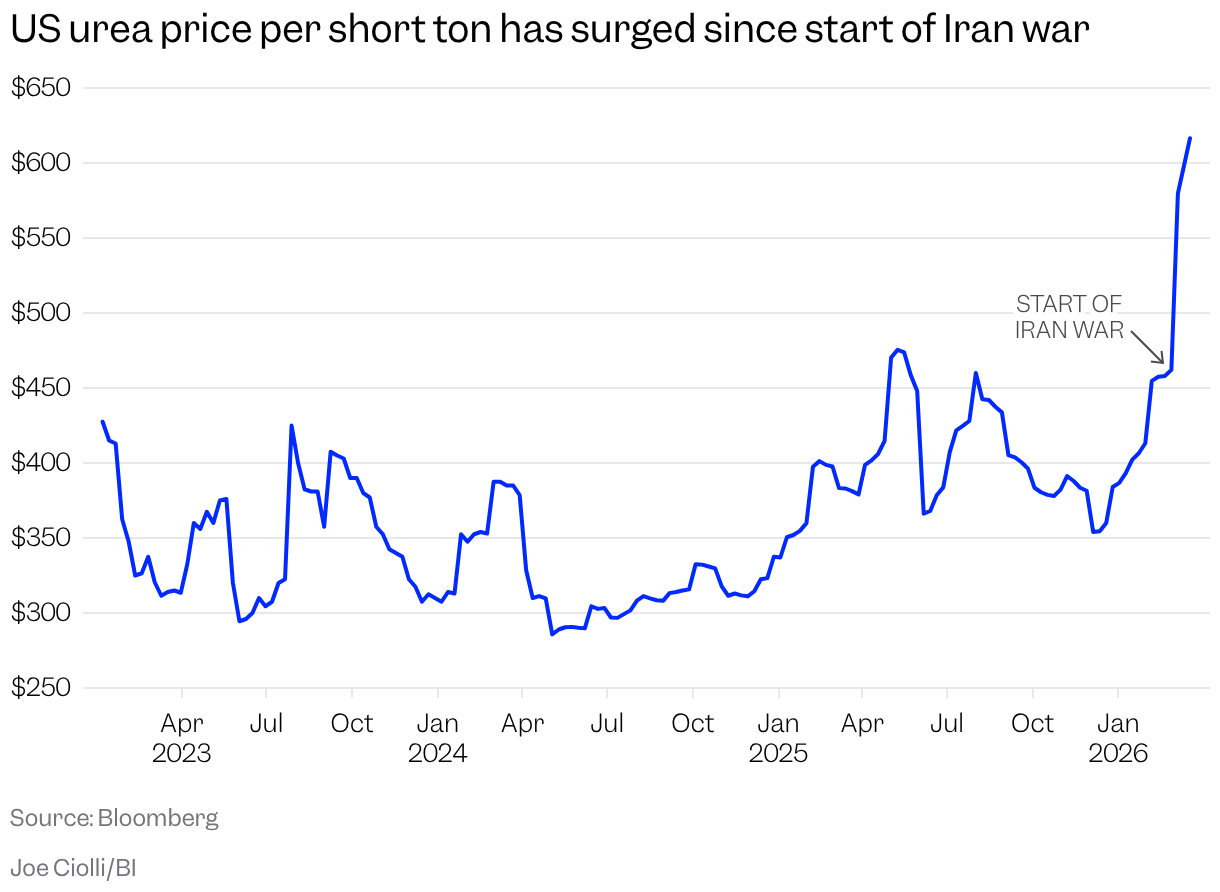
Line chart

The supply of oil gets most of the headlines. There are other commodities, however, that are also facing supply chain disruptions. And those commodities will affect everything from the AI revolution to food prices.

Sulfur, for instance, is a byproduct of oil and gas processing. It’s wisely recycled to help extract metals like copper and lithium. Those metals are in high demand as AI companies race to build data centers to power their products. They are also used in the production of electric cars.

Sulfur is also key to producing urea, a widely used specialized fertilizer. A third of the global fertilizer supply also passes through the Strait of Hormuz. The prolonged disruption to the fertilizer supply will force farmers to ration its use, resulting in lower crop yields and, ultimately, higher grocery prices, hitting the average consumer where it hurts most.

The war on Iran is also affecting the supply of helium. Qatar supplies nearly one-third of the world’s helium, a byproduct of liquid natural gas production that is critical for semiconductor manufacturing. That’s another blow to AI, one of the key industries propping up the US economy.

It’ll require a peace deal between the US, Israel, and Iran to resolve all these disruptions. For now, a deal remains elusive.


Source link

Share. Facebook Twitter Pinterest LinkedIn Tumblr Email
Editor
  • Website

Related Posts

Read the Memo From Skydance’s CEOs After Beating Q3 Earnings Estimates

November 9, 2026

How the Right Payment System Can Help Canadian Small Businesses Grow

November 9, 2026

Leaked Disney Streaming Presentation Reveals Top 2027 Priorities

November 9, 2026
Leave A Reply Cancel Reply

News
Finance

Skydance $6 billion cost savings breakdown

Skydance is pulling back the curtain on how it plans to achieve at least $6…

Lucid Group (LCID) earnings Q3 2026

November 9, 2026

Children’s Place files for Chapter 11, seeks buyer

November 9, 2026
Top Trending
IRS

IRS updates 2027 tax brackets and raises standard deduction to $16,600

The Big Money Show analyzes the latest tax votes as Florida voters…

IRS

IRS CEO Frank Bisignano says mobile app will combat fraud and theft

IRS CEO Frank Bisignano says the agency’s new mobile app will let…

IRS

Chinese national detained, indicted in $360K fake Microsoft tech support scam

Rep. Brett Guthrie, R-Ky., discusses how the United States should handle the…

Subscribe to News

Please enable JavaScript in your browser to complete this form.
Loading

Welcome to USTaxNews.live – Your Trusted Source for U.S. Tax, Accounting, and Financial News.

At USTaxNews.live, we’re committed to delivering accurate, timely, and practical information on everything related to U.S. taxes, IRS updates, legal issues, accounting practices, and the broader financial landscape. Whether you’re a taxpayer, accountant, legal professional, or business owner, we’re here to help you stay informed and ahead of change.

Our Picks

Mark Zuckerberg threatened to leave California over proposed billionaire tax, Meta says

October 22, 2026

California billionaire tax could leave state with less revenue, Stanford study cautions

October 19, 2026

California’s proposed billionaire tax: How does it add up?

October 18, 2026

Subscribe to Updates

Please enable JavaScript in your browser to complete this form.
Loading
  • Home
  • About Us
  • Advertise With Us
  • Contact Us
  • DMCA
  • Privacy Policy
  • Terms & Conditions
© 2026 ustaxnews. Designed by ustaxnews.

Type above and press Enter to search. Press Esc to cancel.