


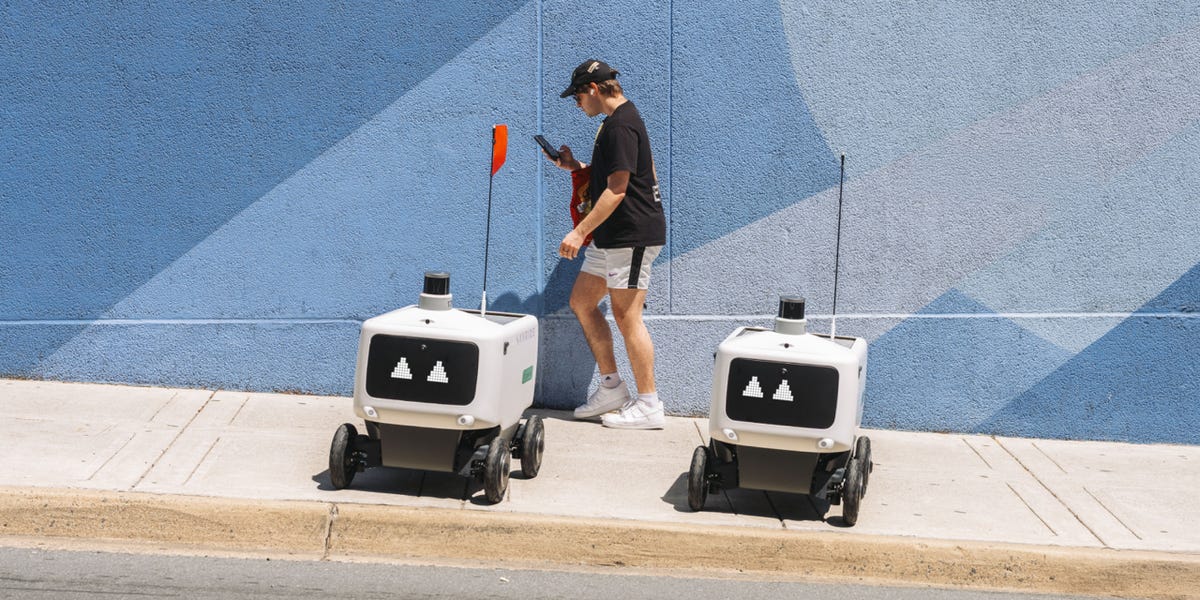
Avride’s delivery robot can navigate city sidewalks for 13 hours and carry six extra-large pizzas at a time.
A 2 ½-foot-tall pole carrying a red flag and a light mounted on the vehicle proved to be an unexpected challenge, though.
Curious — or, perhaps, malicious — humans would bend the pole as the robot passed by them, said Laura Lawton, Avride’s head of communications. Sometimes, they’d break it. The problem became widespread enough that Avride had to redesign the pole to make it tamper-proof, she said.
Companies like Avride spend lots of time and resources developing self-driving vehicles to deliver dinner and pick up passengers. Much of that effort goes toward perfecting the AI “driver” of those vehicles as well as the technology, such as cameras and LIDAR sensors, to train the AI.
But once they hit the streets, the robots encounter the real world. That includes overcoming seemingly mundane but important challenges, such as jagged sidewalks or erratic motorists.
Avride is not alone in facing these challenges. DoorDash has paid gig workers to load the company’s Dot delivery robots, covering the few feet between a restaurant counter and the parking lot, for example.
Avride
So far, Avride has sent its robots to make deliveries in several mostly urban environments. In October, for instance, Avride said it would add robots in Jersey City, New Jersey, where the company already had a pilot program, and bring them next door to Hoboken, New Jersey, as well as Philadelphia and Arlington, Virginia.
In each city, Avride is working with independent restaurants as well as Marc Lore-founded food hall chain Wonder to deliver orders. Avride’s delivery robots also work with Uber Eats in Jersey City.
The company chose its expansion locations because they all have lots of apartments, condos, and other high-density housing, said Sergei Kirillov, Avride’s chief commercial officer. That layout means more food orders in a small area, he added.
Once on the ground, though, the robots have to deal with the real world.
Public infrastructure matters, Kirillov said. Aside from street crossings, Avride’s robots stick to sidewalks and other paths accessible only by foot. Sidewalks that are too narrow or uneven due to a lack of maintenance can be barriers.
“Sometimes, it’s hard to predict how good the infrastructure is before you actually start,” he said.
Avride designed its robot to share the sidewalk with pedestrians, the company said. The robot has four wheels, all of which can rotate to make turns on busy pathways.
The robots also have to avoid accidents with cars as they cross streets. On a recent Friday morning, Avride demonstrated one of its robots in Arlington, Virginia for Business Insider.
At one crosswalk, the signal was flashing red, showing 17 seconds remaining for pedestrians to cross. Many fast-walking humans might see that as plenty of time to cross. Avride’s robots, however, are trained to stop and wait for the next white crossing signal.
“It still needs to assess traffic, including right- and left-turning vehicles, because the walk signal doesn’t guarantee drivers will yield,” Lawton told Business Insider.
Traffic is potentially risky for delivery robots. One of Avride’s robots was struck by a truck in Philadelphia earlier this year while trying to cross a street. It had only minor damage, according to the posted video, and was able to limp across the street.
Some companies have included features to make their robots look cuter in public. DoorDash’s Dot has lights that look like eyes and can greet passersby, for instance.
Avride has incorporated similar features. During the demonstration in Arlington, Avride’s robot flashed an image of a dog on its screen as pedestrians walked by with their four-legged companions.
For now, Avride is focused more on improving its robots in the cities where it operates than finding new places to launch them.
“We’re learning something new,” Kirillov said. “It’s hard to find two similar deployments.”
Do you have a story idea about food delivery? Contact this reporter at [email protected] or via encrypted messaging app Signal at 808-854-4501. Use a personal email address, a nonwork WiFi network, and a nonwork device; here’s our guide to sharing information securely.
