


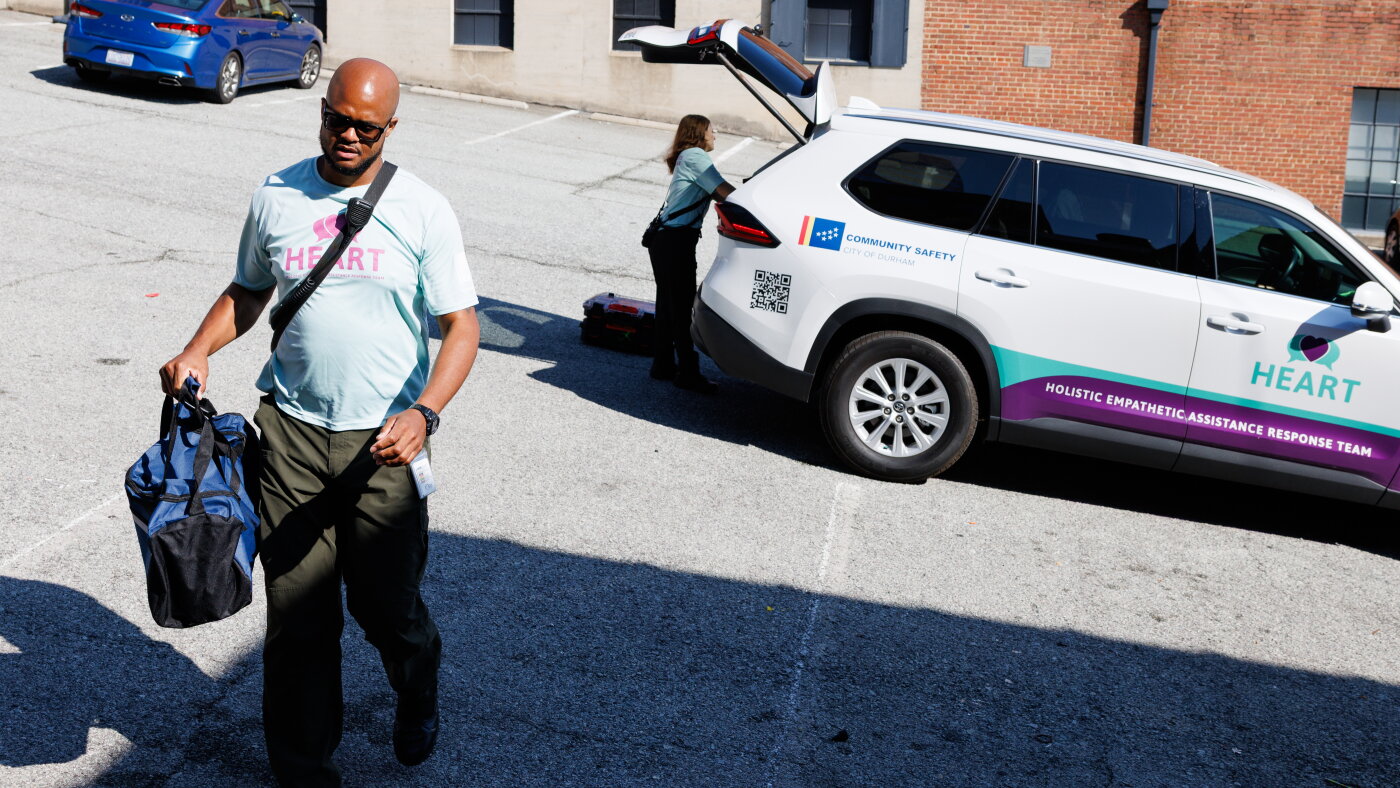
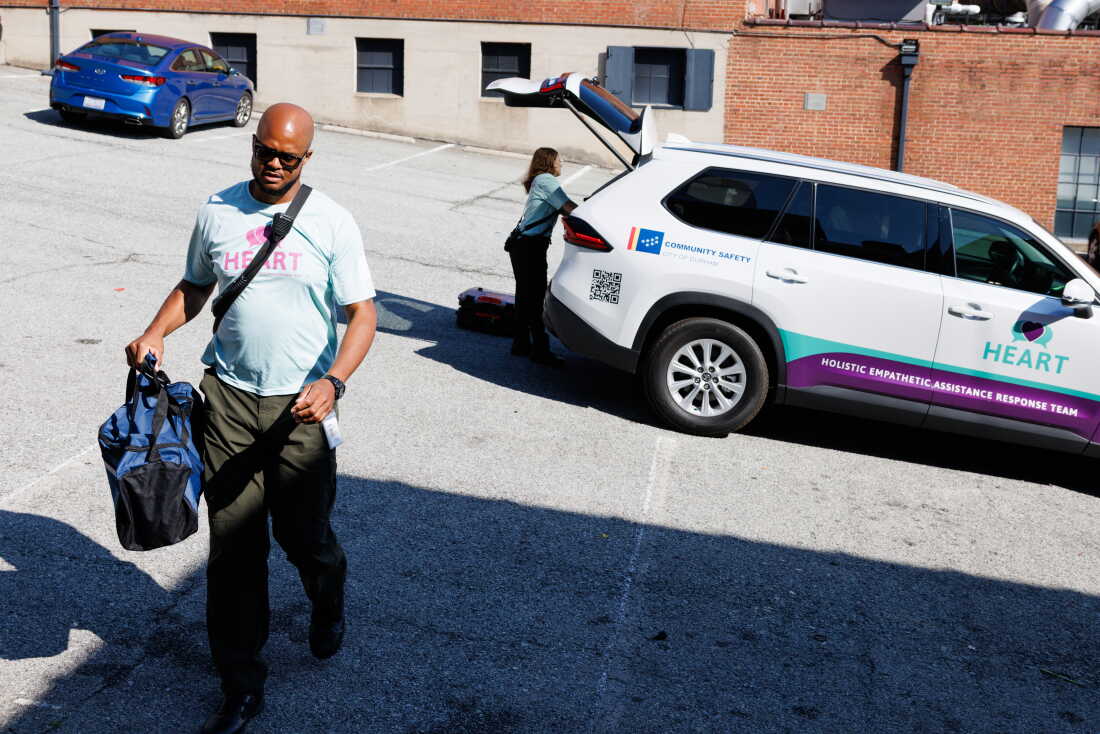
Rob Crisp, a peer support specialist with the Holistic Empathetic Assistance Response Team (HEART) program, responds to a call for a wellness check at a parking lot in Durham, N.C., on Sept. 14.
Cornell Watson for NPR
hide caption
toggle caption
Cornell Watson for NPR
On a recent Wednesday in Durham, N.C., Rob Crisp and Allie Craft were on a mission, equipped with snacks, bottled water and hygiene kits. They are part of Durham’s unarmed community response team, and they were looking for a man someone called 911 about.
“Our notes say we got a trespasser on a business property. He has a bunch of belongings, and he’s refusing to leave,” Crisp said.
In a parking lot on the side of a strip mall, they found the man, wearing a McDonald’s T-shirt and a backward baseball cap and toting several full garbage bags and a sofa with him. Crisp approached the man, who looked tense. He said he didn’t want anyone to touch his things.
Crisp, a peer support specialist who has struggled with drug addiction in the past, took his time talking with him.
“I can relate to not having anything,” Crisp later told NPR. After a few minutes, he calmed the man down.
“I was like, ‘We’re not trying to bother you, but hey, we do have some supplies while we are here. Is it all right if we get you a bag together?’ Little things like that to say, ‘Hey, I don’t have a gun. I don’t have a badge. I’m here because I feel for you, brother,'” Crisp said.
Crisp and Craft, a mental health clinician, gave the man water and a fresh pair of socks. They convinced him to haul his things off the property and onto a nearby vacant lot. It was not a long-term solution, but it resolved the immediate conflict.
Just five years ago, police would have most likely been dispatched to respond to this 911 call.
But since the police killing of George Floyd in 2020, dozens of cities around the United States have made the same calculation: that calls like this don’t always need an armed officer.
In 2020, there were only six programs in the U.S. that sent unarmed responders, such as mental health clinicians, to certain 911 calls instead of police officers. Now, these programs — sometimes called alternative or community response — are in nearly 100 cities.
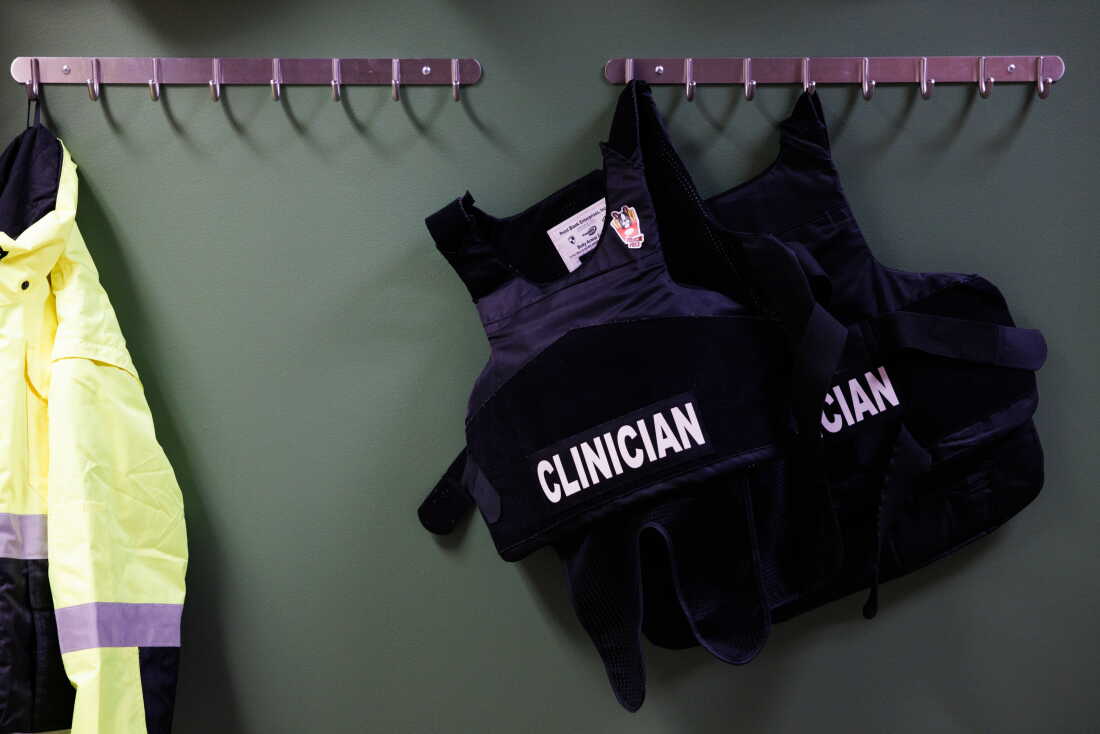
Bulletproof vests for HEART program responders hang inside the office on Sept. 10.
Cornell Watson for NPR
hide caption
toggle caption
Cornell Watson for NPR
“They’re not police officers, but they are a part of the public safety net”
Durham’s program — the Holistic Empathetic Assistance Response Team (HEART) — launched in 2022 and has since responded to more than 25,000 911 calls.
The community response team now operates citywide. The program also has a limited co-response team, in which mental health clinicians are paired with a police officer on patrol, as well as a mental health clinician embedded in the city’s 911 call center.
“Honestly, I would say if you can send a social worker to a call that you could send a law enforcement officer and you got the same results, then it’s already a success,” says Ryan Smith, director of the Durham Community Safety Department, which runs the program.
Recent research suggests Durham is seeing signs of success: A preliminary study from researchers at Duke University last year found that the program has increased 911 calls, a potential sign of growing public trust.
A study this year by the Research Triangle Institute (RTI) found that the city’s program is also associated with fewer arrests, that most police officers find it helpful and that police are rarely called for backup.
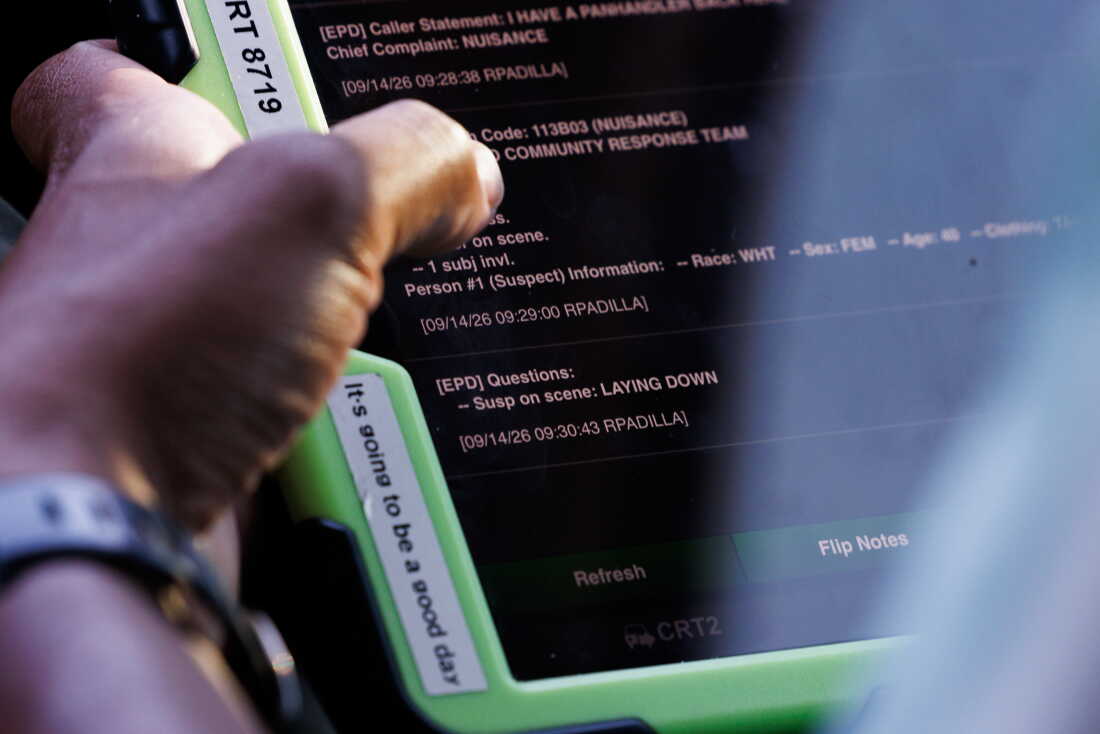
Crisp, of the HEART program, reads dispatch notes for a person accused of trespassing at a business.
Cornell Watson for NPR
hide caption
toggle caption
Cornell Watson for NPR
Elsewhere, other community response programs have also been studied. A 2022 Stanford University study of a program in Denver found evidence that it reduced reports of certain crimes by more than a third. A 2025 study found that a program in Eugene, Ore., reduced the likelihood of a 911 call resulting in an arrest and increased access to medical care.
Still, relatively few of these programs nationwide have been studied, and they’re not always an easy sell.
In Durham, Patrice Andrews, the city’s former chief of police until earlier this year, helped launch HEART. She says at the time, police officers in the city had concerns, even though many agreed that they were not always needed at a 911 call and that forgoing certain calls could potentially free them up to investigate other crimes.
“Their heartburn was, “OK, are we going to have to protect these people that are unarmed? They don’t have the knowledge that we have with law enforcement tactics,'” she says. “And then there was the political side of it — that this was this ultra-uber-liberal idea being pushed down our throats. This was ‘They’re not backing the blue.'”
Over time, Andrews says, police officers began to accept the program as a fourth and equal wing of 911 response, alongside police, fire and emergency medical services. It helped, she says, that police and HEART are on the same radio channel for dispatch: Police officers can hear the unarmed responders, and vice versa.
“That allowed our staff to be able to see that they are a part of the public safety team. They’re not police officers, but they are a part of the public safety net,” Andrews says.
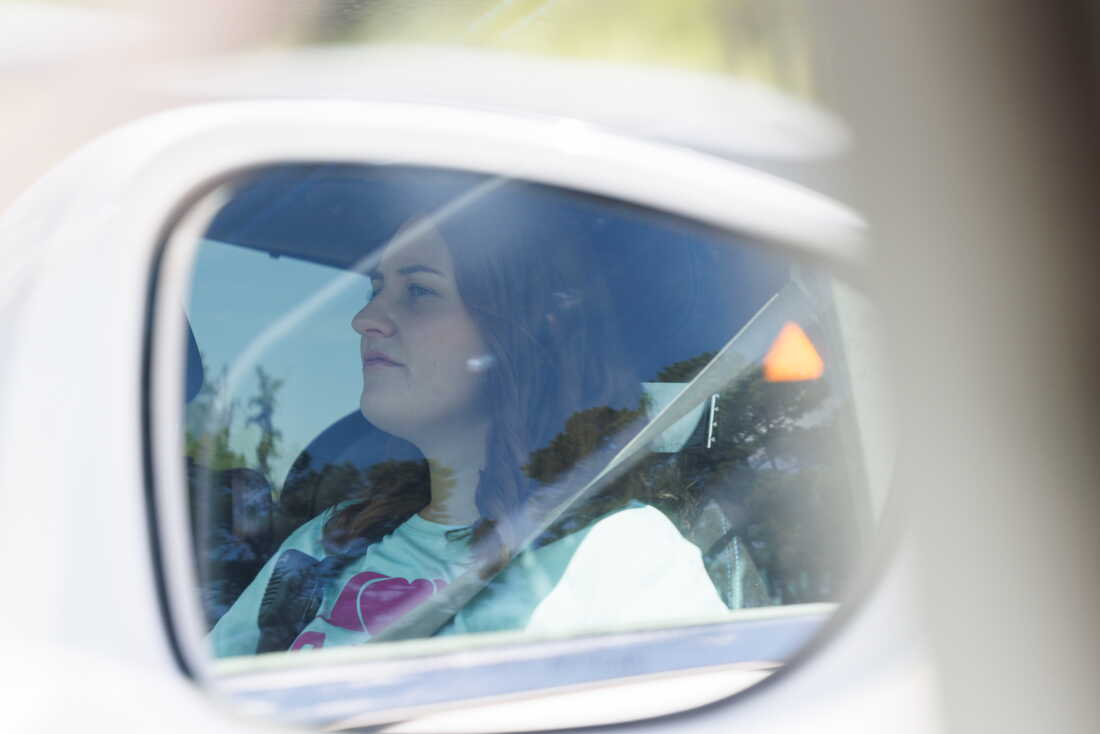
Allie Craft, a mental health clinician with the HEART program, rides to a dispatch call.
Cornell Watson for NPR
hide caption
toggle caption
Cornell Watson for NPR
How many 911 calls can an alternative response program handle?
In some cities, fatal police shootings in recent years have revealed the limitations of their alternative response programs.
In New York City, for instance, the 2024 fatal police shooting of Win Rozario, who was experiencing a mental health crisis, raised questions as to whether its program was answering as many calls as it could. According to a 2025 audit by the Office of the New York City Comptroller, the majority of the city did not have access to the city’s program.
In Baltimore, an investigation by The Baltimore Sun after the 2025 police killing of Pytorcarcha Brooks, who also was suffering from a mental health crisis, found that the number of 911 calls diverted to mental health services had fallen by more than 50% in recent years, even as the total number of mental health calls had surged. The city is now considering modeling its program after Durham’s.
One way to measure success is to assess how many 911 calls a program is handling per capita, says Amos Irwin, who studies community response programs at the Law Enforcement Action Partnership (LEAP), a criminal justice reform nonprofit. Durham HEART, for instance, handles around 28 calls per 1,000 residents according to LEAP, which ranks the city in its top 10 U.S. programs by call volume.
“It is the easiest data point to get and to compare programs,” Irwin says. “It’s a shortcut. It doesn’t tell you the quality and whether they manage to make a long-term difference in the lives of the people that they served.”
But researchers also caution that because almost all of these programs are just a few years old, it’s hard to say what the ceiling is in terms of how many 911 calls they could safely take or what a good goal would even be.
“Many of us are still trying to figure that number out, but we anticipate it’s far more than what any city is handling at this point,” says Mariela Ruiz-Angel, director of community safety initiatives at Georgetown Law’s Center for Innovations in Community Safety.
One limitation some programs face, Irwin says, is that they simply are not funded enough to answer a higher number of calls. Another point of failure, he says, is when community response teams are authorized to respond to only clear-cut mental health crises.
“There are all kinds of calls that responders can handle that do not have mental health on the surface,” he says. “No one calls and says somebody is in a mental health crisis. They call and say there’s somebody panhandling really aggressively here. There is somebody loitering around my store, refusing to leave.”
In Durham, before the HEART program even began, the city, in partnership with RTI, analyzed three years of 911 data. They also held conversations with community members, other first responders and other similar community response programs across the country.
The city zeroed in on which types of calls rarely ended in violence. Those included certain mental health crises but also things like trespassing, panhandling, intoxication, indecency and welfare checks. Those 911 call types became the ones that HEART responds to. Irwin says all the leading programs are handling calls like that.
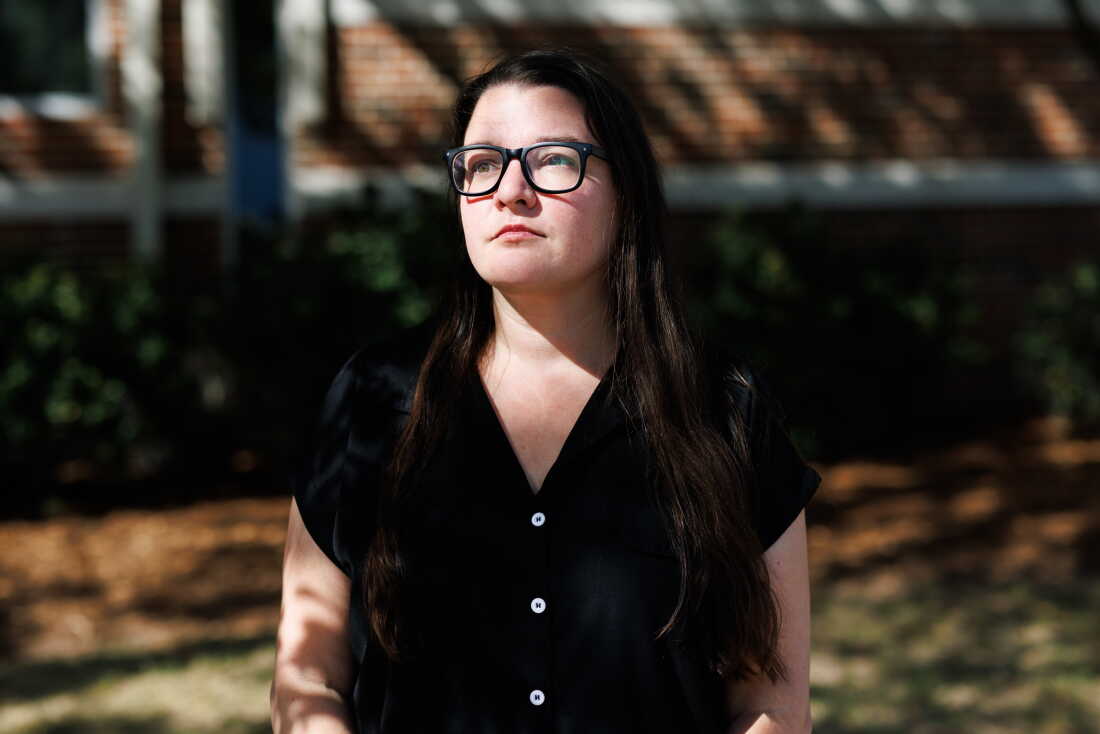
Leigh Mazur, with the Durham Community Safety Department, stands for a portrait outside the building where the HEART program operates.
Cornell Watson for NPR
hide caption
toggle caption
Cornell Watson for NPR
Leigh Mazur, an assistant director in the Durham Community Safety Department, says the decision for whom to send to a call cannot be subjective. When it is, she says, a 911 dispatcher is “more often than not going to — of course and understandably — err on the side of caution and likely send the police to calls that they didn’t necessarily have to send them to.”

“Why aren’t you fixing homelessness?”
On another recent call in Durham, Rob Crisp and Allie Craft, the two HEART responders, handled a dispute involving a mother and adult daughter who called 911 on each other. Brittney, the daughter, didn’t want to use her last name so she could discuss her family situation more freely.
When HEART arrived on scene, Brittney told Crisp and Craft that she was hoping HEART could help her find new housing, because she didn’t feel safe or comfortable where she was currently living. As Brittney listened from the back seat of the van, the HEART responders told her that the only housing immediately available was a homeless shelter. Brittney declined.
Calls about housing are common, Craft later told NPR, and it can feel frustrating that there aren’t more options. Ruiz-Angel, the Georgetown researcher, says this is a frequent limitation for programs across the country.
“People are constantly like, ‘Why aren’t you fixing homelessness?’ And I will say that in 2020, that was not the call to action. The call to action was ‘We don’t want another George Floyd situation to happen,'” she says.
Ruiz-Angel founded the community response program in Albuquerque, N.M. Very quickly, she says the team realized many of the people they encountered did not have their basic needs met.
Every community response program, she says, eventually faces a choice: Should it stay in a narrow lane, answering 911 calls and managing immediate crises, or should it try to tackle the deep-seated causes of those crises, like homelessness?
“They all come down to poverty issues, and there’s just not enough resources at this point. There’s not enough housing. There’s not enough everything out there,” she says.
Durham is choosing that more ambitious path: The city launched a division last year within the Durham Community Safety Department called Stabilization Services.
“The aim of the 911 response is to de-escalate the situation and leave everybody in a somewhat stable place. That does not mean that whoever’s left there has a connection to the right resources,” says Anise Vance, the leader of the city’s new initiative.
His aim now, he says, is to connect people with resources — to offer them a deeper, more systemic path after the initial moment of crisis has passed.
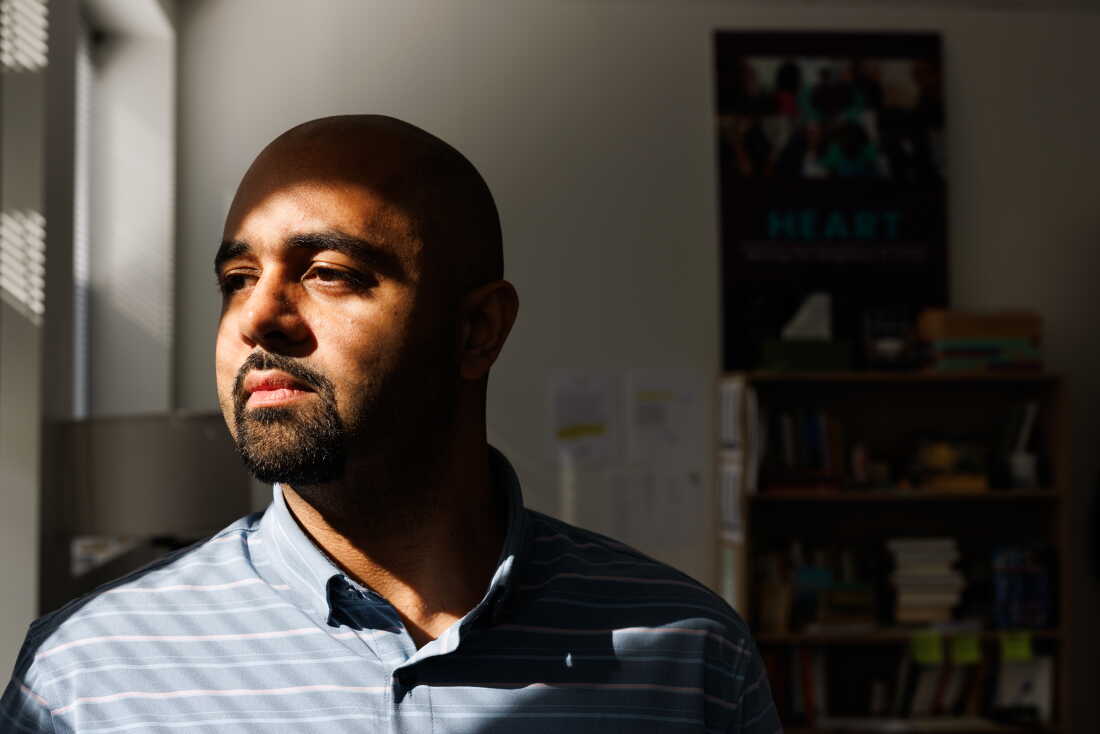
Anise Vance, with the Durham Community Safety Department, sits for a portrait in his office where the HEART program operates.
Cornell Watson for NPR
hide caption
toggle caption
Cornell Watson for NPR
“Those services have to include some of the basic things in life. They have to include housing. They have to include medical care. They have to include behavioral health care. They have to include food. Those are all key ingredients,” Vance says.
It’s too early to say whether it will be a success. But the idea is that, over time, fewer 911 callers will need a team like HEART in the first place.
