


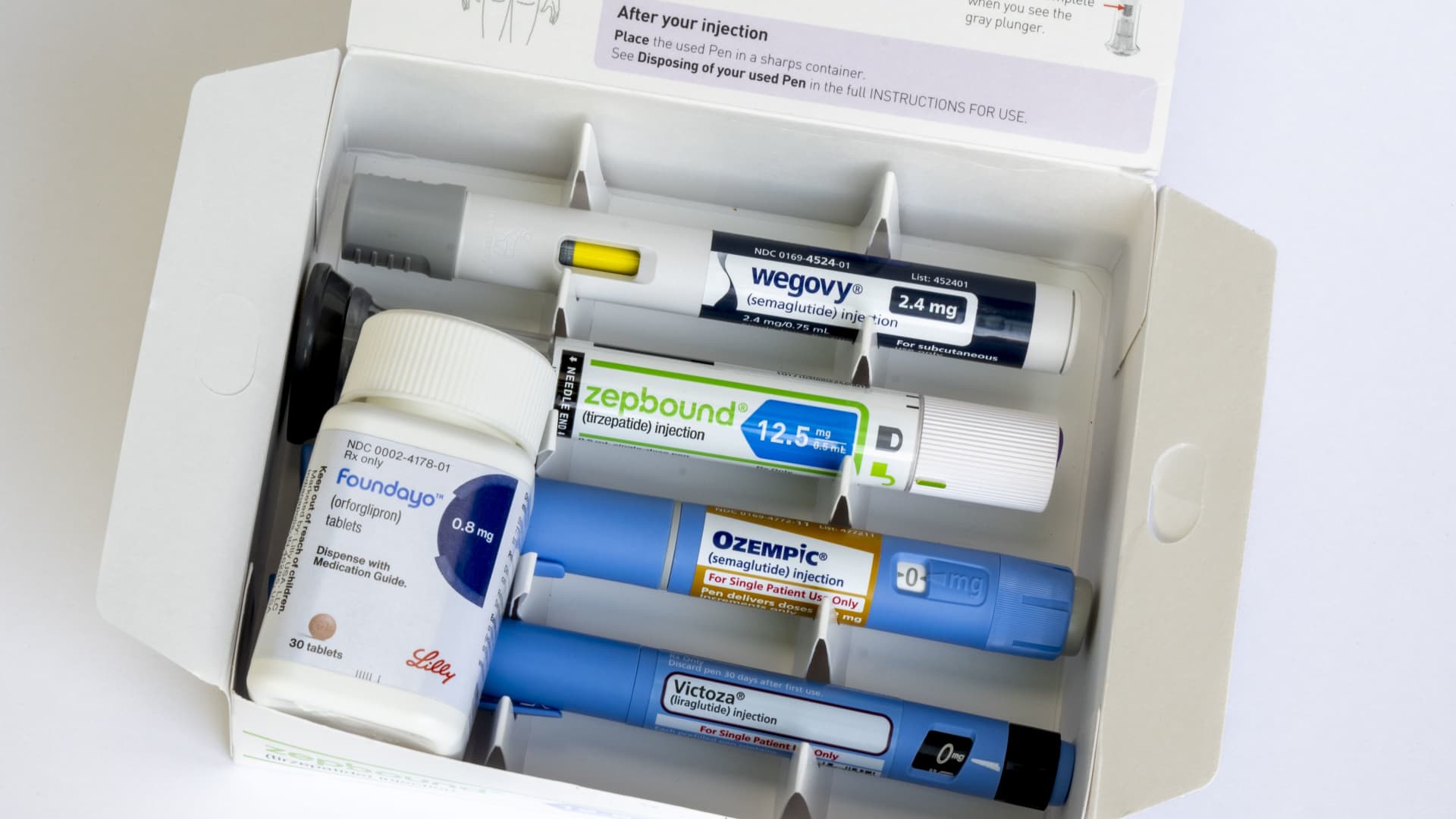
Photo illustration of a group of weight loss medications on a white background.
Ucg | Universal Images Group | Getty Images
Novo Nordisk on Tuesday filed a lawsuit against Eli Lilly, alleging that its advertising campaigns for its blockbuster obesity and diabetes drugs are designed to mislead consumers about their superior efficacy relative to the Danish drugmaker’s rival injections.
Novo is specifically taking issue with nationwide ads that cite what it called “outdated” clinical trials to compare the highest doses of Lilly’s medicines to lower doses of Novo’s drugs. For example, those campaigns don’t include new evidence about Novo’s recently approved high-dose version of its obesity injection, Wegovy, which entered the market in March and brings weight loss that’s more comparable to Lilly’s products.
That “leaves them with the inevitable conclusion that Lilly’s medicines are superior to Novo’s, and that’s not accurate,” said John Kuckelman, Novo’s group general counsel, in an interview on Monday. He said the suit comes after Lilly refused to pull down or correct certain ads despite a formal cease-and-desist request from Novo back in April.
In the suit filed in the U.S. District Court for the District of New Jersey, Novo asked the court to permanently stop Lilly from running the ads and require the drugmaker to issue corrective advertising. Novo is also seeking financial damages, though it’s unclear how much. The company said it has also warned Lilly that if the ads are not removed voluntarily, it plans to seek a preliminary injunction in the coming days to block them immediately while the case proceeds.
Lilly did not immediately respond to a request for comment.
The suit comes as Novo wages an aggressive battle against Lilly to regain market share in the GLP-1 space, positioning its new obesity pill, strategic price cuts and the new high-dose Wegovy to compete with its rival’s top-selling obesity injection Zepbound and diabetes counterpart Mounjaro.
In recent years, Lilly’s medications have become the preferred treatments in the space among many providers and patients due to their high efficacy. But high-dose Wegovy, which showed an average weight loss of around 19%, is a direct answer to that.
Issues with ‘outdated’ trials
Novo said it is specifically bringing federal and state unfair competition and false advertising claims, including under the Lanham Act, which pharmaceutical companies have relied on in the past to hold competitors accountable for deceptive advertising.
The suit alleges that Lilly’s campaigns across television and social media are harmful because consumers often rely on advertising to form their understanding of GLP-1s, unlike healthcare professionals, who have access to the full scientific evidence available.
“Lilly’s advertising campaign deprives consumers of the truthful, current, and complete information they need to make informed decisions about their available treatment options,” the suit said.
The lawsuit cites a TV commercial presenting Zepbound and Wegovy in a direct side-by-side comparison, stating visually and verbally that patients on Lilly’s drug lose 50 pounds on average compared to 33 pounds on the 2.4-milligram dose of Novo’s treatment. That’s based on a previous head-to-head clinical trial comparing the highest doses of Zepbound to the 1.7- and 2.4-milligram doses of Wegovy.
But Novo said in the suit that a more recent study shows that the high-dose 7.2-milligram dose of Wegovy helped patients lose 47 pounds on average, which is “clinically consistent” with Zepbound’s weight loss in Lilly’s most recent rigorous trial on the drug.
Novo said Lilly acknowledges the existence of that high-dose Wegovy in a “small footnote,” but called it “ambiguous, confusing, virtually illegible, and wholly inadequate,” as it does not communicate that it is significantly more effective than the lower doses of the drug.
In the suit, Novo added that no head-to-head trials have compared the highest doses of Wegovy and Zepbound currently available on the market, so Lilly has “no basis to make these comparative claims” that its drugs are more effective.
“While it may have been accurate to say that before 7.2 milligrams became available for Wegovy, it is no longer accurate to say that,” said Kuckelman. “They have, we think, a legal obligation, but even more important, they have a responsibility to patients to share accurate information.”
The suit added that the Zepbound TV commercial has received more than 700 million impressions since it began airing around the end of April, which demonstrates the scale of the competitive harm to Novo.
The suit alleges that Lilly takes the same approach when comparing the efficacy of Mounjaro and Ozempic in its ads, withholding new data on a higher dose of Novo’s drug that was approved more than four years ago.
“We feel that we have a very strong case here that we can show that Lily has indeed misled consumers with the advertising,” Kuckelman said.
