


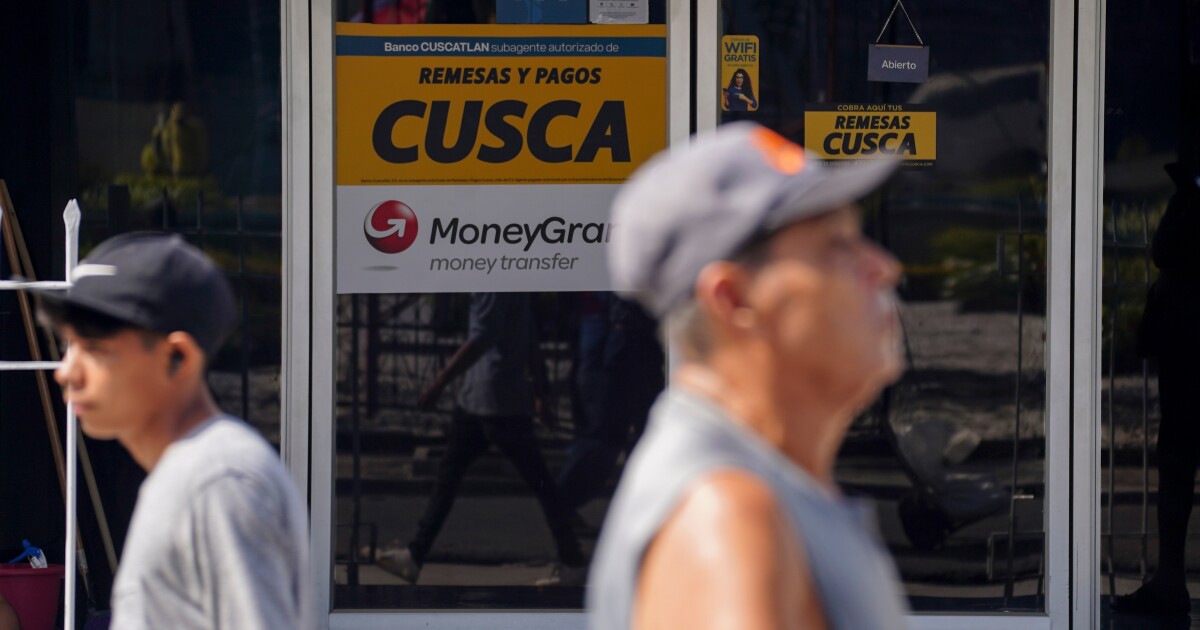
A Republican proposal to tax remittances would deliver an economic blow to some of the U.S.’s poorest neighbors, including a close ally of President Donald Trump.
The bill, presented to the House of Representatives last week, would levy a 5% tax on remittances for noncitizens and foreign nationals. That’s on top of a roughly 5% to 10% fee already charged on the payments by senders like Western Union Co. and MoneyGram International Inc., services migrants in the U.S. use to send money to family members back home.
The tax would directly hit payments that represent about one-fifth of the gross domestic product of El Salvador, where President Nayib Bukele has formed a strong alliance with the Trump administration by accepting deportees to be imprisoned. Honduras, which hosts a U.S. military base that has facilitated deportations to Venezuela, gets a similar proportion of remittances to the size of its economy, and Guatemala isn’t far behind.
A MoneyGram transfer location in San Salvador, El Salvador.
“It’s not good news for those who receive remittances,” said Carlos Acevedo, former central bank chief for El Salvador. “It might have a negative impact on economic growth.”
Migrants from El Salvador, Guatemala and Honduras sent home record amounts of remittances last year, helping drive economic growth across Central America. Remittance flows have surged since Trump took office in January as migrants increase the amount of money they send home in anticipation of being deported.
The funds are used largely for consumption by poorer families who often have few other sources of income. Mexico and Central America are the world’s most dependent areas for remittances sent from the U.S.
“The effect isn’t just macroeconomic, it’s at a microeconomic level too, affecting families,” Guatemala Central Bank chief Alvaro Gonzalez Ricci said in a written response to questions. “The importance of remittances to the Guatemalan economy is growing, not just as a proportion of GDP, but also because the flows of millions of dollars boosts family consumption.”
Gonzalez Ricci said migrants in the U.S. would likely absorb the additional tax, minimizing disruption to the inflows to Guatemala. Some states, especially those with sanctuary cities, will likely oppose the measure, he said.
However, Manuel Orozco, who researches remittances at the Inter-American Dialogue, a Washington-based think tank, estimates that the proposed tax could lead to a 10% decline in volume of remittances sent and number of transactions.
“That’s very conservative — in other words, it’s your best-case scenario,” he said. “If this were to happen, I can see lots of people going crypto and other people relying on relatives that are U.S. citizens to send money for them.”
Mexican Foreign Affairs Minister Juan Ramon de la Fuente said the government would mount a legal and political defense to stop the plan, while the country’s Ambassador to the U.S. Esteban Moctezuma Barragan urged House representatives to reject the bill in a letter sent May 13. The proposal would mean double taxation of migrant workers who already pay income taxes in the U.S. Mexicans living and working in the U.S. paid $121 billion in taxes in 2021, the ambassador said.
“Imposing a tax on these transfers would disproportionately affect those with the least, without accounting for their ability to pay,” Barragan wrote. “The workers referenced in this bill migrated out of necessity and now contribute substantially to the U.S. economy. We respectfully urge you to reconsider.”
Representatives for the governments of El Salvador and Honduras didn’t reply to requests for comment on the tax proposal.
A trade group of digital payment firms — the Electronic Transactions Association — also urged lawmakers to rethink the proposal. The tax would affect unbanked populations who rely on cross-border transfers as lifelines and could force consumers to send money through unregulated channels, they wrote in a letter on May 8.
“These services are not luxuries — they are essential tools for paying bills, supporting family members abroad and managing daily finances,” the group wrote. “A tax on remittances effectively penalizes those who can least afford it.”
It’s not the first time Trump has taken aim at remittances. During his first term, his administration proposed a similar tax, but it was never implemented because of legal and technical difficulties to discriminate between trade-related and worker outflows, Barclays analysts Gabriel Casillas and Nestor Rodriguez wrote in a note on May 14.
Oklahoma is the sole state in the U.S. that has implemented a similar policy: a $5 fee on any wire transfer under $500 and 1% on any amount in excess of $500, passed in 2009. In the first year after it was put in place, the state brought in $5.7 million via the rule; that’s climbed to $13.2 million in the most recent fiscal year.
The renewed push for the tax, if approved, could lead to currency depreciations in countries like Guatemala, Honduras and Mexico. But remittances have been resilient even amid recent threats like the COVID-19 pandemic and “such a tax would be a one-time hit rather than a structural change on remittances,” the Barclays analysts wrote.
