


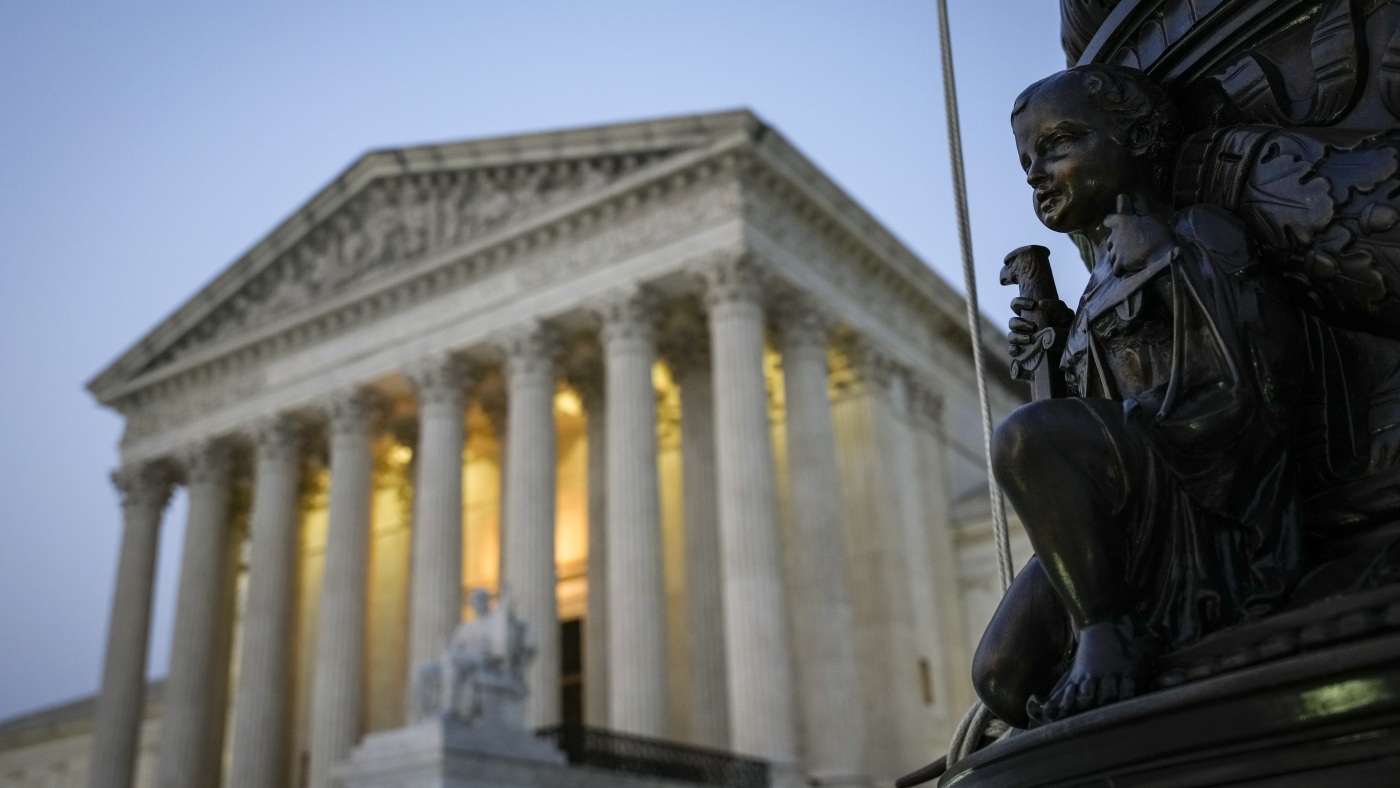

The U.S. Supreme Court
Drew Angerer/Getty Images
hide caption
toggle caption
Drew Angerer/Getty Images
The Supreme Court on Friday allowed the Trump administration to temporarily pause a humanitarian program that has allowed nearly half a million people from Cuba, Haiti, Nicaragua and Venezuela to enter the U.S. and remain here legally for two years.
The move to grant a stay in the case means that the Cubans, Haitian, Nicaraguans and Venezuelans who were granted temporary parole under the program known as CHNV would lose their temporary legal status to be in the U.S.
The court did not give a reason in its brief order. But in a length dissent from Justice Jackson, with Justice Sotomayor joining, Jackson wrote that the court “has plainly botched this assessment today” in causing irreparable harm for everyone admitted under the program.
“It undervalues the devastating consequences of allowing the Government to precipitously upend the lives and livelihoods of nearly half a million noncitizens while their legal claims are pending,” Jackson wrote in the dissent.
The program, put in place by the Biden Administration in 2021, and then again in 2023, has allowed individuals from the four countries to enter the U.S. temporarily for humanitarian reasons, usually because conditions in their home country pose a threat to their safety.
The federal law authorizing such humanitarian “parole” dates back to the 1952 Immigration and Nationality Act. It was first used to provide temporary entry for some 30,000 Hungarians fleeing their country after a failed attempt at overturning Soviet rule and a crackdown that followed. In the decades since then, every administration, including the first Trump administration, has used the parole program to meet some emergency immigration need, allowing individuals who have been screened and approved, to enter the U.S. if they have a U.S. sponsor willing to provide financial and other support. Individuals granted such temporary status can, once here, apply for asylum or some other more permanent status.
The Cuba, Haiti, Nicaragua and Venezuela parole program, known as the CHNV program, is similar to programs created in the wake of the Russian invasion of Ukraine when some 200,000 people were granted temporary parole, and the U.S. military withdrawal from Afghanistan, when more than 76,000 Afghanis fled, many of them people who worked to assist U.S. forces there. So far, the Trump administration has not tried to end the Ukraine programs, but it has terminated the Afghan program, effective July 14.
President Trump, however, on the day he took office signed an executive order directing the Department of Homeland Security to end “all categorical parole programs.” In March, DHS Secretary Kristi Noem formally announced the termination of the CHNV parole process, declaring that it was being terminated immediately, and that the cessation would apply to all people currently enrolled in the program. It was the first en masse termination of such a program on record. Noem’s order said that the interests of the parolees, and their reliance on the government’s promise of protection for two years, were outweighed by the government’s “strong interest” in deporting them through expedited removal, rather than normal removal proceedings under the Immigration and Nationality Act.
A group of individuals whose temporary protection had been guaranteed for two years, and their sponsors, challenged Noem’s order in court, and a federal district court judge in Massachusetts ruled in their favor. Judge Indira Talwani said that the secretary had erred in seeking to expedite removal of individuals who still had time left on their promised two-year protection in the U.S. The judge also said that the secretary’s en masse ending of the two-year term violated the statutory requirement that parole be determined only on a case-by-case basis. For these and other reasons, the judge ordered DHS to pause the truncation of all the existing CHNV paroles pending further review.
The First Circuit Court of Appeals refused to immediately intervene, but directed the government to seek expedited appeal on the merits of the case if it wished to. Instead, however, the government appealed directly to the Supreme Court seeking reversal of the district court order.
It argued that the secretary’s decision to truncate the two-year term set out by the Biden administration is not reviewable by the courts. It contended that nothing in the statute requires a case-by-case treatment of parolees, and that requiring such a case-by-case termination would be extremely burdensome for the government. Indeed, the government contended that all it was doing was modifying the two-year term extended by the Biden administration and in its place putting a shorter term of protected status. Finally, the government argued that actions related to the parole program are not reviewable by the courts.
