


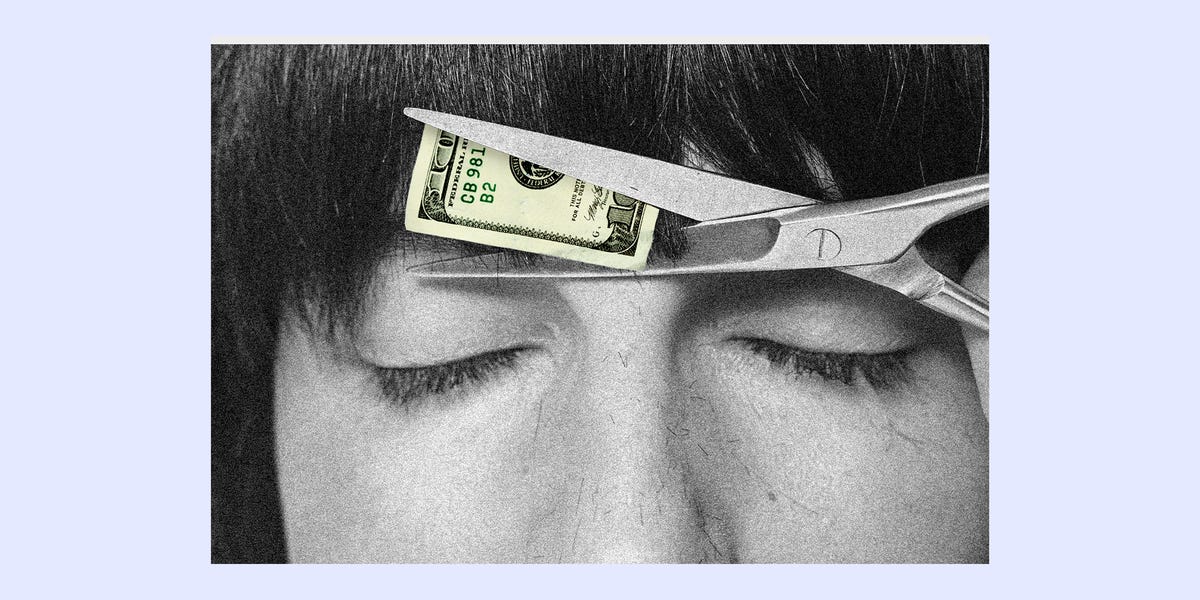
One of the things they don’t tell you about getting bangs is that they require a lot of upkeep. And unless you dare to cut them yourself, it’s a pricey endeavor — even pricier when, in my case, said upkeep comes with a hefty fee.
I finally got bangs a couple of years ago, much to my mother’s delight. (She has long lamented the size of my forehead even though it’s half her fault). Because I don’t yet trust myself with scissors, I go to a professional, accompanied by a crippling fear that they’ll cut them too short and I’ll wind up looking like Courteney Cox in “Scream 3.”
A couple of months ago, I looked in the mirror and determined it was that time again, so I decided to do some price comparison. The salon near my office was $40, so I opted for Hair & Co BKLYN, whose advertised price was just $20. On the walk from the subway to the Brooklyn-based salon, I filled out a form in a link they sent via text message to “ensure the best experience before your visit” without really reading it. It was already too late to avoid the cancellation fee, and who scrutinizes these things anyway?
When I went to pay at the end of my appointment, I noticed an extra $8 charge had been tacked on to the advertised price. A stylist described it as an “environmental service fee” that should have been in an initial email confirming my appointment. She agreed to waive it that time only, which I appreciated, though I was embarrassed. I write about these types of hidden fees all the time, shouldn’t I have noticed?
I went through my communications from Hair & Co to see where I’d missed mention of it. I couldn’t find anything in the body of any emails or texts, and the link to that long form they’d sent over no longer worked. Down the rabbit hole I went.
Surcharges like this are rampant across the economy. Americans spend more than $90 billion on so-called “junk fees” each year, according to one estimate. They are increasingly common in concert tickets, hotels, banking, telecommunications, flights, food delivery, car rentals, and more. Consumers are suffering from a “service fee” epidemic where it’s often unclear what the actual service is.
Ultimately, the main driver behind drip pricing and fee stacking is that it works.
Some companies tell you about fees up front and include them in the total price, either because they want to be transparent or because they have to. In 2025, the Federal Trade Commission implemented a rule requiring ticketing and hospitality platforms such as Ticketmaster, StubHub, and Airbnb to use “all-in pricing.” They now have to disclose the entire cost of what they’re selling, add-ons and all, right off the bat. California has a law requiring all businesses there to do the same, though restaurants are exempt.
Many businesses, however, can be sneakier with fees. They list them in the fine print, partition them out, or hit people with them late in the purchasing process. That latter technique is known as “drip pricing,” in which companies draw customers in with a low initial price and reveal additional charges later.
These types of less-than-transparent pricing practices and junk fees are becoming more commonplace for three reasons, explains Stanford economist Neale Mahoney. First is the diffusion of revenue-maximizing strategies across businesses and industries — just as companies learn consumer-friendly tactics from each other, they also pick up less-friendly ones. Second is the rise of online shopping, which creates more opportunities to add fees. Third is inflation: The cost of everything is up, and surcharges are a way for businesses to keep pace with their costs (or exceed them). In the meantime, “the laws have not caught up,” Mahoney says.
Ultimately, the main driver behind drip pricing and fee stacking is that it works. Research shows that people buy more and spend more when fees are shown at the end of a purchase compared to when they see the total cost right away.
Incremental disclosure makes price comparison more difficult for consumers, so it’s hard to know if they’re getting a good deal. Markets work best when people can easily evaluate the price and quality of different options. But when learning the true cost requires multiple steps, it “throws sand in the gears,” Mahoney says.
And when people finally do see the total price at the end of their shopping journey, they’re hesitant to abandon the purchase.
“We think it’d be such a hassle to start all over again, and we overestimate how much effort it would be,” says Vicki Morwitz, a marketing professor at Columbia University’s business school. “We also underestimate the benefits of starting over again.”
Hair & Co’s environmental service fee did not appear in my email inbox, as the salon’s stylist had suggested, nor did it appear anywhere prominently in the online booking process. (Its cancellation policy, however, did.) After clicking around the website for a while, I found a mention of the fee in question by hovering over the “services” section, clicking on “policies,” and then scrolling halfway down. It was placed right above the section on transparent pricing.
The page attributed Hair & Co’s fee to its status as a “proud member” of Green Circle Salons, a sustainability program that says it helps beauty businesses recover and recycle waste. Green Circle’s website was pretty clear that the point of this is part environmental friendliness, part profit. “Most salons turn sustainability into an additional revenue stream,” it reads. It has a little calculator for salon owners to estimate how much they can bring in through a “Green Fee.”
I could have stopped there, but I couldn’t find Hair & Co listed as one of Green Circle’s partner salons. Via email, Green Circle told me that Hair & Co was “part of our movement, but their program is currently paused.”
It was time to reach out to Hair & Co. as a confused customer. I asked the salon: Where was the fee conspicuously disclosed and what’s the fee going toward if the Green Circle program was on hold? The salon’s owner, Allyson Hurley, responded in a series of back-and-forths. Hair & Co had found a “better service” than Green Circle, she said, and the environmental service fee was charged to every client as a cost of doing business. She said it was all spelled out in the form I’d signed without reading, which is true. I can no longer access the original form I was sent, but I was later sent a copy. She noted I’d paid the fee before, which is also true. It was in 2024, and I didn’t notice it. She said that the fees were “everywhere” in the booking process, which was not my experience. I found the fee, but I had to dig for it.
Hurley told me that post-pandemic, her expenses had increased significantly, and folding in the fee “would make it too expensive.” She wanted to “keep it affordable,” she added.
But the service fee is mandatory, meaning it’s just part of the price. And that price is more expensive and less affordable for the customer. The salon could list a $28 trim and explain that $8 goes toward waste management, sustainability, or other operating costs. The question is why the first number customers see is $20. Right after my haircut, I left a couple of online reviews to warn other customers about the issue.
Price strategies like this depend on consumers like me moving through the economy on autopilot and being too lazy, tired, and/or busy to scrutinize how every single dollar is justified.
When I followed up a couple of months later to say I was working on a story, Hurley said the fees are a “necessary part of business” for a small operator in New York City and that Hair & Co is “one of the few salons with limited price increases,” adding that they offer benefits to employees.
Hair & Co isn’t an outlier in tacking on a mandatory fee or surcharge — it’s becoming an increasingly common practice in salons. One recent industry survey found that about one in four salons nationwide were sharing a “green fee” with clients that averaged $2.98.
There are a lot of should-haves for me in this equation. I should have read the form before signing it. I should have checked out the website more thoroughly. I should have noticed the other time I was charged the fee instead of assuming I was mistaken and not wanting to rock the boat over the equivalent cost of a semi-fancy coffee.
But that’s also what makes this whole thing so frustrating: Price strategies like this depend on consumers like me moving through the economy on autopilot and being too lazy, tired, and/or busy to scrutinize how every single dollar is justified. People don’t generally set out to reconstruct the true price of each purchase from the fine print, policy pages, and checkout screens. I wanted to get my stupid bangs trimmed and go home. Instead, I’m here, two months later, obsessing over $8. I realize this ordeal is a bit Kelly Clarkson-esque on my part.
These small potatoes can become pretty big, life-altering potatoes in different settings. A growing number of patients report being charged hospital “facility fees” for doctor visits, even though they never set foot in a hospital, resulting in hundreds of extra dollars in charges. In housing, renters across the country are encountering surprise surcharges they only realize they can’t afford once they’ve signed leases.
I reported the incident with Hair & Co to New York City’s Department of Consumer and Worker Protection the day it happened, but I haven’t heard back on my case. The city has a new rule in the works that would bar businesses from misrepresenting the nature, purpose, amount, or refundability. It would also require businesses to include fees in advertised prices and document what they’re for. That rule isn’t in place yet.
Since my visit, Hair & Co has scratched Green Circle Salons from its website. It now says its service fee — no longer specified as “environmental” — is attributable to its water-conserving showerheads and color management software. It has also increased the fee to $9.
Emily Stewart is a senior correspondent at Business Insider, writing about business and the economy.
Business Insider’s Discourse stories provide perspectives on the day’s most pressing issues, informed by analysis, reporting, and expertise.
