



National Guard soldiers block protesters during an ICE immigration raid at a cannabis farm on July 10 near Camarillo, California.
Mario Tama/Getty Images
hide caption
toggle caption
Mario Tama/Getty Images
CHICAGO — It’s a sunny October morning, and Yackson is waiting for a bus that will take him to meet his immigration attorney.
The Venezuelan, who NPR is identifying by his first name because of his immigration status, looks at a big, run-down apartment building in front of him. Earlier this month, it was raided by Immigration and Customs Enforcement agents who landed a helicopter on the roof, and arrested more than 30 people.
Yackson, 39, says he’s terrified. Besides this raid, he’s also heard about the possibility of National Guard troops deploying here, something a federal court has put on hold for now. The father of three lives in this neighborhood and he’s been scared to leave his house.
“We already don’t know who is grabbing us, whether it’s ICE or whether it’s people who disguise themselves as ICE,” Yackson says in Spanish. “With the National Guard, it’s going to be even harder, scarier.”
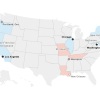
In several cities across the country facing National Guard deployments, NPR has heard similar sentiment.
“The government isn’t exactly doing a great job of proactively delineating this person is National Guard who isn’t allowed to arrest immigrants, and this person is an ICE agent or an FBI agent who is,” says Dara Lind a senior fellow at the American Immigration Council, noting that many times federal agents are in military-style gear, or masked, or not clearly marked.
She says this makes it hard to look at patrols on the street and figure out who is legally authorized to engage in law enforcement activities or not.
Under U.S. law, the National Guard and other military personnel can’t make arrests. But experts worry that the pattern of their deployments, alongside increased federal immigration raids and operations, has allowed for violent crime and illegal immigration to be conflated into a single crisis.

National Guard officers at an anti-ICE protest in Downtown Los Angeles on June 12.
Benjamin Hanson/AFP via Getty
hide caption
toggle caption
Benjamin Hanson/AFP via Getty
The Guard’s actual role in immigration enforcement in these deployments remains unclear.
In September, the Trump administration announced a widespread ICE operation in Illinois called Operation Midway Blitz, saying it was needed to fight crime by undocumented immigrants. It came after Trump had been pressuring Democratic Illinois Governor JB Pritzker to deploy the state National Guard for the same reason, but Pritzker refused.
After weeks of fighting between the two, Trump federalized the Illinois National Guard – a highly unusual move — and worked with Republican Texas Governor Greg Abbott to send hundreds of his state’s Guard to Illinois.
Part of Trump’s continued rhetoric
Trump has been conflating crime and illegal immigration since he first emerged on the political scene. It’s something that has proved popular with his base — and helped garner support for his unprecedented crackdown on immigrants.
The net has swept up people living in the country illegally along with U.S. residents, people with visas, or those granted humanitarian parole.

The White House regularly characterizes undocumented immigrants as drivers of urban lawlessness, even though the data show that is not true. Officials at the Department of Homeland Security and the White House constantly refer to ICE actions as only targeting “the worst of the worst,” a talking point that isn’t supported by the arrest data.
“This is really, really core to the administration’s immigration policy. They toggle between ‘we’re only going after these really, really bad criminals,’ and ‘we’re deporting everybody who’s in the country without authorization,'” says Lind. “They get to play that two-step because there’s this bigger body of fears that they’re playing into about urban areas as unsafe, as unruly, about there being some kind of unrest, and about protests being always akin to riots.”
Trump has deployed the National Guard in five Democratic-led cities so far — often over the objections of state and local leaders — claiming troops are needed to control crime and lawlessness, although data show that violent crime in many of those places has decreased in recent years.
Some of those deployments — like in Chicago and Portland, Ore. — have been blocked by the courts and are making their way through a federal appeals process. But others are ongoing, like in Washington, D.C., and Memphis.

These deployments have coincided with increased immigration raids which have, in effect, blurred the lines between traditional law enforcement, immigration enforcement and the role of the National Guard.
In June, Trump federalized California’s National Guard — against Democratic Governor Gavin Newsom’s wishes – and sent in members of the U.S. Marine Corps to quell protests in Los Angeles in response to increased immigration and deportation raids in the city.
There, protesters confined to an area of downtown Los Angeles clashed with federal agents. And ICE often launched raids at Home Depot stores and other locations across the city.
A federal judge in California later ruled that the National Guard troops were being used illegally there, violating the Posse Comitatus Act, a 19th-century law that bars the use of federal troops for domestic policing, except when “expressly authorized by the Constitution or Act of Congress.” Trump appealed that ruling, and a hearing is expected later this month.
Trump has also deployed troops to guard federal agents who are carrying out immigration enforcement operations.

In August, Trump sent National Guard troops into Washington, D.C., a unique place where Trump has the legal authority to do so, along with a flood of federal law enforcement agents, including ICE, which has carried out a sizable chunk of the arrests.
The next month, Trump announced a similar operation in Memphis — with the support of Republican Governor Bill Lee, who approved the use of Tennessee National Guard troops.
The deployment started at the end of September and is ongoing. The operation also includes officials from more than a dozen federal agencies, including ICE, and has led to more than 800 arrests, according to the Department of Justice.
While the DOJ has not released a breakdown of that data, Shelby County Mayor Lee Harris, who has been critical of the federal intervention, noted at a press conference this week that immigration offenses made up a significant portion of the arrests.
Immigration and National Guard deployments are “deeply intertwined”
In Illinois, Texas National Guard troops were briefly stationed at an ICE facility outside of Chicago, before their deployment was temporarily blocked. In D.C., troops have mainly been cleaning up streets and guarding federal buildings. In Memphis, they’ve been seen accompanying local law enforcement.
But legal experts say there’s a clear connection developing between Trump’s use of the troops and his immigration enforcement tactics.
“We see these as deeply intertwined,” says Benjamin Farley, special counsel at the National Immigration Law Center, which advocates for immigrant rights.
“The Trump administration is using an increasingly aggressive, increasingly brutal approach to immigration enforcement, which, unsurprisingly, inspires protests. And then the protests themselves serve as a pretext or an excuse for the Trump administration to deploy the National Guard and the Armed Forces of the United States,” he says.

ICE and other federal agents take a delivery driver into custody at Union Station on August 16 in Washington, D.C.
Andrew Leyden/Getty Images
hide caption
toggle caption
Andrew Leyden/Getty Images
The Texas National Guard — which has been federalized and deployed to Illinois, even as the deployment is challenged in court — has been involved in immigration-related operations in the past.
In 2021, Gov. Abbott sent hundreds of troops to the Texas-Mexico border to assist in his multibillion dollar initiative called Operation Lone Star. Among the tasks for the troops were repelling migrants and, at least in one instance, troops used tear gas on a group of Venezuelan migrants at the border. That operation is still ongoing.
Scott R. Anderson, a fellow specializing in national security law at the non-partisan Brookings Institution, notes that the way Trump seems to be using the National Guard now — largely guarding federal property — is not as dramatic as a lot of the rhetoric surrounding the deployments.
Still, he says that it is pushing the envelope of the law, and could gradually change with further deployments.

“I think precisely because it’s unprecedented and because it’s on uncertain legal territory, the administration is actually doing it kind of incrementally, they’re not immediately jumping to the most severe thing they could be doing. And that makes just a more complicated picture, and it also complicates how you respond to it in a lot of ways,” he says.
But the legal grounds for the deployments aren’t something many people caught up in them have the luxury of thinking about, says Lind of the American Immigration Council. For communities who are targeted and already frightened, taking the time to differentiate between the National Guard and a federal law enforcement agency is secondary to staying safe.
“I don’t think a whole lot of people are particularly interested in parsing the relationship between the National Guard and federal law enforcement,” she says.
NPR’s Marisa Peñaloza contributed to this report from Chicago.
