



During the Covid-19 pandemic, Greg Silverman watched an MTA bus driver pull over on Manhattan’s Upper West Side, let his passengers off and run across the street toward him.
Silverman, who runs New York nonprofit West Side Campaign Against Hunger, initially thought the driver wanted to use the bathroom at the church where the food distribution was taking place. Instead, the man asked, “Can I get some food?”
“He was a full-time employee,” Silverman said. “You are an essential personnel, making the city survive and you need food.”
Now, Silverman said, his organization has seen demand surpass even the levels it observed during that time of crisis when the U.S. economy ground to a halt — and many of the people now seeking food also have jobs. Silverman expects the nonprofit to distribute as much as 6 million pounds of food this year.
“The height of the pandemic was not the height of need, by any means,” he said.
Echoes of the pandemic
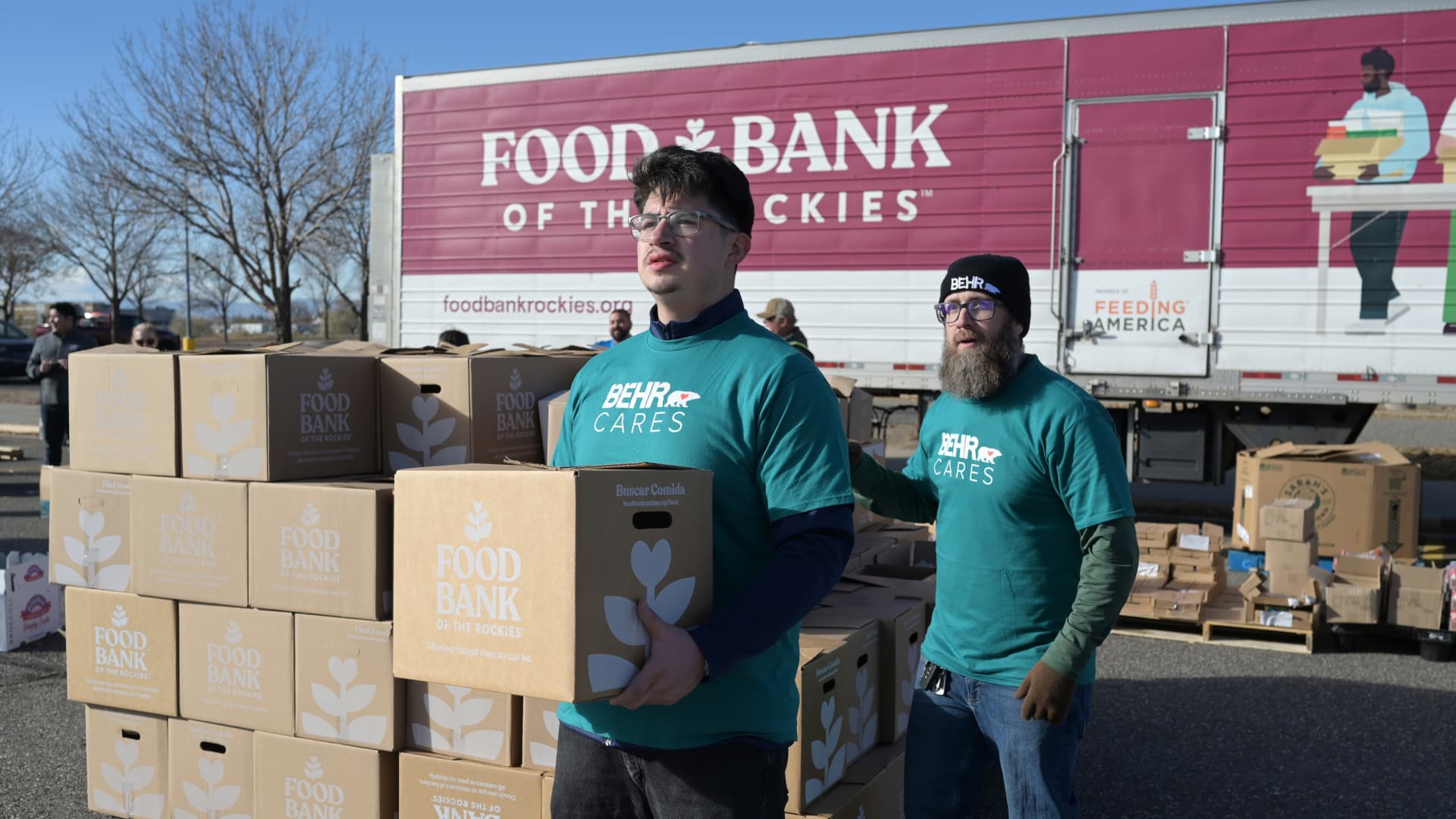
Volunteers Valentin Flores, left, and Keith Harrison load boxes of food for Thanksgiving at the parking lot of Dick’s Sporting Goods Park in Commerce City, Colorado, Nov. 20, 2026.
Hyoung Chang | Denver Post | Getty Images
The pressure on the emergency food system extends beyond New York. Nationally, use of charitable food programs remains elevated as sustained inflation makes it harder for Americans to afford food, housing and healthcare. Higher prices come at the same time that the federal government has restricted food aid.
The Department of Agriculture’s latest annual report found that 13.7% of U.S. households, roughly 18.3 million households, experienced food insecurity in 2024. That rate was significantly higher than in every year from 2016 through 2021.
The pandemic initially brought a surge in demand for charitable food programs, which was followed by government support. In the years that followed, pandemic-era policies such as expanded Supplemental Nutrition Assistance Program, or SNAP, benefits, the enhanced child tax credit and school meal programs phased out as inflation spiked.
“This is not because you can’t go to work,” said City Harvest President Carlos Rodriguez. “Primarily, your work and your wages are just not keeping up with the way costs have gone up in the last five years alone.”
City Harvest, which works with food providers across the five boroughs of New York, told CNBC 1 in 5 New Yorkers is currently experiencing food insecurity, or limited access to enough food because of a lack of money or other resources. That is up from 1 in 6 a year earlier, and 1 in 8 before the pandemic.
Average monthly visits to food pantries and soup kitchens in New York are also 85% higher than before the pandemic, said Rodriguez.
In the Federal Reserve’s October Beige Book, the central bank’s New York regional branch described a sharp rise in first-time food pantry users. One nonprofit leader told the Federal Reserve Bank of New York that the strain was comparable to the pandemic, “but without the same philanthropic and government support.”
Data from Plentiful, a technology platform that connects people with food pantries and tracks their usage, also points to growing demand and limited resources.
“For pantries using our reservation and pre-registration features, we see that the overwhelming majority of those are at or over capacity,” said Catherine Compitello, CEO of Plentiful. “Demand is growing while supply is not.”
First-time users of Plentiful in New York City rose roughly 56% from August to October, Compitello said. It was the second-largest fall surge since 2016; the only larger one came during last year’s federal government shutdown, when delayed SNAP benefits drove more people to seek food assistance.
Compitello said that when families have trouble affording essentials, they often prioritize healthcare, transportation, childcare and utilities, leaving food as the expense they cut back on.
Hunger around the country
Staff distribute food at the Bounty & Soul food bank in Asheville, North Carolina, Oct. 30, 2026.
Allison Joyce | Getty Images
Demand for food banks is rising in other regions of the country, and nonprofits are facing their own operational challenges as they try to meet it.
A spokesperson for the Los Angeles Regional Food Bank told CNBC the organization’s diesel bill more than doubled in September, to roughly $75,000, adding to the cost of delivering food and running refrigerated trucks.
Demand in the region is also spiking. Distribution in the Los Angeles area for January through September totaled 116 million pounds of food and grocery products — the equivalent of 93 million meals — and slightly higher than a near-record year in 2025, according to the Los Angeles Regional Food Bank.
Federal food aid changes have exacerbated the problems. Rodriguez of City Harvest described SNAP as a first line of defense against hunger, saying the program can provide as many as nine meals for every one meal the organization provides. But City Harvest has estimated at least 8.7% of SNAP recipients in New York City lost benefits over the past year, after congressional Republicans and President Donald Trump approved work certification requirements and changes to eligibility.
The pressure is also mounting in Los Angeles County, where roughly 260,000 CalFresh recipients are subject to expanded federal work requirements that took effect in June. CalFresh is California’s version of SNAP.
That does not mean all 260,000 will lose benefits, since people who meet the work requirements or qualify for an exemption can remain eligible. But a Los Angeles Regional Food Bank spokesperson told CNBC the changes add another layer of uncertainty for households already struggling with food costs.
In Atlanta, the pressure extends beyond the city itself to the surrounding region. The Atlanta Community Food Bank serves about 270,000 households a month, or nearly 700,000 people, through partner pantries across North Georgia. President and CEO Kyle Waide said the number of people it serves has jumped more than 70% in five years.
“Much of that increase is among people whose incomes are too high to qualify for federal benefit programs,” said Waide.
Under current SNAP guidelines in Georgia, most households must have gross monthly income at or below 130% of the federal poverty level to qualify. They must also meet a separate net income test. For fiscal 2027, which began Oct. 1, the gross income limit is $2,960 a month for a household of three, or about $35,520 annually, and $3,575 a month for a household of four, or $42,900 a year.
More than 60% of Atlanta Community Food Bank clients have household incomes above the cutoff for SNAP eligibility, Waide said, generally in the mid-to-upper $30,000 range depending on household size. The food bank does not collect everyone’s income, he said, but the figure is based on survey estimates.
Given those dynamics, Waide said he does not expect the need to ease.
“We’re preparing for the level of demand to stay where it is today, or even increase more,” Waide said. “We don’t see a big source of relief coming anytime soon.”
