


The US-China trade deal gave markets a huge boost on Monday, but progress on tariffs over the weekend still leaves some risks to stocks and the economy intact, top Wall Street commentators say.
The US is set to lower the tariff rate on Chinese goods from 145% to 30%, while China plans to cut its tariff rate on US goods from 125% to 10% for 90 days as negotiations continue.
Investors, who had been closely watching for signs of easing in recent weeks, are relieved. Yet the reaction is varied among some of Wall Street’s top voices, who see an improved outlook for the US economy but are still eyeing risks to the market ahead.
Here’s what some of Wall Street’s brightest minds have to say.
Barclays
Barclays on Tuesday walked back its earlier call for a mild recession to hit the economy in the second half of this year.
While the economy will likely slow in the coming quarters, the bank expects GDP to grow 0.5% year-over-year by the fourth quarter of 2025, and grow by 1.5% year-over-year in the fourth quarter of 2026.
“We think these lower tariff rates on China will be considerably less disruptive for domestic activity, labor markets, and less inflationary, than prior rates. According to indicators of inbound container traffic, these rates had dramatically reduced trade flows between the two countries in recent weeks,” the firm said in a note on Tuesday.
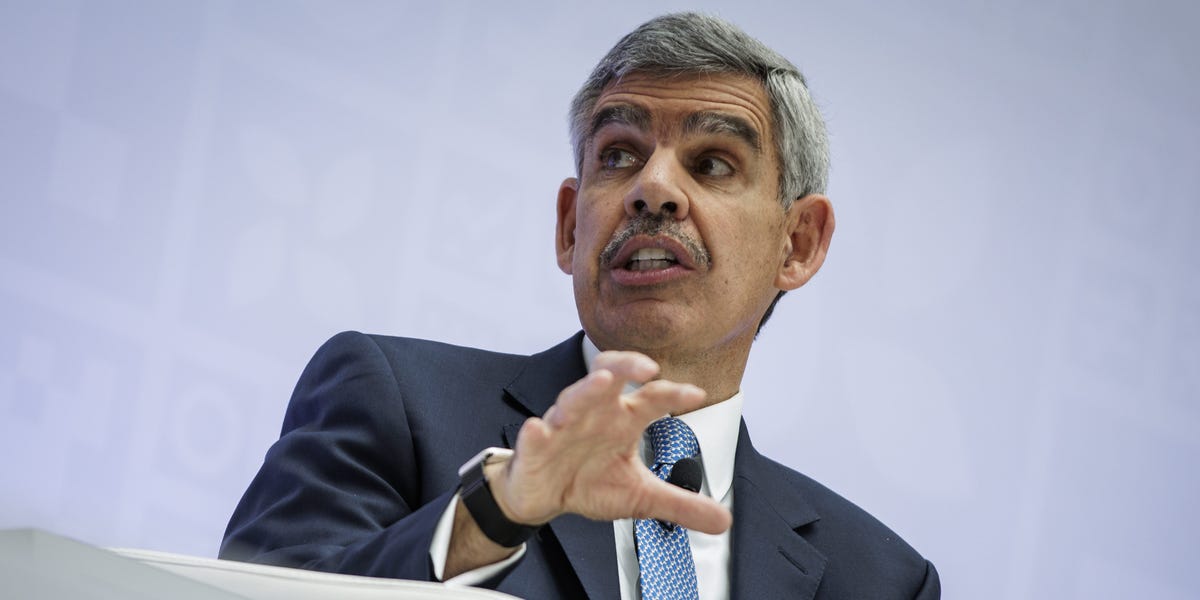
Mohamed El-Erian, chief economic advisor, Allianz
Nordin Catic/Getty Images
The trade deal isn’t signaling an all clear for markets, Allianz’s chief economic advisor said. That’s partly because tariffs will still stoke inflationary pressures in the economy, even though a lower rate on imports will allow for some economic activity between the US and China, he said.
“It’s not a straight line. And you’re going to be really frustrated when you hear the opinion of economists like me,” El-Erian said of his market outlook when speaking Monday with CNBC.
He said economic activity would likely be higher than expected for the next 90 days because of short-term optimism on the trade agreement. Still, El-Erian saw the Federal Reserve issuing fewer rate cuts in 2025 and pushing them further down the road as it monitors inflation.
“My own gut feeling is we will get some slowing in the economy. We will get some higher inflation. But most CEOs will remain in the wait-and-see,” he said, adding that there was still uncertainty around the economic, political, and national security implications of the deal.
Torsten Sløk, chief economist, Apollo
Bloomberg
Apollo’s top economist said on Monday that the trade agreement could easily boost the US economy’s growth. That’s because progress in talks with China has removed a “major tail risk” from the economy, Sløk said, referring to fears that trade between the US and China would shut off completely under the original tariffs.
On Tuesday, Sløk added that the odds of a recession are at about 30%. Prior to the deal to lower tariffs on China, he said there was a 90% chance of a “voluntary trade reset recession,” with a downturn on track to materialize by the summertime.
As a result of the deal, consumers, corporations, and foreigners could regain confidence in the US economy and markets, which could provide a tailwind to growth. However, Sløk cautioned that rebuilding confidence in the US could take time.
Markets are starting to focus more on the impact of inflation stemming from tariffs. Traders are now pricing in two rate cuts for the year, down from three to four cuts they expected in the prior week, Sløk said. Still, investors appear confident that the more positive outlook for growth will outweigh the inflationary impact of tariffs, he said.
“So it’s very clear that by removing this tail risk and the risk of a recession, we now have the markets saying, ‘Well, maybe the growth outlook is not that bad.’ And maybe therefore, yes, inflation will still go up, but if we still have that GDP growth is going to be still OK, at least for now, we will eventually get a tailwind as a result of removing this tail risk,” he added.
Mike Wilson, chief investment officer, Morgan Stanley
The Morgan Stanley chief investment officer said he believed stocks had already hit a “trough” after President Donald Trump’s “Liberation Day” tariffs fueled a historic sell-off. He also doubled down on his forecast that the S&P 500 would reach 6,500 by the end of the year, a gain of about 12%.
Dialed-back tariffs could give the Fed more room to cut interest rates this year, Wilson added, a move that would boost risk assets like stocks.
“If tariffs aren’t going to be as onerous, they can now start looking at this dual mandate again, and saying, ‘Hey, the growth picture is maybe a little bit better, but if we’re going to err on the side of policy, probably to help the growth side than maybe the inflation side, if the tariffs aren’t going to be as bad,'” Wilson told CNBC.
He added that the risk of a recession had also “come down meaningfully,” assuming that negotiations with China hold true. That, along with a weaker US dollar, brightens the outlook for corporate earnings.
“I feel better that the second half now, from a rated change standpoint, can be better than what people were expecting because the first half was actually worse than what people were expecting,” Wilson said of his outlook on stocks.
Roger Altman, founder, Evercore
Evercore’s founder said the main issue with the trade deal is that the terms aren’t final yet.
Please help BI improve our Business, Tech, and Innovation coverage by sharing a bit about your role — it will help us tailor content that matters most to people like you.
What is your job title?
(1 of 2)
What products or services can you approve for purchase in your role?
(2 of 2)
Continue
this data to improve your site experience and for targeted advertising.
By continuing you agree that you accept the
Terms of Service
and
Privacy Policy
.
Thanks for sharing insights about your role.
“It’s encouraging. It’s very encouraging. But it’s preliminary,” Altman told CNBC. “It’s essentially a 90-day pause on the ultrahigh tariffs in order to negotiate to try to get a permanent framework, permanent tariff reduction framework, and other progress.”
The US and China still have to negotiate on several “tough” issues, Altman said, pointing to the fact that many of China’s products are heavily subsidized by the government. If the costs for those goods were “objectively set” for the US and European markets, prices in those nations could rise, he said.
Meanwhile, the overall US tariff rate is still sharply higher than it was before Trump’s April 2 tariff announcement. Even considering the 90-day pause and framework for trade negotiations with China, the US’s overall rate will likely be pushed up to about 14%, Altman estimated, up from about 3% to 4% during then-President Joe Biden’s term.
“That will still be a drag, when we all know what tariffs do,” he said. “As Chairman Powell said, they raise prices, reduce consumption, raise inflation.”
Ed Yardeni, president, Yardeni Research
The latest trade agreement between the US and China shows that America’s constitutional checks and balances are “working just fine,” the veteran market analyst Ed Yardeni wrote in a note on Monday.
Yardeni said Trump faces mounting pressure to ease trade tensions ahead of midterm elections next year. There are also lawsuits challenging Trump’s constitutional power to start a trade war without approval from Congress.
Chinese President Xi Jinping has his own incentives to strike a deal, including efforts to halt a deflationary spiral in China’s economy, Yardeni wrote.
On Monday, Yardeni lowered his estimate for the odds of a US recession from 35% to 25%, and said he now sees the S&P 500 reaching 6,500 by the end of 2025 — a roughly 10% gain from its current level near 5,840.
James Knightley, chief international economist, ING
While the easing of US-China trade tensions benefits both sides, it also means that China retains its cost advantage in manufacturing, said James Knightley, the chief international economist at ING.
Please help BI improve our Business, Tech, and Innovation coverage by sharing a bit about your role — it will help us tailor content that matters most to people like you.
What is your job title?
(1 of 2)
What products or services can you approve for purchase in your role?
(2 of 2)
Continue
this data to improve your site experience and for targeted advertising.
By continuing you agree that you accept the
Terms of Service
and
Privacy Policy
.
Thanks for sharing insights about your role.
“‘Big beautiful tariffs’ were intended to encourage reshoring and generate trillions in tax revenue to fund tax cuts,” Knightley wrote in a note on Monday.
But with tariffs scaled back to around 30%, “most production remains cheaper in China than relocating it to the US,” he wrote.
Lower tariffs also reduce the trade revenue Trump had hoped to collect.
“Nonetheless, it de-escalates economic tensions and provides a boost to risk sentiment, which can help ease headwinds facing the US economy,” Knightley added.
Jim Reid, head of global macro and thematic research, Deutsche Bank
Jim Reid of Deutsche Bank wondered if he’d been dreaming these past few weeks in a note late Monday:
“Will the last 6 weeks go down in the annals the same way as series 9 of Dallas back in the mid-1980s? This series was expunged from memories as a dream sequence of Pam Ewing, rendering the death of husband Bobby Ewing as just a nightmare.
“With both the US and China slashing their tariff rates by 115 percentage points, with the US rate on China down from 145% to 30% and China’s rate on the US falling from 125% to 10%, we’re almost back to pre-Liberation Day levels. And if you include the fact that 20 percentage points of the 30% US levy is around fentanyl, and could surely be negotiated down with the current momentum, China is now back in the pack with regards to pure trade tariffs on other countries.
“The dramatic reduction in tariffs is only a temporary one for 90 days, but as far as markets are concerned, there’s now a belief that the worst of the trade war has passed, and that the trend is now towards de-escalation. There’s little doubt about how positive this news is, but the US is not out of the woods yet.”
Larry Summers, former US Treasury Secretary
In a post on X, Larry Summers, former Treasury Secretary and President Emeritus at Harvard University, said that between Beijing and Washington, the US blinked, not China.
“We had said that we were determined to impose these policies for an indefinite period,” he wrote. “China didn’t make any consequential or significant change in its policies.”
Summers wrote: “Sometimes it’s good to blink. When you make a mistake, it’s usually best to correct it and retreat, even if it’s a little bit embarrassing.”
Mandel Ngan/AFP/Getty Images
David Rosenberg, founder and president of Rosenberg Research & Associates
David Rosenberg, founder and president of Rosenberg Research & Associates, said he was impressed by Trump.
“He has convinced everyone that a 30% tariff rate on China, and a 13% average tariff rate on the world (was 2.5% in 2024), are both normal and manageable,” Rosenberg wrote in a post on X.
“Nothing like a 10-percentage point levy on this $30 trillion beast called Global Trade,” he said. “The Art of the Deal is working brilliantly.”
