


Close Menu
USTaxNews.live – Your Trusted Source for U.S. Tax & Finance Updates
  • Home
  • Audit
  • Finance
  • IRS
  • Legal
  • Tax News
  • Tax preparation
  • Tax Tips
  • USA Accounting
What's Hot

American Airlines brings fresh food back to NY-Chicago first

November 11, 2026

Kennedys sue over Trump’s arch, citing JFK’s Arlington grave : NPR

November 11, 2026

Alex Karp Says Palantir Is ‘Essentially Progressive’

November 11, 2026

Subscribe to Updates

Subscribe to our newsletter and never miss our latest news

Subscribe my Newsletter for New Posts & tips Let's stay updated

Subscribe to USTaxNews

* indicates required

Subscribe for Tax Updates

Get the latest IRS news, tax tips, and deadlines delivered to your inbox.

style="display:none">
Facebook X (Twitter) Instagram
USTaxNews.live – Your Trusted Source for U.S. Tax & Finance Updates
  • Home
  • About Us
  • Advertise With Us
  • Contact Us
  • DMCA
  • Privacy Policy
  • Terms & Conditions
  • Home
  • Audit
  • Finance
  • IRS
  • Legal
  • Tax News
  • Tax preparation
  • Tax Tips
  • USA Accounting
USTaxNews.live – Your Trusted Source for U.S. Tax & Finance Updates
Home » Usually Employed Workers Struggle With Job Market Shifts, AI Impact
Audit

Usually Employed Workers Struggle With Job Market Shifts, AI Impact

EditorBy EditorAugust 14, 2026No Comments3 Mins Read
Share Facebook Twitter Pinterest LinkedIn Tumblr Email
Share
Facebook Twitter LinkedIn Pinterest Email Copy Link


It used to be that if you’re the type of person who always has a job, you’re the type of person who can always find a job.

But a new analysis of job-finding rates complicates that picture. The study from the Federal Reserve Bank of Richmond examines three types of workers and how they’ve fared in their job search.

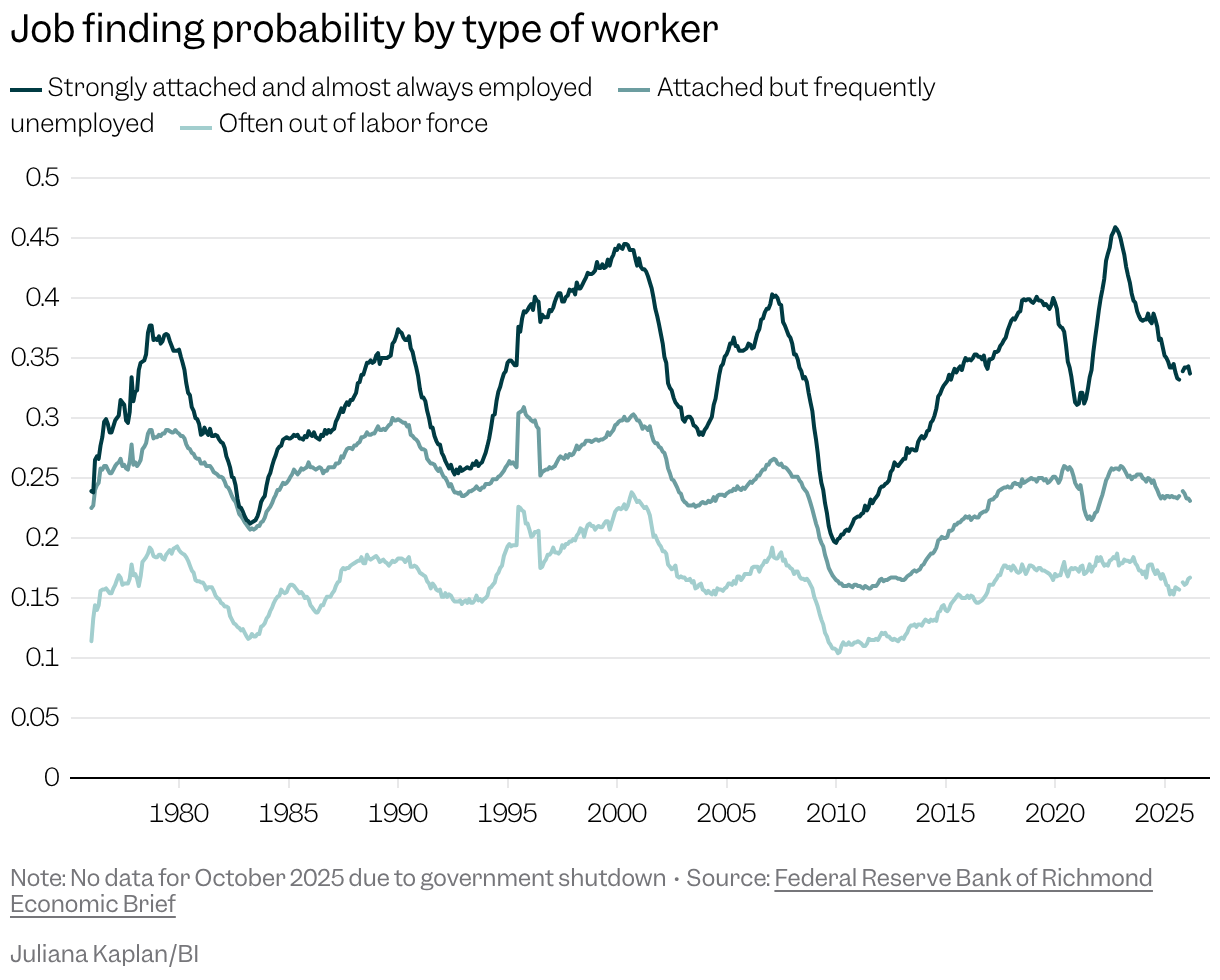
“Primary workers,” who make up about 55% of the US labor pool, are “almost always employed,” per the analysis. They have steady work histories and usually only show up in unemployment statistics when something has gone wrong.

Historically, primary workers had the best odds of finding a new job. But their job-finding rates have fallen 13 percentage points from a November 2022 high to a September 2025 low — the biggest drop for any group the analysis covered.

Secondary workers, who make up about 14% of the labor pool, are often out of work or cycling through different jobs. They often make up the bulk of measured unemployment, and have a historically lower job-finding rate. While those workers still have a harder time finding jobs than their more attached peers, they haven’t seen their fortunes fall as much; in the same period of November 2022 to September 2025, the job-finding rate for secondary workers fell just two percentage points.
Line chart

This is new. In major recessions in the past, primary workers have seen their job-finding rates fall the most, followed by secondary workers. But now, primary workers are seeing that massive drop, while less secure secondary workers are not. So why would it be happening when the US economy is growing?

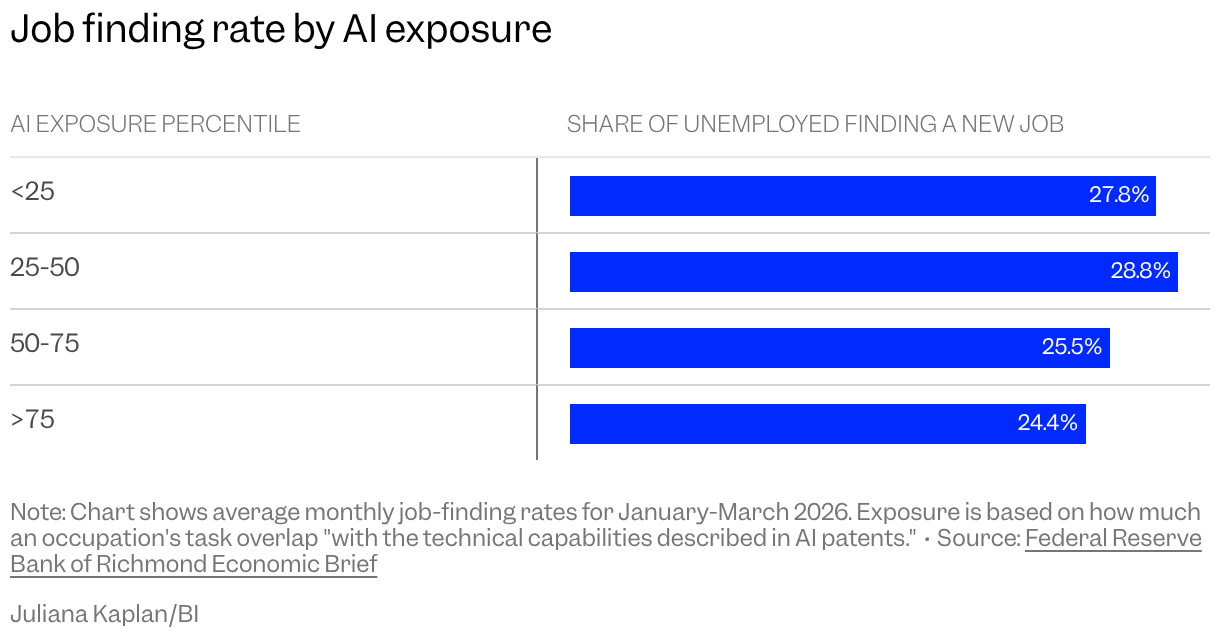
At the same time, the analysis finds that roles more exposed to AI — which the researchers define as the overlap of jobs’ tasks with the capabilities listed in AI patents — have the biggest drop in job-finding rates. Before 2023, when ChatGPT became publicly accessible, job-finding rates for roles across levels of AI exposure moved together. Since then, outcomes have worsened dramatically for the AI-exposed fields.
Table

AI has also shaken the hiring landscape for the new workers who might otherwise become strongly attached to the job market: As the report notes, research has found that generative AI can “substantially increase productivity at the task level (particularly for less-experienced workers), potentially altering the composition of new hiring.”

For entry-level workers, that means a tighter labor market defined by roles requiring a wider variety of skills. For the experienced white-collar workers contending with a declining job-finding rate, that’s meant taking drastic measures — including pay cuts.

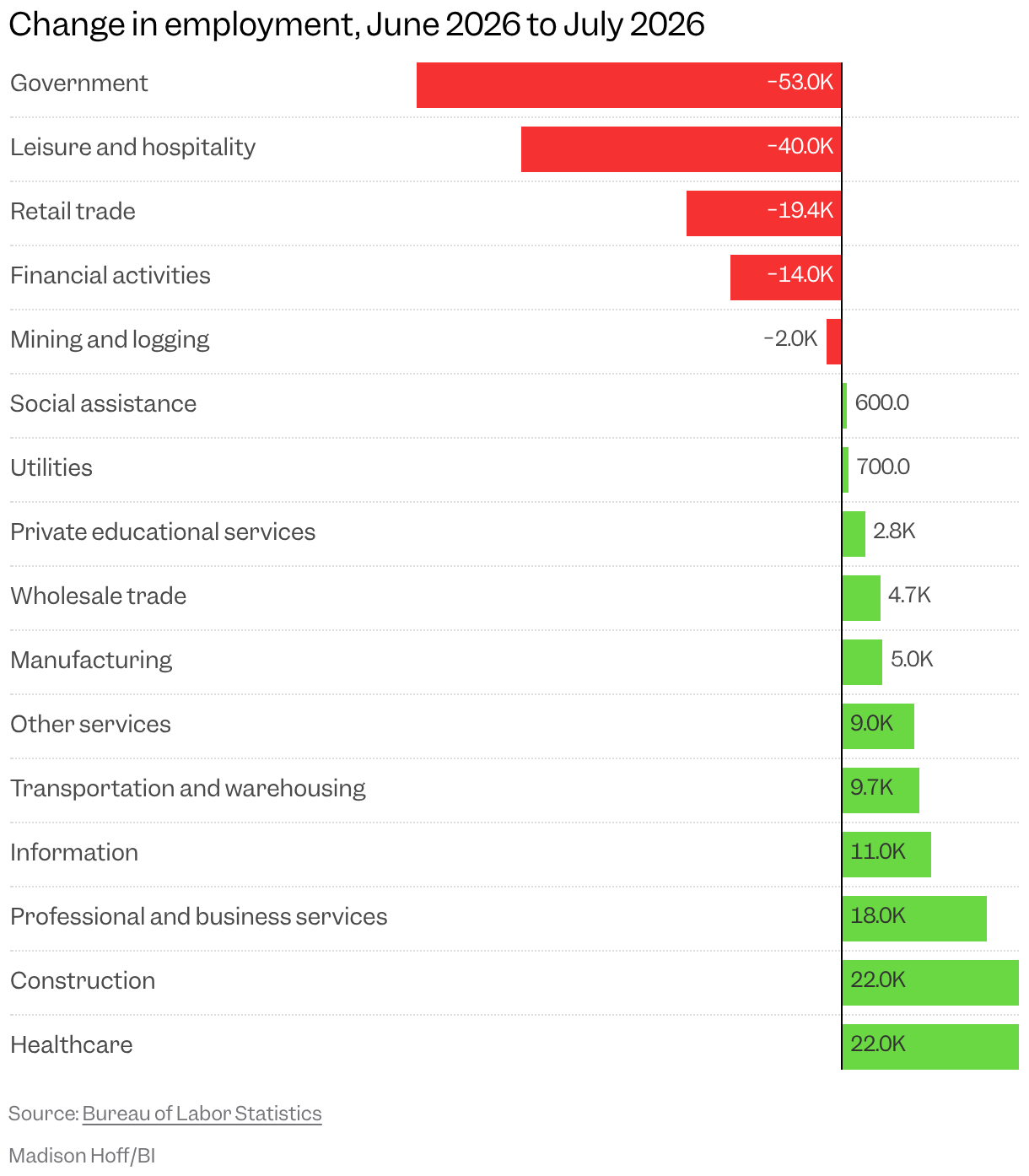
It’s not all bad news for white-collar workers. In the latest jobs report, both the professional and business services and information sectors added payrolls.
Bar chart showing the change in employment from June 2026 to July 2026

But those mild white-collar gains still weren’t enough to offset a troubled labor market. On the whole, the US lost jobs in July — another sign that job hunting might not get much easier anytime soon.


Source link

Share. Facebook Twitter Pinterest LinkedIn Tumblr Email
Editor
  • Website

Related Posts

Alex Karp Says Palantir Is ‘Essentially Progressive’

November 11, 2026

Questions We Get About Living Between a Van and Boat for 10 Years

November 11, 2026

Rising Stars of Real Estate 2026

November 11, 2026
Leave A Reply Cancel Reply

News
Finance

American Airlines brings fresh food back to NY-Chicago first

An American Airlines plane taxis at Chicago O’Hare International Airport in the northwest side of…

JetBlue’s CEO has pushed back on creditor fears, bets on premium

November 11, 2026

U.S. measles outbreaks can cost millions

November 11, 2026
Top Trending
IRS

IRS updates 2027 tax brackets and raises standard deduction to $16,600

The Big Money Show analyzes the latest tax votes as Florida voters…

IRS

IRS CEO Frank Bisignano says mobile app will combat fraud and theft

IRS CEO Frank Bisignano says the agency’s new mobile app will let…

IRS

Chinese national detained, indicted in $360K fake Microsoft tech support scam

Rep. Brett Guthrie, R-Ky., discusses how the United States should handle the…

Subscribe to News

Please enable JavaScript in your browser to complete this form.
Loading

Welcome to USTaxNews.live – Your Trusted Source for U.S. Tax, Accounting, and Financial News.

At USTaxNews.live, we’re committed to delivering accurate, timely, and practical information on everything related to U.S. taxes, IRS updates, legal issues, accounting practices, and the broader financial landscape. Whether you’re a taxpayer, accountant, legal professional, or business owner, we’re here to help you stay informed and ahead of change.

Our Picks

California voters reject Prop. 40 billionaire wealth tax, CBS News projects

November 10, 2026

Mark Zuckerberg threatened to leave California over proposed billionaire tax, Meta says

October 22, 2026

California billionaire tax could leave state with less revenue, Stanford study cautions

October 19, 2026

Subscribe to Updates

Please enable JavaScript in your browser to complete this form.
Loading
  • Home
  • About Us
  • Advertise With Us
  • Contact Us
  • DMCA
  • Privacy Policy
  • Terms & Conditions
© 2026 ustaxnews. Designed by ustaxnews.

Type above and press Enter to search. Press Esc to cancel.