


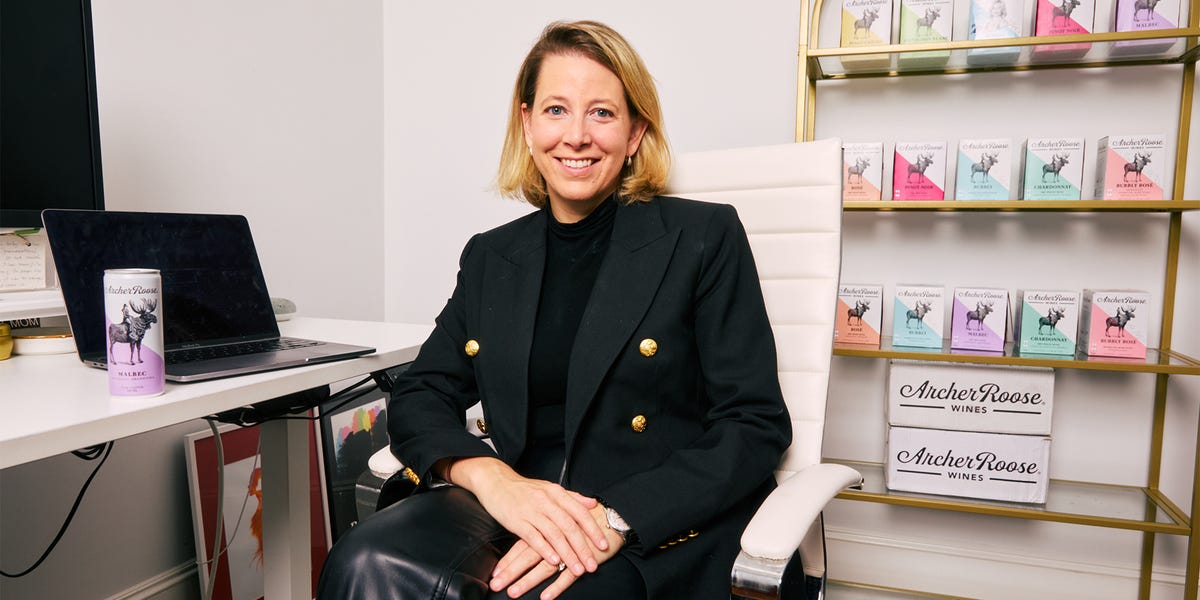
This as-told-to essay is based on a conversation with Marian Leitner-Waldman, the 39-year-old founder and CEO of Archer Roose Wines, based in Boston. It has been edited for length and clarity.
When I was young, I really wanted to make the world a better place. After graduating with a degree in international studies, I worked at Gavi, the Vaccine Alliance, and later at the Global Partnership for Education, which was based at the World Bank.
I’d always had side hustles, and I’ve always loved wine. My husband, David Waldman, had previously founded his own winery in the Republic of Georgia, but he was no longer involved with it by the time we started our business. I really wanted to answer the question of how to have a glass of wine without opening a bottle.
We’ve turned that answer into Archer Roose Wines, a business that generates eight-figure revenue.
George Annan for BI
We wanted to break a dynamic in the wine industry
While still working at the World Bank in 2013, I found research indicating that packaging and distribution account for a substantial share of wine’s carbon footprint. By tackling the format, we would also have an opportunity to lower the carbon footprint.
For bottles under $25, you’re typically paying more for shipping and packaging than for the wine inside. We set out to flip this dynamic so that when a consumer purchases the product, they’re really paying for the wine.
We looked at bag-in-box, but cardboard and the bag inside were not recyclable everywhere. It’s very hard to enact change on issues like recyclability and waste management. I wanted to leverage the existing infrastructure.
Aluminum cans can be recycled repeatedly and are accepted by almost all local recycling programs. What really pushed me over the edge was looking at trends more broadly and seeing more beverage categories expanding into cans.
I realized that the consumer had changed, and the emphasis was now on individual serving size and convenience.
George Annan for BI
I worked on Archer Roose on the side for a while
I was constantly pressure-testing the idea because canned wine was still pretty shocking. I couldn’t get any distributor to sign us on for a while. Finally, a sorority sister who worked for a wine importer and distributor in New York agreed to start working with me.
I quit my job to go all in on Archer Roose in the summer of 2015. By then, we had our first supply chain in place and had signed our first distributor. Cans actually came a little later. We initially launched as a boxed wine.
We funded the first three years with friends and family
I had just gotten married, and my husband had just graduated with his MBA. We were moving to Boston for his job, and I was planning to get my MBA. I realized I would rather take the money that we saved for my degree and put it toward the company because this was going to be my education.
We used that money to start the business and then raised $350,000 in a friends-and-family round in 2016.
George Annan for BI
We knew early on that we wanted to source from Chile
The idea of partnering with winemakers around the world, shipping the wine to the US in flexitanks, and packaging and distributing it here was my husband’s idea.
The quality of wine in Chile is outstanding, and the country sits in roughly the same time zone as we do, which made working together a lot easier. We bought nearly every Chilean wine we could find under $25 and tasted them all, taking careful notes. Then we worked backward on the ones we liked: who made the wine, where the grapes came from, who the winemaker was.
We started reaching out from there. Most of them had no interest in working with an alternative-packaging brand. Then we met Luca Hodgkinson. He connected with what we were trying to do and agreed to take a chance on us.
Investors criticized me for spending too much money on product development
I got criticism for how much time and energy we put into making sure the wine tasted right, but fundamentally, I believe wine is a treat, and if it doesn’t taste great, it’s not worth it.
I wanted to be the brand you go to on a Wednesday night when you don’t want to open an entire bottle. It’s about a ritual: a repeat purchase that becomes a habit. That means mass distribution and volume.
I asked myself who had a similar account universe and route to market, and would be incentivized to learn a different way of working. That’s when it hit me: beer distributors. We met with a brewer who told us that you have to brew beer differently for cans than for bottles.
George Annan for BI
We started to dig into the chemistry behind the can liner
We saw a gap in research on how different wines interact with can liners over time. We collaborated with Cornell food science professor Gavin Sacks, first by providing cans for existing research and later by helping to fund dedicated studies.
We also began collecting our own research. We learned that we needed to approach each wine variety differently.
We started selling cans in 2017.
In 2022, Constellation Brands invested in us
They took a minority stake, and they brought validation to the table. I’m not from the industry. I was a wine company distributed through beer distributors in cans. I think people didn’t know what to make of us.
By then, the business had changed enormously. After our first fundraising round, we learned fast that boxed wine made from the grapes we wanted to use was too expensive for people who had never tried the brand. We continued to refine our product-market fit and our go-to-market approach.
The important lesson I’ve learned in category and company building is that you constantly need to look beyond what you can afford to what your company will need next.
George Annan for BI
The business is kind of an extension of our family life
I’m the CEO, and my husband is the chairman of the board. Early on, we decided that only one of us was going to be full time in the business, mostly because we didn’t want anybody working for us to be reporting to two married people.
We have 15 to 20 employees and work with five winemakers around the world. We’re a fully remote company.
During the pandemic, I reached out to Elizabeth Banks, and she joined in 2021 as a chief creative officer and co-owner.
Most of our plans for the coming years are to scale up what we’re doing
We’ll be adding to our portfolio in 2027 with more lower-ABV options in response to customer feedback.
We also want to continue supporting the wine industry at large as its interest in alternative formats grows, and figure out how we can share the IP we’ve developed so that we can build this category together.
I want to compete on the quality of our wine, on our brand, and on our route to market. I don’t want consumers to ever feel like buying canned wine is a gamble.
