


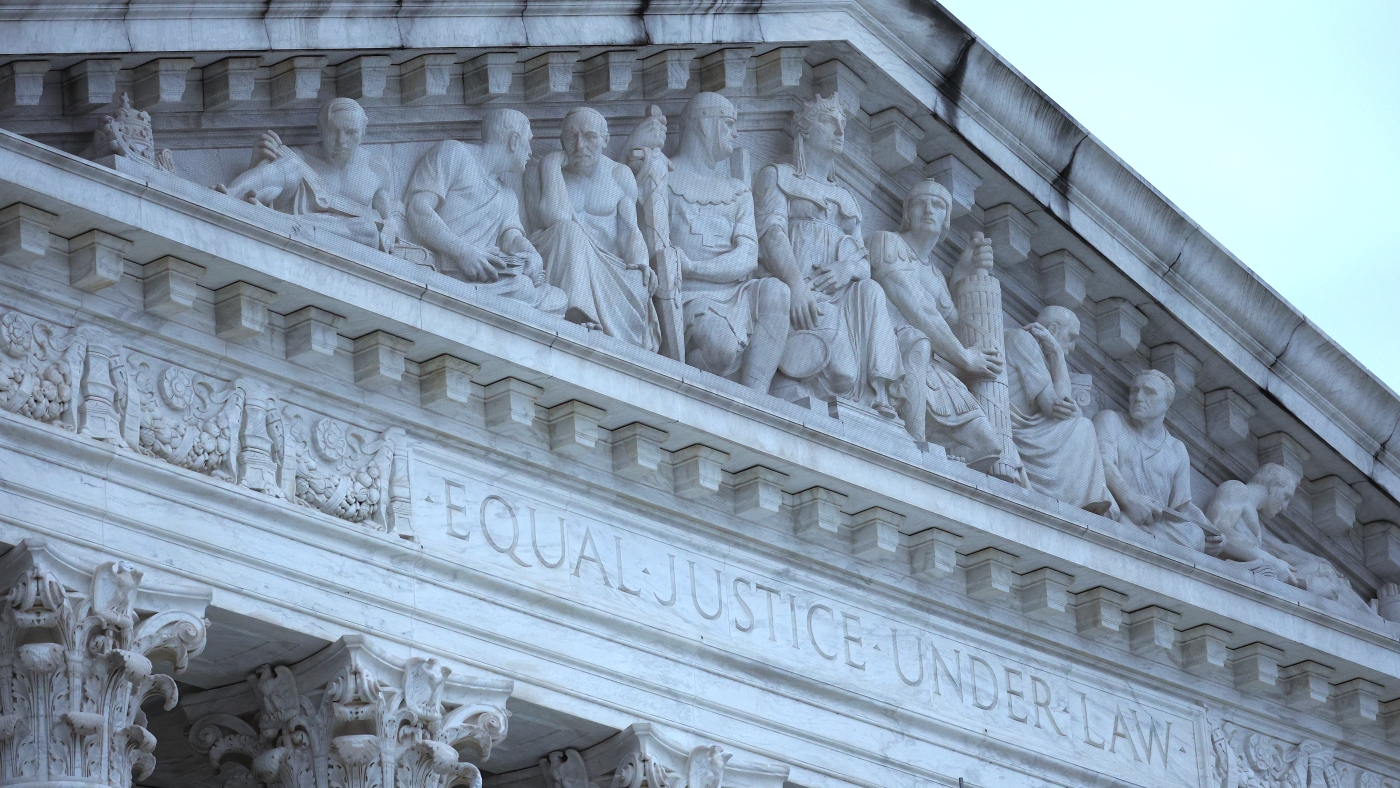
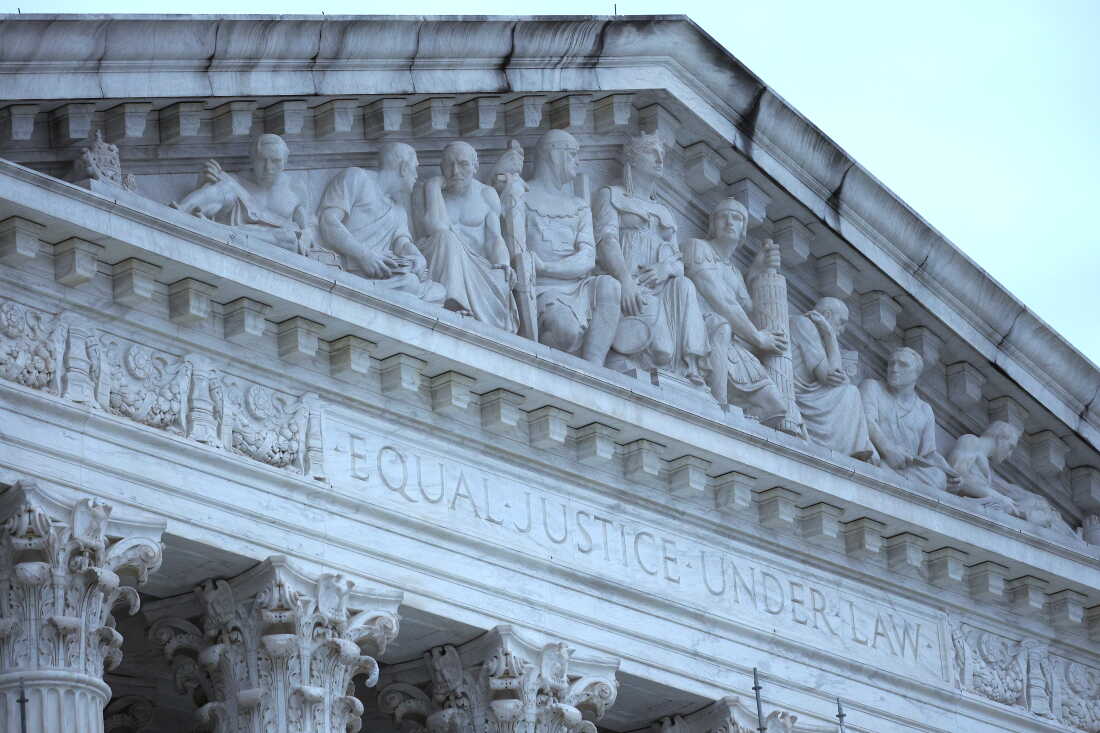
The U.S. Supreme Court hears oral arguments on May 15 in a case challenging an executive order President Trump signed in January to limit who is entitled to birthright citizenship.
Win McNamee/Getty Images
hide caption
toggle caption
Win McNamee/Getty Images
The Supreme Court hears historic arguments on Thursday, as the Trump administration seeks to challenge the constitutional provision that guarantees automatic citizenship to all babies born in the United States. And yet, the arguments are likely to focus primarily on a different question entirely, a legal question on nationwide injunctions that could make it much more difficult and time-consuming to bring challenges to all of Trump’s legal policies, not just this one.
The Fourteenth Amendment to the Constitution, enacted after the Civil War, was aimed at reversing the Supreme Court’s infamous Dred Scott decision, a ruling that declared Black people, enslaved or free, could not be citizens of the United States.
The Amendment says: “All persons born or naturalized in the United States and subject to the jurisdiction thereof, are citizens of the United States.”
Challenges to birthright citizenship have long been considered a fringe legal theory. That’s because 127 years ago, the Supreme Court ruled to the contrary by a unanimous vote. Moreover, as if to put icing on the cake, Congress in 1940 passed a statute codifying birthright citizenship for any child born in the U.S.
President Trump, however, has long maintained that the Constitution does not guarantee birthright citizenship. So, on Day One of his second presidential term, he issued an executive order barring automatic citizenship for any baby born in the U.S. whose parents entered the country illegally, or who were here legally but on a temporary visa.
The legal challenge
Immigrant rights groups and 22 states promptly challenged the Trump order in court. Since then, three federal judges, conservative and liberal, have ruled that the Trump executive order is, as one put it, “blatantly unconstitutional.” And three separate appeals courts have refused to unblock those orders while appeals are ongoing. Meanwhile, Trump’s legal claim has few supporters. At a program put on by the conservative Federalist society, writer Robert Verbruggen, a senior fellow at the conservative Manhattan Institute, referred to birthright citizenship as “a nutty policy we’re probably stuck with.” As he observed, the only way to undo the Fourteenth Amendment’s birthright citizenship provision would be by enacting a constitutional amendment, a process that requires the House and Senate to approve by a two-thirds vote, and three-fourths of the states to do likewise — something that is unlikely in the current political climate.
Nonetheless, the Trump administration took its case to the Supreme Court on an emergency basis. But instead of asking the court to rule on the legality of Trump’s executive order, the administration focused its argument on the power of federal district court judges to do what they did here—rule against the administration on a nationwide basis.
The odd result is that on Thursday the Supreme Court may hear some arguments about birthright citizenship, but most of the debate is likely to focus on what are called “universal” or “nationwide injunctions,” like the ones in this case, that have barred the administration from enforcing its birthright policy anywhere in the country while the case proceeds through the appellate process in numerous jurisdictions.
Bipartisan complaints
The Trump administration is not the first to complain about nationwide injunctions, observes Notre Dame law professor Samuel Bray. Over the last decade, both Democratic and Republican presidents have seen their policies stymied by these injunctions, which is why Bray calls these injunctions “a bipartisan scourge.”
And yet Bray admits that there is little wiggle room in terms of a principle that would weed out unjustified nationwide injunctions, and leave in place the ones that are needed to preserve the status quo and prevent ongoing harm from continuing. “I don’t find a lot of middle-ground options here,” he concedes.
Still, he thinks nationwide injunctions, powered by overt judge shopping—in which partisans often bring cases before judges they think will agree with them—do more harm than good. And he contends that because Trump is so “flagrantly wrong” about birthright citizenship, the court could acknowledge that but use Thursday’s case to get rid of nationwide injunctions altogether.
Georgetown University law professor Stephen Vladeck vehemently disagrees.
“To me that sort of gives up the game about what’s really at stake here because you’re saying, ‘Yes, we all know that this is unlawful and we’re [still] going to let the government put it into effect anyway,'” he says.
Indeed, he adds, the birthright citizenship case is a prime example of why nationwide injunctions are sometimes needed.
The question the court needs to think about, he says, “is whether it wants the federal courts to be able to block these policies on a nationwide basis or whether its going to require these cases to go plaintiff by plaintiff and district by district when you have an administration that will see that as a green light to try to manipulate the circumstances of other cases.”
And that, he maintains will end up deluging the court with more, not fewer, emergency cases.
‘A logistical nightmare’
Professor Bray, however, thinks this case was filed at just the right time psychologically.
“You just have to imagine the justices are looking at the potential for the emergency docket consuming the entire summer when they’re supposed to be away,” he says.
The summer break is good for the justices, he observes. They get time to recharge, let tempers cool, and come back from vacation refreshed for a new term in the fall. But in laymen’s terms, given the huge number of emergency appeals about Trump administration policies, this could really screw up justices’ summer.
Fixing the problem is not so easy, though, explains William Powell, one of the lawyers representing the Asylum Seeker Advocacy Project, a group suing to block Trump’s birthright order.
“Citizenship under the Fourteenth Amendment needs to apply in a way that is uniform across the country,” he says. “We cannot have a situation in which a baby born in Massachusetts is a birthright citizen but a baby born in Tennessee isn’t.”
The 22 states that are also challenging Trump’s birthright order contend that a Supreme Court decision barring nationwide injunctions would cause chaos until each case is ultimately resolved, perhaps with a second trip to the Supreme Court. The states are particularly worried about how to ascertain citizenship when a new resident comes from another state, according to Noah Purcell, solicitor general for the state of Washington. How would the new state resident prove citizenship in order to vote or qualify for a state benefit, he asks.
“Under their theory, a child born in Philadelphia would not become a citizen, but of course, that child could easily move across the border to New Jersey or another state,” he says, adding, “And that would just be a logistical nightmare.”
Of course, behind all the legal arguments, there are real people. People like Dina and Henry—those are the pseudonyms they used for our interview.
They have been in the U.S. for six years. Both are IT specialists seeking asylum. Their stories are different but both say they fled their home country in fear for their lives.
“My Dad was forcing me to get married to somebody and one of my brothers intervened, and in the process he got killed,” Dina says.
Dina and Henry’s daughter was born in April and their biggest worry right now is that their child will be stateless—neither a citizen of the U.S., nor of Kenya. As Henry puts it, “We feel as though she may be relegated to a class of population that are not identified with any country.”
A decision in the birthright citizenship case is expected by late June or early July.
